DIMAPUR — Nagaland
government on Saturday signed a landmark Memorandum of Understanding (MoU) with
the British High Commission to India that would see the latter reserve five
annual slots in the prestigious Chevening Scholarship programme exclusively for
candidates from the state.
An update from the DIPR on Saturday informed that said
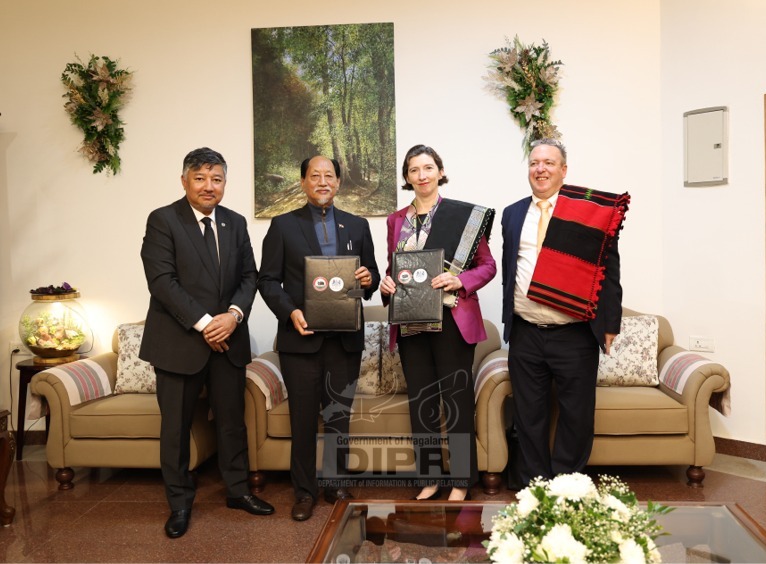
memorandum was inked by Abu Metha, Advisor to the chief minister, and Dr.
Andrew Fleming, British Deputy High Commissioner, Kolkata, on Saturday at the
Chief Minister’s official residence in Kohima.
“The signing ceremony took place in the presence of the
Chief Minister of Nagaland, Neiphiu Rio, and Linda Cameron, British High
Commissioner to India. Copies of the MoU were formally exchanged between the
two dignitaries. The initiative was conceived and facilitated by IDAN,
underscoring its commitment to driving investment in human capital and
fostering international partnerships.
“The Chevening Scholarship programme, a flagship initiative
of the UK government, is a globally recognised Fellowship aimed at nurturing
exceptional individuals with leadership potential. This collaboration will
provide full funding for a one-year master’s degree at any UK university,
equipping scholars with advanced knowledge and skills in their chosen fields.
Under the terms of the MoU, the government of Nagaland will part-fund the
reserved slots, enabling aspiring leaders from the state to join Chevening’s
global network of changemakers,” it stated.
Applications will follow the standard Chevening process,
with candidates evaluated by a panel of experts, including representatives from
the government of Nagaland. It described this partnership as a transformative
step for Nagaland.
“With the state requiring advanced human capital to drive
its development, these scholarships will play a pivotal role in cultivating
future leaders, fostering global academic engagement, and showcasing Nagaland’s
unique potential on the international stage.
“The collaboration also reaffirms Nagaland’s commitment to leveraging
education as a cornerstone of progress, aligning its growth with global
standards, and creating opportunities for its youth to engage in cutting-edge
intellectual and professional pursuits. Aspiring candidates are encouraged to
contact the Investment & Development Authority of Nagaland for guidance on
the application process, which will commence in mid-2025,” it informed.
On the same day, Nagaland government, in collaboration with
the British High Commission and the Welsh Government, hosted a roundtable
discussion at Hotel Vivor in Kohima.
A separate DIPR update stated that the event served as a
platform to showcase Nagaland’s growing opportunities and investment potential
while fostering international partnerships in key sectors such as agritech, the
creative economy, and entrepreneurship.
In his opening remarks, Abu Metha, Advisor to the chief
minister and Chairman of IDAN, emphasised the global significance of the
Hornbill Festival as a venue for networking and collaboration. He highlighted
Nagaland's transformation into a land of opportunities while retaining its rich
identity as a land of festivals.
Stressing the potential for agritech and the creative
economy to drive economic growth, Metha underscored the importance of strategic
collaborations with the United Kingdom and Wales to usher in a new era of
sustainable development for the state.
Lindy Cameron, British High Commissioner to India, and
Andrew Gwatkin, Director of International Relations and Trade for the Welsh
Government, applauded Nagaland’s efforts to strengthen bilateral ties and
foster international cooperation.
“They outlined potential areas of collaboration, including
sustainable agriculture, renewable energy, skill development, and the creative
industries, which hold immense promise for both regions. The roundtable
concluded with a shared vision for fostering innovation, cultural exchange, and
economic development through enduring partnerships,” it stated.
Hekani Jakhalu, Advisor for Industries and Commerce, echoed
the call for innovation and entrepreneurship, stressing the need to nurture a
robust startup ecosystem in Nagaland with the support of international
partners.
She highlighted the state’s commitment to creating an
enabling environment for businesses and entrepreneurs, particularly in sectors
with high growth potential. Jakhalu emphasised the role of collaborative
efforts in building a sustainable and inclusive economy for Nagaland’s youth
and emerging entrepreneurs.
Director of British Council India, Alison Barrett, and
British Deputy High Commissioner, Dr. Andrew Fleming, also addressed the
roundtable, emphasising the importance of cultural and educational exchanges in
fostering long-term partnerships.
“Both leaders reaffirmed the UK’s dedication to working
closely with Nagaland to create impactful programs that benefit communities and
enhance Nagaland’s global visibility,” it added.
As a prelude to the roundtable, a separate roundtable was
conducted in Dimapur, bringing together key stakeholders from Nagaland's
business community to understand the challenges, opportunities, and pathways
for fostering economic growth in the region.
The discussion focused on enhancing ease of doing business,
exploring innovative financing mechanisms, and identifying sectors with high
potential for investment, including agribusiness, the creative economy,
tourism, and technology.
“The session also provided an opportunity for stakeholders
to present their perspectives on how international partnerships, like those
with the UK and Wales, could support local industries, promote
entrepreneurship, and drive sustainable development in Nagaland,” it stated.