


Nagaland signs INR 574.63 crore MoA under ELEMENT Project to restore landscapes, boost climate resilience and livelihoods across 16 districts.
Share


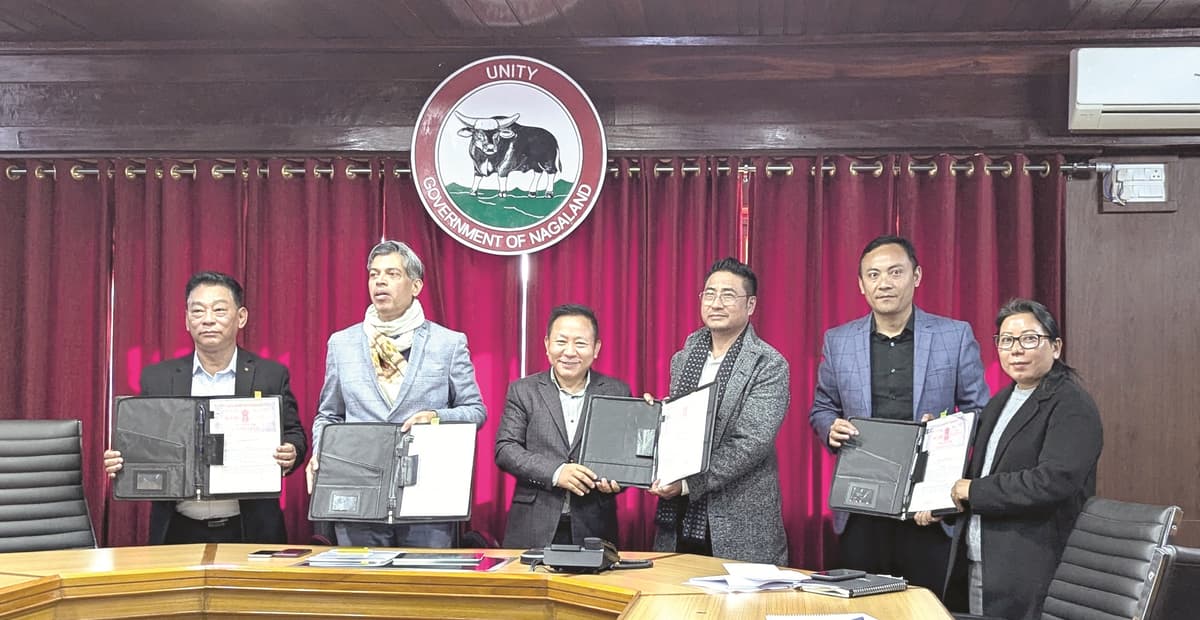
KOHIMA — Memoranda of Agreement (MoAs) involving projects worth INR 574.63 crore, with a target to implement activities across 16 districts of Nagaland, were signed on Thursday at the chief secretary’s conference hall in Kohima.
The MoA were signed under the ELEMENT (Enhancing Landscape & Ecosystem Management) Nagaland Project with two departments—Land Resources and Nagaland Empowerment of People through Economic Development (NEPED).
The agreements aim to restore degraded landscapes, build climate resilience and improve livelihoods across 225 villages in 16 districts over a five-year period ending in 2030.
With the department of Land Resources, the agreement focuses on strengthening springshed management and coffee development in the state, while the agreement with NEPED engages its Centre of Excellence for Renewable Energy Studies (CERES) as a state technical partner for research, innovation and technology development.
V Shashank Shekhar, ACS & APC and Mission Director at ELEMENT Nagaland Project, said that the collaborations would be strengthened in the coming days and extended to other departments.
Also read: Nagaland promulgates new ordinance for hotels and establishments
He informed that the project is a joint initiative of Nagaland government, Centre and the World Bank. While the World Bank has provided a loan, it will be jointly repaid by the state and central governments.
Highlighting water conservation concerns, he said that excessive extraction through borewells and tankers has depleted water bodies, underscoring the need for stronger replenishment efforts to prevent future water scarcity.
He also underscored that investment in research and development is key to economic prosperity and commended NEPED for its successful projects in the past. He added that strengthening R&D would improve quality of life, boost local manufacturing, generate employment and enhance economic circulation within the state.
Hekato N, Additional Director of Land Resources, said that the department, being the nodal agency for coffee and springshed development, would extend full support to ensure effective implementation of the agreement. He expressed confidence that the partnership would positively impact rural livelihoods.
Kovi Meyase, Team Leader of NEPED, informed that the collaboration focuses on two verticals—biodiversity and energy. Referring to CERES, he said that the centre had faced fund shortages despite having good infrastructure and skilled technicians, describing the agreement as a “dream come true” for NEPED and CERES.
Joint Secretary of Agriculture, Limanenla, described the partnerships as important milestones that symbolise shared achievements.
Under the MoA, the department of Land Resources has been designated as the state technical partner for springshed and coffee development. The initial engagement is for one year, with provision for annual renewal based on performance, to be reviewed biannually by the State Project Management Unit (SPMU).
The department will provide technical support including resource mapping, spatial analysis, preparation of Detailed Technical Reports (DTRs), implementation planning, monitoring and capacity building. Key interventions include spring rejuvenation, sustainable coffee plantation planning, and installation of Customized Automatic Weather Stations (CAWS).
Data generated will be integrated into the ELEMENT Decision Support System (DSS) and ERP platforms.
At the village level, activities will be implemented through Village Management Committees (VMCs) with support from Project Facilitating Agencies (PFAs) and Zonal Management Units (ZMUs).
The ELEMENT Project–SPMU will oversee coordination, procurement, monitoring and compliance with World Bank fiduciary and environmental safeguards, with all outputs remaining the property of the government of Nagaland.
The partnership with NEPED will run for 18 months, with scope for extension. It focuses on developing low-energy, indigenous technologies such as zero-energy cold storage, hybrid dryers, micro-hydro units, sustainable waste-management solutions and low-energy agricultural machinery.
A key component is the revival and strengthening of CERES as a state-owned hub for research, skills training and enterprise incubation. Local youth, SHGs and village institutions will be trained to ensure sustainability and community ownership.
Through this initiative, the ELEMENT Project aims to promote innovation rooted in local knowledge and position Nagaland as a leader in climate-smart, people-centred development.