 Eastern Mirror Desk
Dimapur, April 22 (EMN):
Eastern Mirror Desk
Dimapur, April 22 (EMN): Sericulture, after bifurcation from the Industries department in 1988, started functioning independently as an agro-based industry and a ‘developmental department’ in Nagaland.
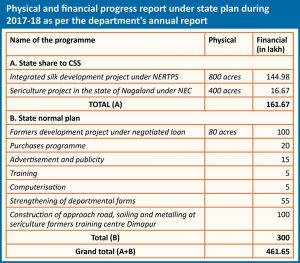
According to the department’s annual administrative report of 2017-18, it has formulated ‘farmers development project’ to be implemented in the state for a period of three years starting 2017-18. The project, worth INR 559 lakh, has been funded by ‘Negotiated Loan’ from NABARD.
It aims to cover 300 acres of host plant cultivation besides other major project component of silkworm rearing, raising of seedlings, strengthening of silkworm seed centres, establishment of cocoon bank and imparting skill upgrade. In the current financial year INR 100 lakh has been provided to the project.
Centrally sponsored scheme
Integrated Eri Silk Development Project (IESDP) is a centrally sponsored scheme under North Eastern Textile Promotion Scheme (NERTPS) implemented by the state sericulture department which seeks to cover exclusively eri sector of Kohima from 2016-17 to 2018-19. It aims to cover 1000 women beneficiaries through silkworm seed production, rearing, spinning and weaving etc.
The main objectives of the project are to empower women groups through sustainable livelihood, create awareness among women about their rights and responsibilities, upgrading skills of women through ericulture practice and generate income of the target women groups.
Activities proposed under the project are: raising of kissan nursery and maintenance of plantation, provide irrigation facilities and establishment of vermicompost sheds, establishment of rearing house at farmers' level for conduct of silkworm rearing, construction of cocoon storage centres, provide spinning machine and certified looms for post cocoon activities, establishment of common facility centres and provide training to extension personnel and stakeholders with exposure visit.
Mulberry project
Intensive Bivoltine Sericulture Development Project (IBSDP) for mulberry is a project funded by Ministry of Textiles, GOI under NERTPS with a project period of three years from 2015-16 to 2017-18. It is currently being implemented at Medziphema block and Dhansiripar block in Dimapur.
According to the report, the project is 100% women-oriented programme covering an area of 500 acres under mulberry plantation involving 1000 women farmers at 0.5 acres per farmer.
During the year 2017-18, 150 acres of land were brought under mulberry cultivation covering a total of 300 women farmers at 0.5 acre per farmer and a total of four kissan nurseries were raised for supply of mulberry saplings.
Rashtriya Krishi Vikas Yojana (RKVY)
Under RKVY 2017-18, the department is implementing development of eri seed sector in Mokokchung and Dimapur district for production of eri disease-free layings (dfls) with a production target of 1 lakh dfls per annum per ‘grainage’. Its strategy involves Adopted Eri Seed Rearers (AESRs) selected from among the eri farmers having minimum 0.5 to 1 acre eri plantation from the nearby villages of the proposed commercial ‘grainages’, and financial assistance provided to all AESRs.
The department is implementing ericulture under RKVY, Tribal Sub-Plan in Longleng district for 20 farmers covering 20 acres of land under eri hostplant cultivation and silkworm rearing, the report read.
The report stated that its Samvrudi Trust, with the union Ministry of Textile, is working for the uplift of economically backward people particularly tribal women. Under this project 400 women are identified based on their economical conditions – those who come under Below Poverty Line.
The project, it reported, is implemented by the department and fully executed by Samvrudi Trust as executing agency and is located at Sabangya and New Chungtia in Mokokchung district.
This project, the report stated, will focus on creating post-cocoon linkages from spinning, reeling, weaving till creating of finished silk products.


