


Nagaland explores collaboration with NETC to boost power transmission, renewable energy, battery storage and generation, aiming to reduce dependence on external power.
Nagaland generates just 20 MW against 193 MW peak demand
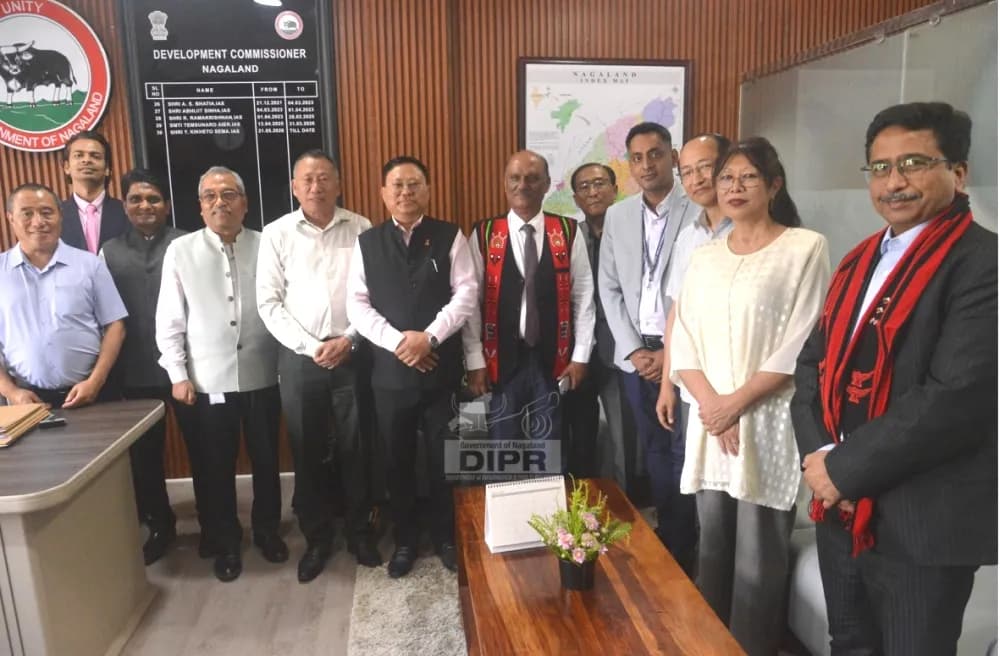
DIMAPUR — Principal Secretary and Development Commissioner, Nagaland, Y Kikheto Sema held a high-level meeting with officials of the North East Transmission Company Limited (NETC), led by its Managing Director Jai Shankar, at his office chamber at the Nagaland Civil Secretariat here on Thursday.
According to a DIPR report, the meeting focused on potential collaboration and investment opportunities in Nagaland’s power sector, particularly in transmission infrastructure, renewable energy generation, battery energy storage systems and other areas of mutual interest.
Sema called for greater investment and collaboration in the state’s power sector, stressing that reliable power supply is essential for industrial growth, healthcare, employment generation and overall development.
He highlighted Nagaland’s significant renewable energy potential, particularly in solar and hydropower, while noting that the state continues to depend heavily on power purchased from outside.
Sema said Nagaland’s peak power requirement is around 193 MW, while generation within the State is only about 20 MW, meeting roughly 10 per cent of the requirement.
Also read: Nagaland: High Court sets August 19 hearing on Indigenous status PIL
Although the state has an installed generation capacity of 29.4 MW, actual generation remains around 20 MW.
He added that another 202 MW of capacity comes from central sector projects, including NEEPCO, NHPC, NTPC and OTPC, through Nagaland’s share allocation.
Sema said the State needs to explore innovative and sustainable solutions, including solar, hydro and hybrid energy projects, supported by adequate transmission and storage infrastructure. He stressed that power generation should be viewed as a key foundation for attracting industries and creating economic opportunities.
Highlighting Nagaland’s rich natural resources, he called for investments that would ensure sustainable development while protecting the State’s environment.
Welcoming NETC’s initiative, Sema asked the company to provide concrete options and submit proposals for collaboration aimed at strengthening Nagaland’s power sector and creating long-term benefits.
He said the government was open to examining viable partnership models and innovative approaches to harness the state’s energy potential and reduce dependence on external power.
NETC Managing Director Jai Shankar expressed the company’s interest in working closely with the state government and exploring strategic partnerships to strengthen Nagaland’s power infrastructure, including transmission systems, renewable energy development and battery energy storage.
Shankar said NETC viewed Nagaland not merely as an external partner but as a stakeholder in the company’s long-term vision, with the focus being on developing collaborative models for infrastructure development.
He stressed the need for Nagaland to prepare for the evolving energy landscape by strengthening transmission and transformation capacity alongside the expansion of renewable energy.
He suggested an appropriate energy mix involving hydro, solar, wind, gas and other sources, supported by adequate storage systems.
The NETC is examining several areas for collaboration, including the development of transmission lines and substations, renewable energy projects, battery storage systems and hybrid energy projects.
Shankar also proposed the possibility of forming a Special Purpose Vehicle (SPV) with equitable participation from NETC and the state government to jointly develop transmission infrastructure and associated substations.
He said investment in solar and hybrid projects integrated with storage systems could be another key area of cooperation.
He further suggested that Nagaland could optimise its existing transmission connectivity to evacuate surplus renewable energy, noting the State’s significant untapped hydro and solar potential.
Such development, he said, could support power consumption within the State as well as energy trading outside Nagaland, thereby generating revenue and reducing overall power costs.
Principal Secretary, Power, KD Vizo highlighted the need to scale up Nagaland’s power generation capacity, particularly through solar energy, while ensuring adequate transmission and substation infrastructure.
OSD Finance, Ketoulhou Metha said energy remains a priority sector for the State despite its fiscal challenges. He added that the government would examine NETC’s proposals and explore viable avenues for collaboration and resource mobilisation.
Head, HR & BD (Corporate), NETC, Riteish Kumar, made a presentation on the company’s proposal for strengthening Nagaland’s power infrastructure through strategic partnership with the State government.