


Our Correspondent
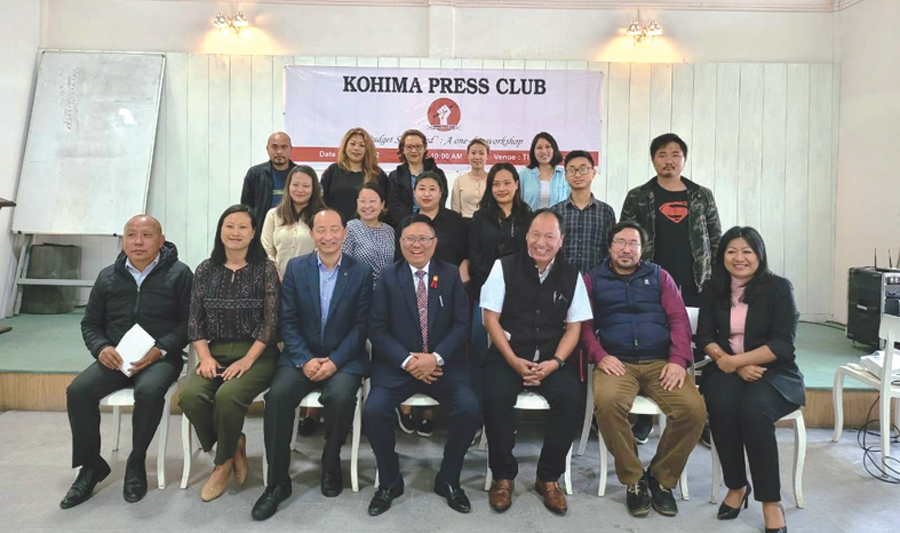
Kohima, March 12 (EMN): Ahead of the budget session scheduled from March 19, the Kohima Press Club (KPC) on Saturday conducted a day-long workshop on ‘budget simplified’ to help media persons better understand the basics of budget and Nagaland finance scenario at present.
Senior research officer (budget) of the Finance department, Ketoulhou Metha, and Agriculture Production Commissioner, Y Kikheto Sema, who is also the former secretary of finance, were the guest speakers of the workshop.
Speaking on the ‘present status of state finances,’ Metha said the sources of fund for the state included a share of central taxes (major source), revenue deficit grant, state’s own tax (SGST, VAT, Road tax, etc.), non-tax revenue (Power, NST, Lotteries, Water Supply, Forest Royalty, etc), centrally sponsored schemes/ NEC/ NLCPR, externally aided projects (EAP), security-related expenditure reimbursements, other finance commission awards, and borrowings.
He informed that the state generates revenue from 11% to 15% crore a year from lotteries. As for public service undertakings, grants are allocated but return revenue is zero. When it comes to public transportations, it is normally run by the corporation in other states but in Nagaland, it is under the government, he said.
The revenue expenditures are in terms of salaries and wages, pensions, debt servicing, administrative/ establishment charges, grants to PSUs, asset maintenance, power purchase, centrally sponsored schemes/NEC/NLCPR, EAPs, state development (earlier state plan).
He stated that implementation of demonetisation and pandemic had badly affected the financial position of the state which resulted in revenue deficit. He hoped that a compensation fund would come in the future.
He stated that a certain improvement is expected this year due to undertakings such as prepaid metering, which will bring more revenue generation and reduce loss. He further suggested ways forward to addressing the revenue loss which included reducing revenue expenditure by way of rationalising government employment. “Alternatively, a congenial environment for economic growth needs to be created, facilitate the private sector to grow to accommodate the upcoming population, and increase capital investment and EAP funding for capital projects,” Metha added.
Kikheto Sema, while giving an ‘overview of the state finance and budget,’ stated that the state's own revenue is “very little” which is about 10% (maximum) out of 100%. The major challenge to the state’s own revenue loss was the prolonged conflict due to Naga political issue. The other issues included excess departments and establishments (74 in total), which he said is “eating our resources.”
“Nagaland is the second-highest in the country after Uttar Pradesh with maximum offices,” he said.
Over-employed in governmental organisations is another reason according to the officer. The total number of state government employees in Nagaland as of March 2020 was 1,24,855 out of which 1,00,001 are regular employees and 24,854 are fixed employees. In addition, the work charged employees stands at 14,744, taking the grand total to 1, 40,765. Unfortunately, ‘many of the employees are not giving their best', he lamented.
Sema estimated that people of the state are investing approximately INR 900 crore per annum for education outside the state. He added that there is also a huge dependence on other states on essential commodities.
Some of the ways forward to addressing state own revenue, according to him, included early solution to Naga political issue and creating a peaceful atmosphere, investment in quality educational institutions within the state, including clean elections, bio-diversity, introduction of policies on work and eat, syllabus of elementary education, Sunday school, and pulpit preaching and teaching. He further suggested more investment on infrastructure so that young people could take up business enterprises instead of depending on government jobs.