[caption id="attachment_102447" align="aligncenter" width="560"]
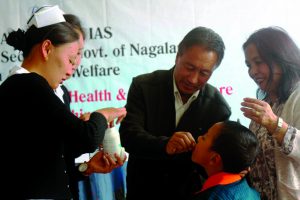 Director of Health and Family Welfare Dr John Sweyievisa, centre, launching the De-Worming Day by giving an albendazole tablet to a student on Wednesday.
[/caption]
Kohima, March 10(EMN): With the main objective to treat children in the age group 1-19 years in schools and anganwadi centres, the first phase of the National De-worming Day (NDD) for 2017 was launched at the Northfield School in Kohima on Friday.
The National Deworming Day programme was organized by the department of Health and Family Welfare in collaboration with the Ministry of Health and Family Welfare, Government of India.
De-worming programmes were being organised throughout the state in pre-schools and schools for children in stated age group through the platform of government-aided schools, private schools and angawadi centres. The objective is to improve the overall health, nutritional status of children; improve access to education and quality of life.
The director of Health and Family Welfare, Dr John Sweyievisa, addressed the Kohima event. In his keynote address, the official said that ‘with universal deworming, proper hand washing, good sanitation and hygiene, we can reach our target to eliminate morbidity due to worm infection by 2020.’
Dr. Sweyievisa said that the National Deworming Day was a ‘fixed day approach’ when all children in the ages 1-19 years would receive treatment for parasite intestinal worm (Soil Transmitted Helminthiasis) through the platform of school and anganwadi centres.
He said that the World Health Organisation (WHO) recommends “deworming of all school age and pre-school age children” with the global target aiming to eliminate morbidity due to worms in children by 2020.
The government of India aims to cover at least 90% of all children through the programme. The WHO says further that 65% of children in India in the age group 1-14 years are at risk of worm infections.
The official also mentioned that worm infection in children leads to anaemia, weakness, nutritional impairment, loss of appetite, stomach ache, vomiting, diarrhoea, weight loss etc. A simple intervention in the form of one tablet of albendazole (safe and proven) avoids all these and indirectly helps children in improving concentration and capacity thereby improving this livelihood opportunity along with good health.
This programme is being carried out in coordination with the department of School Education and Women and Child Development (ICDS), he added.
Likewise, State Programme Officer Dr Bendangla Longkumer informed that the programme was organised by the ministry of Health and Family Welfare, Child Health and National Health Mission in collaboration with sister departments including the School Education and Social Welfare departments.
During the previous year, she said, the department had covered government school children of said age group. However, for this year the department is targeting the private schools, the official said. The authorities will be administrating free medicines to school children ‘in order to provide healthy life,’ it was informed.
Dr Longkumer also informed that the ministry aims to eliminate worm infections completely by 2020 across the country. The next round of de-worming will be held on August 10, it was informed.
After the launching programme, the department’s personnel administered deworming medicines to more than 1000 students.
According to the World Health Organisation, India has the highest burden of Soil-Transmitted Helminths (STH) in the world, with 220 million children aged 1-14 estimated to be at risk of worm infections.
Almost 7 in 10 children between 6 month and 5 years are anaemic, with even higher rates of anaemia in rural areas, the 2006 National Family Health Survey reported.
- Children enrolled in government and government aided schools
- Children enrolled in private schools
- Pre-school children registered at anganwadi centres
- School age children who are out of school
A ‘mass de-worming mop up day’ will be organized on the 15th of March for children who missed out on the deworming event, it was informed.
The first round of the National De-Worming Day was launched in Tuensang district too on March 10 by the District Health Society of Tuensang at the government primary school station-II in Tuensang. The authorities will carry on with the de-worming drive in all schools and Anganwati centres covering children in the age group 1-19 years, a note from the Tuensang Chief Medical Officer’s establishment on Friday stated. The department has appreciated the cooperation from allied departments.


