


Khonoma village launches a community-based sustainable waste management system under FBMP to promote waste segregation, responsible disposal and environmental conservation.
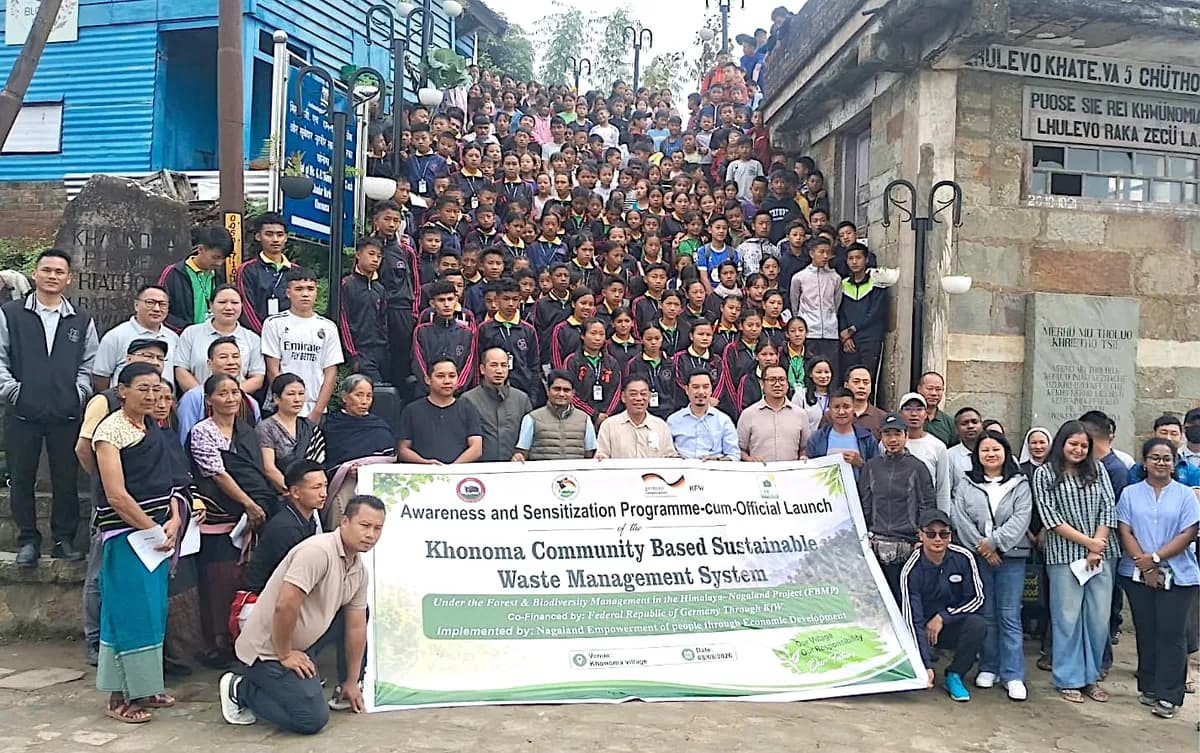
DIMAPUR — The Khonoma Community-Based Sustainable Waste Management System (KCSWMS) was officially launched at Khonoma village, Kohima district, on Saturday, marking a significant step towards strengthening community-led waste management and environmental conservation in the village.
The initiative aims to establish an efficient, community-driven system for waste segregation, collection, processing and responsible disposal, while promoting behavioural change and sustainable waste management practices among residents, an update stated.
The awareness and sensitisation programme-cum-official launch was organised under the Forest and Biodiversity Management in the Himalaya (Nagaland) Project (FBMP), bringing together government officials, project functionaries, community leaders, church representatives, youth organisations, students and village residents.
Speaking at the programme, Kovi Meyase, Commissioner and Secretary to the Government of Nagaland and Team Leader, Nagaland Empowerment of People through Economic Development (NEPED), stressed the importance of community ownership and active public participation in achieving sustainable environmental management.
He said effective waste management was essential to protecting Khonoma's rich natural heritage while ensuring cleaner and healthier living conditions.
Dr Kezevituo Metha, POU, NEPED and PIA in-charge, gave an overview of the KCSWMS, outlining its objectives and long-term vision.
He explained that the system seeks to create a sustainable mechanism for managing waste at the community level, from segregation and collection to processing and responsible disposal.
Sidramappa M Chalkapure, Chief Conservator of Forests (Planning & Development) and Project Director, FBMP, lauded the people of Khonoma for their continued leadership in community conservation and environmental stewardship.
He said sustainable waste management was an important component of biodiversity conservation and climate resilience, adding that its successful implementation would depend on strong community participation and local ownership. Chalkapure encouraged the community to sustain the initiative and serve as a model for other villages across Nagaland.
The launch was followed by an on-site demonstration of the various components and operational processes of the waste management system.
The KCSWMS is being implemented under the FBMP, co-financed by the Federal Government of Germany through KfW.
The project is jointly implemented by the Department of Environment, Forests and Climate Change (DEFCC), Government of Nagaland, and NEPED.
The FBMP seeks to strengthen community conservation efforts through forest and biodiversity protection, improved ecological connectivity and sustainable livelihood opportunities for forest-dependent communities. The project covers 64 villages across Peren, Kohima, Wokha, Mokokchung and Tuensang districts, supporting Community Conserved Areas through improved natural resource management, biodiversity conservation, eco-tourism promotion and climate-resilient development initiatives.
The launch was chaired by Viriatsü Meyase, president of the Khonoma Students' Union (KSU), who appreciated the collective efforts of the stakeholders in making the initiative a reality.
The initiative is expected to further strengthen Khonoma's efforts towards environmental sustainability and demonstrate the role of community participation, supported by government institutions and development partners, in building cleaner villages and healthier ecosystems.