Dima
[caption id="attachment_196352" align="aligncenter" width="500"]
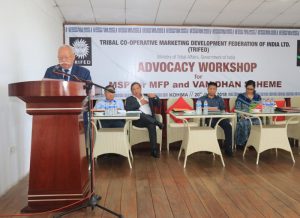 CM Chang speaking at the advocacy and publicity workshop at Hotel Vivor in Kohima on July 20.
[/caption]
pur, July 20 (EMN): Nagaland being blessed with rich biodiversity and one among the biodiversity hotspots of the country, minister for Environment, Forest and Climate Change, CM Chang said that the state is home to an approximate 2,431 plant species belonging to 963 genera and 186 families. He believed that more than half of the total species would be important medicinal and of other economic values.
Chang said this while addressing the advocacy and publicity workshop on minimum support price for minor forest produce scheme jointly conducted by Tribal Cooperative Marketing Development Federation of India (TRIFED), Ministry of Tribal Affairs, Government of India, and Department of Underdeveloped Areas (DUDA), on July 20 at Hotel Vivor in Kohima.
With the introduction and implementation of the Van Dhan Scheme in Nagaland, Chang was optimistic that the rural farmers would be extensively benefited. He hoped that the department of DUDA and TRIFED would take up the scheme to the doorsteps of the farmers who have now taken up cultivation of medicinal plants as a source of livelihood and also to supplement their income.
“In-situ conservation of the rich genetic resources of the minor forest produces (MFPs) of the state should be encouraged and Ex-situ cultivation of the important medicinal plants species and other minor forest produces should be promoted so that the rich biological resource is conserved at the same time,” Chang said.
Advisor to the department of Underdeveloped Areas, N Bongkhao Konyak, highlighted the departmental activities. DUDA being the implementing agency of the state, Konyak stated that the main objective of the department is to implement people centric developmental programmes for Eastern Nagaland region.
With this objective, he said the department is working tirelessly to bridge the gap with regard to economic and livelihood opportunities and bring the backward region at par with the rest of the state. He stated that the department had made enormous strides and successfully created infrastructure and provided livelihood solutions in ensuring sustainable growth in the eastern region since its inception in 2003.
With 337 villages in eastern Nagaland coupled with the lack of proper road and basic infrastructure in place, he said it is still an uphill task for the department to successfully impact the region. Moreover with the lack of air and rail connectivity, he said all raw materials have to be transported to commercial hubs as far as Dimapur resulting in high cost for development, he said.
Lack of job opportunities and distance to commercial districts, he said the people of the region cannot effectively initiate self-employment venture other than dependency on government jobs or government fundings. Stating that that the department had successfully implemented all CSS programmes, he stated that it still far from reaching the target due to limited funding from both the state and the central governments.
In addition to having minimum support price (MSP) for the minor forest produce (MFP), he said there are needs for storage facilities, organic certifications, value addition, market linkages and for study and documentation of the ethno-botany of the important plant species of the state.
TRIFED managing director and DUDA principal secretary, L Kire, expressed his concern about the operational guidelines and requirements of the schemes as geographical area and biological environment varies from state to state. He has suggested taking into consideration those requirements while framing the guidelines and policies of the schemes.
Power point presentation on MSP-MFP and Van Shan Schemes was presented by executive director, Sangeeta Mahindra, while another presentation on implementation was presented by Duda joint director, Dr. Anungla Imdong Phom, DIPR updated about the event on Friday.


