


Nagaland records India’s second-highest adult HIV prevalence at 1.37%, while new infections and AIDS-related deaths continue declining.

DIMAPUR — Nagaland continues to have one of the highest HIV burdens in the country, with the state recording 1.37% adult HIV prevalence, the second-highest in India after Mizoram, Health and Family Welfare Minister Paiwang Konyak said on Wednesday.
Speaking at the state-level launch of Intensified IEC Campaign 3.0 on HIV & STI awareness at the Agri Expo in Chümoukedima, Konyak said an estimated 23,470 people are living with HIV in Nagaland.
District-wise data showed Dimapur recording the highest positivity rate at 3.29%, followed by Noklak at 3.07% and Chümoukedima at 2.01%. Peren, Mokokchung, Zunheboto and Longleng were categorised under moderate prevalence, while Mon recorded the lowest rate at 0.29%.
He cautioned, however, that lower figures could also reflect lower testing rates or fewer cases being reported to health centres.
Despite the high prevalence, Konyak highlighted significant progress since 2010, saying Nagaland had recorded a 39.97% reduction in new HIV infections and an 80.21% decline in AIDS-related deaths.
Also read: Nagaland to deploy five ‘Health on Bike’ units for HIV outreach
Nagaland begins process to establish organ transplant services
He attributed the gains to prevention, early diagnosis and uninterrupted treatment, while stressing the need to intensify efforts to reduce stigma and expand access to testing and care.
‘Health on Bike’
The minister also flagged off five new ‘Health on Bike’ outreach motorbikes for Niuland, Tseminyu, Tuensang, Longchem in Mokokchung and Tobu in Mon.
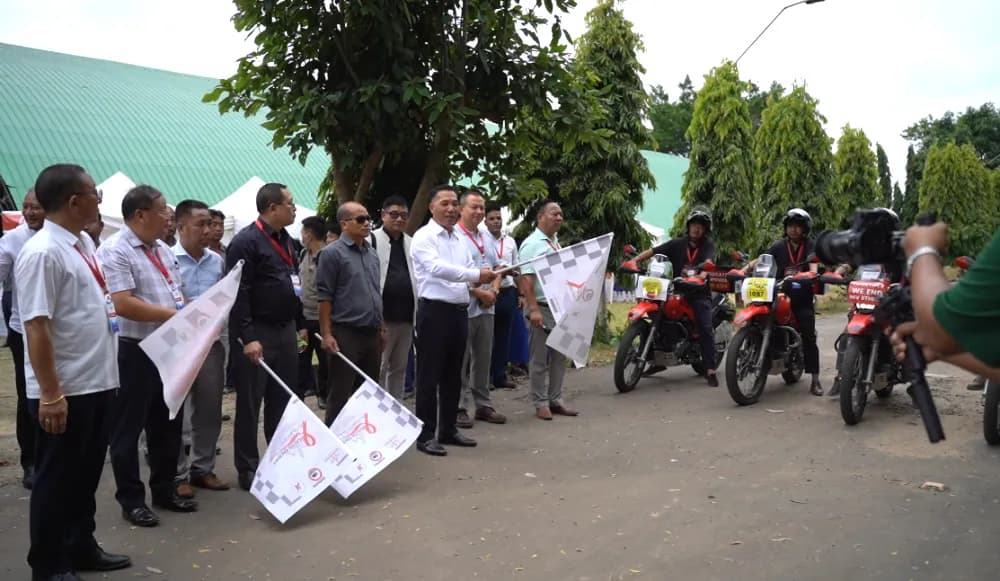
Describing the initiative as a practical solution for reaching people in difficult terrain, Konyak said the motorbikes would take essential healthcare services closer to communities, particularly those located far from established health facilities.
Konyak also said the first two rounds of the IEC campaign had reached more than two lakh people through 1,300 village meetings, over 1,000 schools, 200 colleges and 7,600 door-to-door drives.
WATCH MORE:
He added that the success of the third round should not be measured merely by the number of programmes conducted, but by increased testing, timely treatment, reduced stigma and the number of lives protected.
The minister further called for intensified efforts towards the triple elimination of mother-to-child transmission of HIV, syphilis and Hepatitis B.

October target
H&FW Secretary S Tainu, in her keynote address, said the government, with support from NACO, had launched the Intensified IEC Campaign 2026 with the objective of taking HIV and STI awareness to every village in Nagaland by October 12, 2026.
She said the campaign seeks to convert awareness into action through community outreach, accurate information and stigma-free services.
The campaign will focus on correcting myths and misconceptions about HIV/AIDS and STIs, promoting safer practices and encouraging early testing, counselling and treatment.
Youth and vulnerable populations are among the key target groups. Schools, colleges, youth organisations and social media platforms will be used to disseminate accurate information and promote responsible behaviour.
For remote and underserved areas, the campaign will use folk media, village meetings, door-to-door visits and multimedia tools.
Tainu said the drive would also strengthen community ownership by involving health workers, village councils, NGOs and students. Planned activities include village-level meetings, school and college programmes, special camps at district hospitals and folk performances across the state.
She said the campaign was aligned with India’s goal of ending AIDS as a public health threat.
Konyak, meanwhile, called for collective action to build a Nagaland where young people can access information without shame, HIV testing is free from fear, people living with HIV are treated with dignity and mothers receive timely care.