


Minister KG Kenye appeals to the Gorkha community not to be disheartened amid prevailing uncertainties.
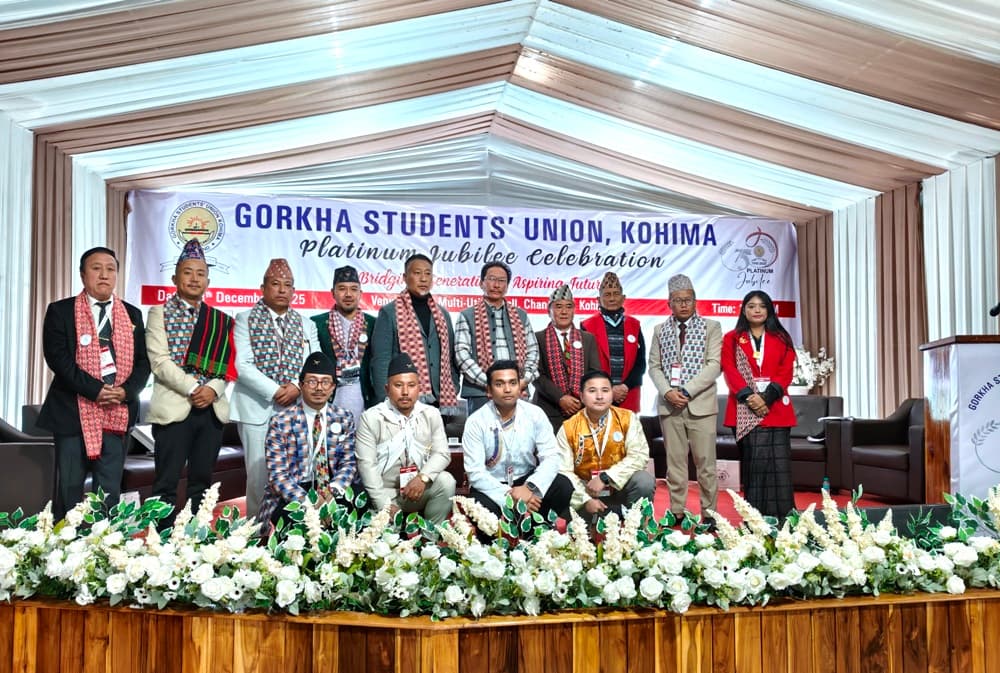
KOHIMA — Minister for Power and Parliamentary Affairs, KG Kenye, appealed to the Gorkha community not to be disheartened amid prevailing uncertainties.
The minister assured that the state government is committed to finding a permanent and inclusive solution to address their concerns, acknowledging their long-standing contribution and close association with the people of Nagaland.
Kenye was addressing the platinum jubilee celebration of the Gorkha Students’ Union Kohima (GSUK) held at the GPPK multi utility hall, Chandmari, Kohima, as the special guest.
His remarks come in the wake of the Gorkha community being notified as not indigenous inhabitants of Nagaland by the state government, after it previous notification.
The minister paid tributes to the pioneers of Gorkha settlers in Kohima and said that the community has contributed significantly to the development of present-day Kohima.
He maintained that the state government understands that certain communities deserve special arrangements. He stated that the state has lately faced an onslaught of outsiders, which has created a situation where the indigenous Naga people have begun to feel threatened by the possibility of being overwhelmed and overrun.
He said the sudden change jolted the people and government out of a peaceful and complacent state. He noted that for decades, there was no perceived sense of threat, but this awareness dawned over the past two decades.
Kenye stressed the need for caution and for the government to frame precautionary measures so that Nagaland does not face situations witnessed in some neighbouring state, where indigenous people have been reduced to minorities in their own land.
“So maybe it is this unnatural response to the situation which has made us look a little too rough, tough and aggressive. But in all that we may do or say, we are humans, and we have a special corner of our hearts reserved for people who have been close to us for centuries,” he said.
The minister emphasised that government policies must be permanent in nature and not temporary or emergency responses. He explained that this was why the government was taking time to resolve issues related to categorisation and the question of indigeneity.
On indigeneity, Kenye said it relates to a geopolitical territory and its original inhabitants, which cannot be altered. While migration laws may affect citizenship status, indigeneity, he said, is inherited by birth and cannot be acquired or altered through legislation.
Referring to the British Empire’s reliance on Gorkha regiments as royal guards, he said such trust reflected the community’s inherited qualities of gallantry, valour, loyalty, discipline and integrity, virtues he described as increasingly rare in modern society.
He acknowledged that the Gorkha community in Nagaland had been temporarily displaced from indigenous status but urged them not to lose heart, noting that in 2023 the state government had explored arrangements to accommodate communities that have long been integrated into Naga society.
Kenye stated that categorising Gorkhas of Nagaland under Other Backward Classes (OBC) was one of the first options considered by the government, adding that other communities, including Marwaris, were also being considered under the same category.
Guest of honour Dr Tseilhoutuo Rhutso said the Gorkha community has contributed immensely to Nagaland, particularly in infrastructure development and human resources, contributions that are well documented.
He said that while the government’s earlier notification declaring Gorkhas as indigenous in 1974 may have been erroneous and the current definition limits indigeneity to communities present since time immemorial. He noted that although Gorkhas have lived in Nagaland for over 200 years, their origins can be traced elsewhere.
Dr Rhutso stated that while the government could recognise Gorkhas as permanent residents, indigeneity may not apply, urging the community to understand the distinction.
Theme speaker Nobin Pradhan, president of the Nagaland Gorkha Association (NGA), traced the cordial history between the Gorkhas and Nagas and urged the community to reciprocate the goodwill shown by Naga society, especially during challenging times.
Greetings were delivered by Santu Thapa, president of GPPK, while short speeches were delivered by Khriesaneikuo Kire, president of KVSU, and P John Thakuri, president of ANGSU.
Earlier, the presidential address was delivered by GSUK president Meghraj Lama.