


Nagaland marks International Coffee Day 2026 by promoting ‘Coffees of Nagaland’ as a specialty brand and expanding coffee value chains for sustainable rural livelihoods.
State highlights value-chain development, jobs and sustainable livelihoods
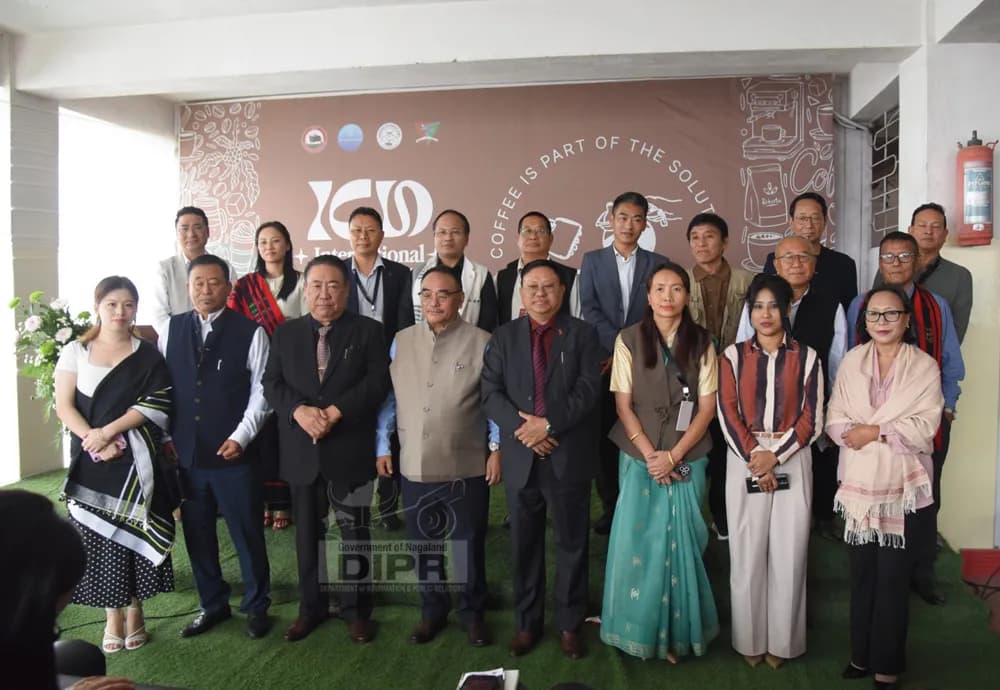
DIMAPUR — The Directorate of Land Resources, Government of Nagaland, observed International Coffee Day 2026 on Thursday in Kohima, highlighting the state’s potential to develop coffee as a sustainable rural industry and establish “Coffees of Nagaland” as a distinct specialty coffee brand in national and international markets.
The programme, held on the theme “Coffee is Part of the Solution,” focused on strengthening the coffee value chain, improving quality and productivity, expanding market opportunities and creating sustainable livelihoods for farmers and youth, a DIPR report stated.
Advisor, Land Resources, G Ikuto Zhimomi, said coffee had been identified as a unique selling proposition (USP) of Nagaland and emphasised its potential to contribute to rural transformation through sustainable agriculture, employment, enterprise development and climate-resilient land use.
He said the Coffees of Nagaland Mission, launched on May 19, 2026, in New Delhi, aims to establish the state as a distinct origin-based specialty coffee brand with global recognition. Under the mission, cluster-based coffee value-chain development is being taken up through two pilot projects—Tuophema cluster in Kohima district for Arabica coffee and Ghotovi cluster in Niuland district for Robusta coffee.
Zhimomi said the coffee sector should not be viewed merely as plantation agriculture but as an ecosystem connecting farmers, processing, trade, employment, business and culture.
Also read: Nagaland coffee production jumps to 72.77 MT in 2024–25
He stressed the need for continued investment across the value chain and called for greater participation of youth in building the sector.
“Coffees of Nagaland”, a documentary showcasing the journey of coffee from farm to cup, employment opportunities and the sector’s potential to access international markets, was also launched and screened during the programme.
Advisor for Labour, Employment & Skill Development and Excise, Moatoshi Longkumer, said coffee represented a new expression of the department’s longstanding objective of linking land, water and people with sustainable rural livelihoods. Recalling the department’s work in afforestation, natural resource conservation and livelihood generation, he said the future of Nagaland coffee would depend largely on farmers and the sector’s ability to develop into a genuine rural industry.
CEO, SLNA and Director, Land Resources, Albert Ngullie, traced Nagaland’s coffee journey from its introduction as an alternative cash crop in 1981 by the Coffee Board of India and Nagaland Plantation Crops Development Corporation.
He noted that plantations were handed over to local communities in 1991, while the Department of Land Resources began efforts to revive the sector from 2014-15.
Ngullie said the department’s priorities include expanding cultivation, improving productivity and quality, strengthening skills across the value chain, completing branding and certification, and positioning coffee as a sustainable alternative livelihood.
Coffee grower Khenyen Konyak from Tobu, Mon, shared his experience of establishing a coffee plantation and recalled the difficulties growers faced, particularly poor road connectivity in the initial years.
He appreciated departmental assistance through machinery, saplings and field visits, and encouraged farmers to work with a long-term vision.
Director Marketing of Lithanro Pvt. Ltd. and founder of Juro Coffeehouse, Searon Yanthan, highlighted the company’s six to seven years of work in developing a farm-to-cup coffee ecosystem, with markets in India, Canada and the UK.
He urged farmers to focus on quality, consistency and proper post-harvest practices, while encouraging youth to explore opportunities across the coffee value chain.
Representatives of the Coffee Board of India, NABARD and the North Eastern Council also highlighted opportunities and challenges in developing the sector.
NABARD General Manager and Officer-in-Charge, Nagaland Regional Office, Pauliankap Bulte, said the institution was supporting coffee value-chain projects in partnership with the Land Resources Department through the Rural Infrastructure Development Fund (RIDF).
He stressed the need for policies enabling farmers and entrepreneurs to access institutional finance for cultivation, processing, marketing and branding.
Director (Tourism & Industries), NEC Secretariat, Shillong, Dr. Sentitula, said the NEC was supporting the state government as a funding and guiding agency for the mission.
She emphasised the need to develop the entire value chain—from quality planting material and processing to QR-based traceability, GI tagging, branding, marketing and exports—to ensure greater value reaches farmers.
The programme also saw the release of coffee brochures and publications and the book “Coffee Cultivation” by Dr. Mary N Odyuo and Khrielanuo Khezhie.
The formal programme was followed by the flagging off of coffee-related events and activities by Advisor, Fisheries & Aquatic Resources, Pangjung Jamir, marking the commencement of a series of International Coffee Day activities in the state.