


Nagaland University holds a Rural Talk Series on forest governance, indigenous rights and community-led environmental sustainability
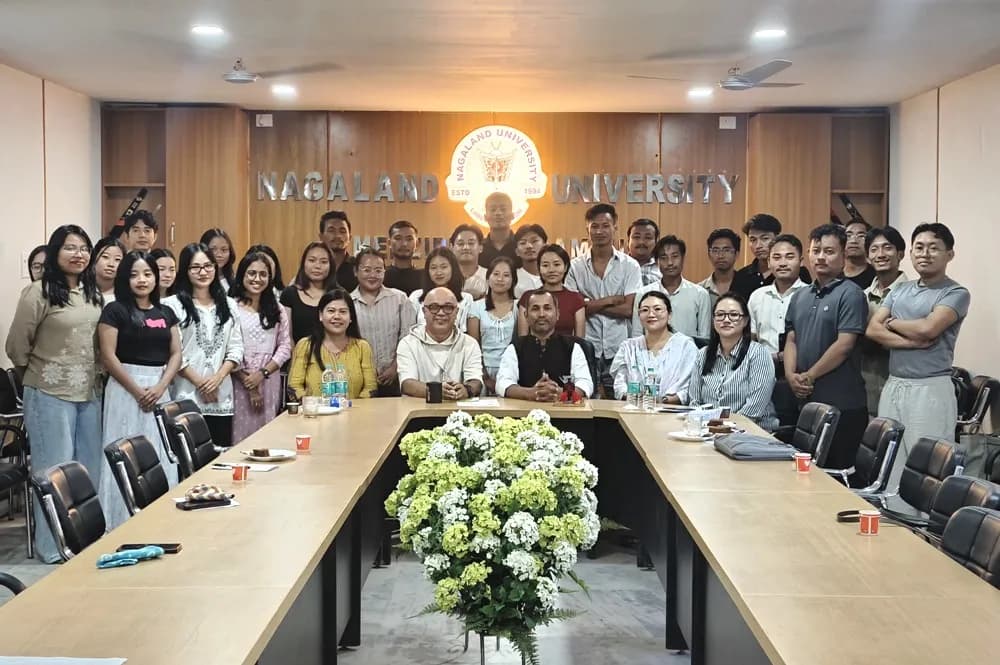
DIMAPUR — The Department of Rural Development and Planning, School of Social Sciences, Nagaland University, Medziphema Campus, organised a Rural Talk Series on “Community-led Natural Resource Management” on October 15, focusing on community participation in forest resource governance, environmental sustainability and the protection of indigenous communities’ traditional rights and practices, particularly in Scheduled Areas and the North Eastern region.
The programme featured expert lectures by Dr. Geetanjoy Sahu, Professor and Dean, School of Habitat Studies, Tata Institute of Social Sciences (TISS), Mumbai, and Dr. Abhinandan Saikia, Assistant Professor, School of Social Sciences and Humanities, TISS, Guwahati, Assam, an update stated.
The discussions highlighted the importance of customary institutions, participatory decision-making and indigenous knowledge in promoting sustainable natural resource management.
Dr. Sahu spoke on “Forest Resource Governance in the Scheduled Areas”, examining the evolution of forest governance from the pre-colonial period to post-independence India and the present day.
He discussed the National Forest Policy, 1988, and the relationship between statutory forest laws and customary practices governing forest resources in the North East.
He also highlighted the significance of Article 371A of the Constitution in protecting Nagaland’s customary laws and practices, and discussed the Forest Rights Act (FRA), 2006, in the context of traditional landownership systems and community-based forest governance.
Emphasising the need to recognise the region’s distinct socio-cultural context, Dr. Sahu underlined the importance of safeguarding indigenous communities’ traditional rights and practices while addressing forest governance and conservation.
His session drew attention to the role of customary institutions and locally rooted approaches in shaping natural resource management in the region.
Dr. Saikia delivered a talk on “Environmental Governance: Role of Community”, exploring the importance of collective action and community participation in environmental protection and sustainable resource management.
He discussed the challenges posed by climate change, the role of women in environmental governance, resource conservation and the importance of Environmental Impact Assessment.
He also highlighted the transdisciplinary nature of climate change studies and the need for collaborative approaches to addressing environmental challenges.
Discussing jhum cultivation, Dr. Saikia emphasised that it should not be viewed merely as an agricultural practice but as a way of life closely connected to the socio-economic and ecological systems of the communities that practise it.
He drew attention to the broader socio-economic and ecological dimensions of jhum cultivation and the importance of understanding its significance within local livelihoods and cultural traditions.
In her welcome address, Dr. Deepa Thangjam, Assistant Professor, Department of Rural Development and Planning, highlighted the relevance of community-led approaches to rural development in Nagaland and the wider North Eastern region, where traditional institutions and communities’ close relationship with their natural surroundings play an important role in resource management.
Dr. Jayanta Choudhury, Professor and Head of the Department of Rural Development and Planning, delivered the introductory remarks.
He emphasised the importance of community-led initiatives in natural resource management and highlighted the role of indigenous practices in the sustainable management of resources in Nagaland.
The talks were followed by an interactive question-and-answer session in which faculty members, research scholars and students engaged with the speakers, raised questions and exchanged views on forest governance, environmental sustainability and community participation in natural resource management.
The Rural Talk Series is an initiative of the Department of Rural Development and Planning aimed at promoting academic dialogue, knowledge exchange and interdisciplinary engagement on contemporary rural development challenges. The programme provided a platform for students, researchers and faculty members to explore practical and academic perspectives on sustainable rural development.