[caption id="attachment_130856" align="aligncenter" width="565"]
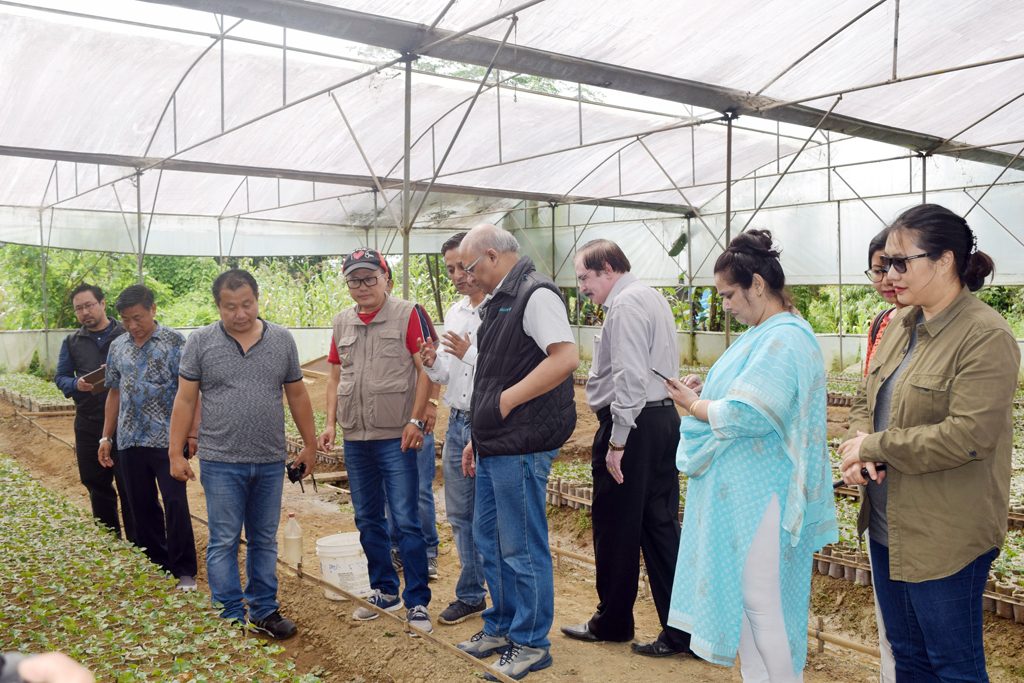 CBI officials along with the State chief secretary and LRD officials during inspection to coffee nursery in Kohima on August 5.
[/caption]
Kohima, August 5 (EMN): Nagaland is said to be one of the first states in North East to undertake coffee plantation on commercial scale and etched its name in the world map. Because of the default organic nature in Nagaland, coffee is said to have a huge scope.
This was said by the Joint Director (Extension) of Coffee Board of India (CBI), Guwahati, Dr. VR Gudde Gowda during a visit to coffee nursery and plantations in Nerhe Phezha, Tsiesema, L Khel and P Khel Kohima village along with four other members from CBI, State chief secretary Pankaj Kumar, Secretary of Land Resources Kikheto Sema and other department officials.
It was also informed that the Naga Coffee Private Limited has tied up with the Noble Coffee firm in South Africa for exporting Nagaland coffee where an MOU was signed for 30 years.
Sharing the history of coffee in India around 1600-1800 and the benefits of coffee, Dr. Gowda expressed confident that coffee will flourish in North East states, especially in Nagaland. Although marketing has always been a problem, Dr. Gowda has encouraged the plantation of other crops and vegetables alongside coffee for economic sustainability.
On the environmental aspect, Dr. Gowda said coffee is important because it protects the forest and conserve water thereby indirectly conserving and giving back to the next generation. He assured to enable Nagaland coffee gets recognition among coffee drinkers in the world adding the Board will give necessary requirements.
Chief Secretary, Pankaj Kumar, who was impressed to witness the coffee plantation, urged the farmers to put in more efforts and patience. He also cited on the need to grow other crops and vegetables at the same time for an alternate income by looking at the diverse form of economy and to conserve our forests.
LRD Director, Hoto Yepthomi said Nagaland has one of the best coffees in the world as proved by one of the best coffee tasters during his visit to the State. He also shared the initiative undertaken by the department on coffee plantation way back in 2011, where the department had experimented coffee plantation in one of its watershed areas which turned out to be a success. Since 2014, the project began where hybrid seeds were provided and grown.
Yepthomi was of the view that the project will not bear much fruit unless the villagers put in their efforts.
LRD secretary, Kikheto Sema observed that marketing needs to be improved as the State have received good review from tourists since it was introduced during the Hornbill Festival last year.
Nagaland coffee, he said, is being sold at the same rate as other coffee across the world and although there is no scope for large scale industry, the Agro and allied sector has the best scope.
Sema pointed out there has been an increase in the production of coffee over the years whereby 2400 kg coffee could be exported this year. He said the department is expecting to achieve 4200 kgs in the following years.
Sharing his experience, former NAPO president Vilieo Rutsa, who has taken up coffee plantation recently, said coffee plantation project was neglected and not maintained when it was introduced in Kohima decades ago. Even though the coffee grew well, the concerned authorities neglected it and the villagers left it to animals and birds for consumption, he said.
While acknowledging the department for giving its best effort to enhance production, Rutsa was apprehensive if it will be abandoned again as in the past. He said farmers will not be able to afford such loss again.
He expressed hoped that this time the farmers will be able to sell products as it has received money for the maintenance. He was optimistic that the project on coffee production will also help uplift the villages and society.
Rutsa also appreciated the contribution of the LRD Department to the farming community for giving them the choice to grow vegetables and also helping the Self Help Group. While observing that farmers are decreasing day by day and have become dependent for vegetables from markets outside the State which are often sprayed with pesticides, Rutsa remarked that ‘there is a lot of satisfaction in growing our own products organically, saves us a lot of money, while also provides health benefits.’


