


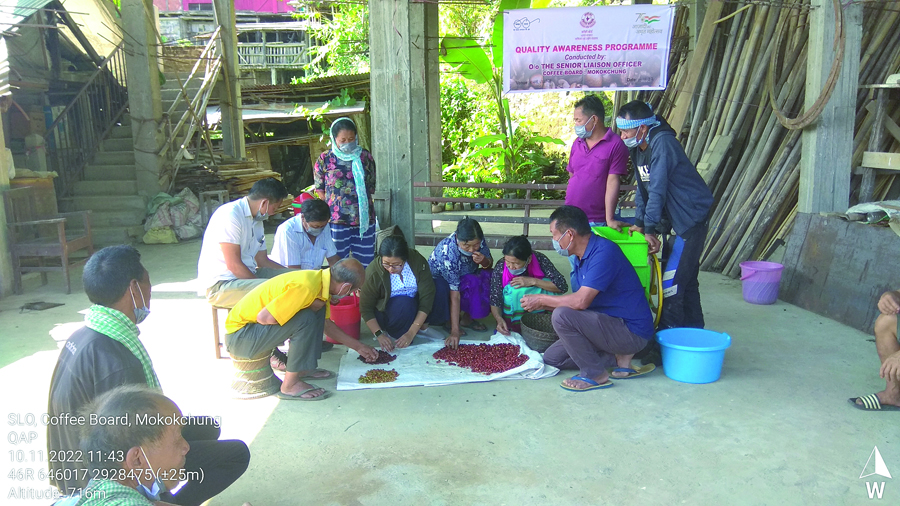
Dimapur, Nov. 11 (EMN): With an aim to produce good quality coffee at the estate level and to ensure good price at the farm gate, a quality awareness programme (QAP) was conducted at Khar village on November 10 for the coffee growers by the senior liaison officer of Coffee Board, Mokokchung.
An update stated that the EI of Coffee Board, Mokokchung, Sentiyangla, exhorted the growers that major portion of coffee produced in India is exported to developed counties, which impose stringent quality standards. She also informed that this year private sectors have interacted with growers directly and bought the coffee at the farm gate based on the quality.
She informed that the coffee could have fetched higher prices had there been better post-harvest protocol. She noted that the high moisture content was one of the most noticeable defects. She added that the post-harvest practices at the farm level play a very important role in preserving/ enhancing intrinsic quality along with microbial contaminants in coffee by observing good agricultural practices and plant protection practices adopted at farm level.
During the technical session, the EI demonstrated that processing of coffee is nothing but obtaining marketable coffee seeds, which is done by two methods: dry method or natural method, which is cherry coffee, and wet method or washed method, which is parchment coffee.
Generally, Arabica coffee is mainly processed by wet method while Robusta coffee is predominantly processed by dry method, she informed.
Steps involved in wet method include harvesting of fruits at the right stage of ripeness, sorting (green/overipe), pulping (removal of fruit skin/floats), de-mucilization (removal of mucilage), washing, soaking, sun-drying of parchment, winnowing, conditioning, bagging and storing.
She also said the steps involved in dry method include harvesting, sorting, drying of fruits, winnowing, bagging and storing.
The drying should be done only in clean, tiled or concrete drying yard and if pucca drying yard is not available, then drying should be done in polythene or tarpaulin for parchment, it stated.
The prescribed moisture level after drying for parchment should be 10.5 % and cherry coffee is 11%, which can be tested using a moisture meter.
Storing should be done in well ventilated stores and bags should be stored on raised wooden platforms. Cherry and parchment coffee should not be stacked together and other materials like fertilizers, pesticides etc should not be stored together, Sentiyangla added.
The assistant inspector of Land Resource department, Mokokchung, L Temsu, also explained that quality of coffee could be achieved by doing the right things at the right time. According to him, harvesting and processing of coffee are both an art and science.
Temsu shared that it should be of considerable pride and joy to a grower to make his contribution to the production of good quality coffee.
Along with the programme, Swachhta P.akhwada was also observed where awareness on COVID protocols was undertaken and masks, hand sanitisers and dustbins were distributed.
Altogether 30 participants attended the programme.
Meanwhile, the growers thanked the deputy director (Ext) Coffee Board, Jorhat, for arranging the training programme and conveyed that similar programmes on different topics would be conducted in future to enrich their knowledge in coffee.
Leaflets and brochures related to post-harvest management in coffee were distributed to the growers for future reference, it stated.