


Sentiyanger Imchen calls for industry-aligned courses and practical learning to bridge the skills gap.
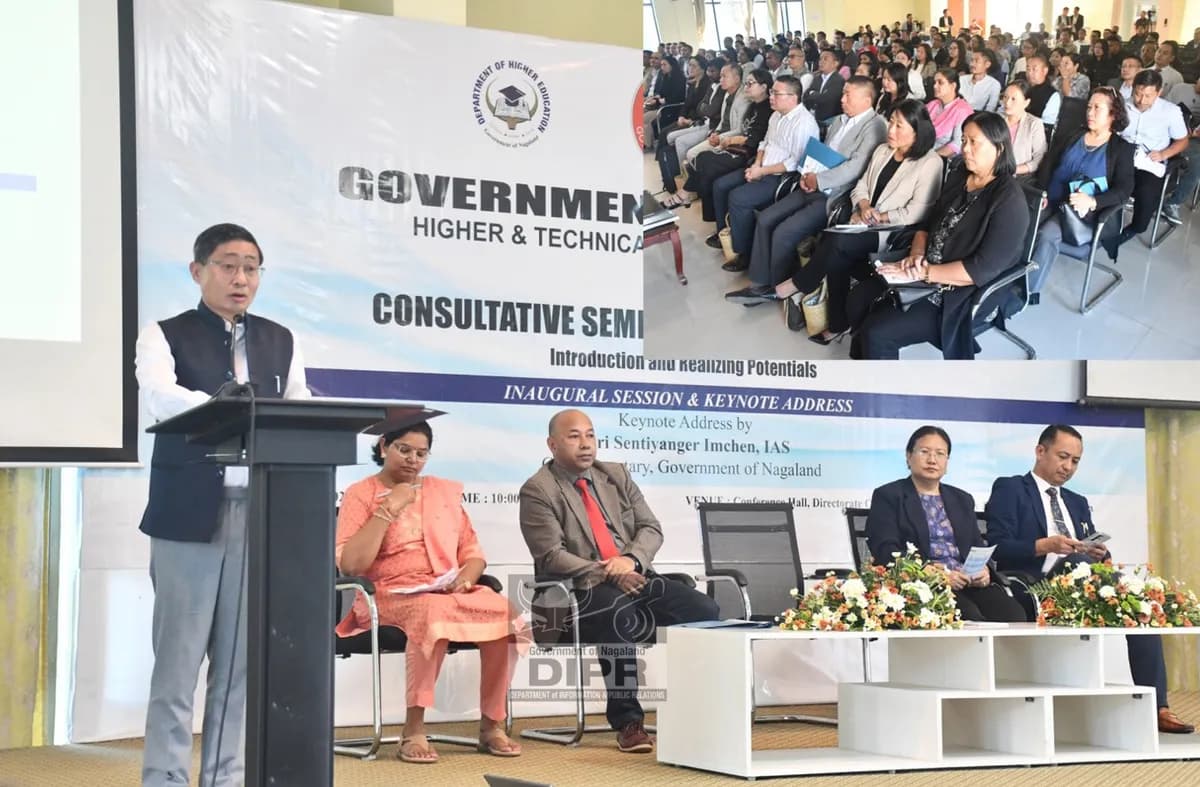
Sentiyanger Imchen urges universities and colleges to integrate emerging disciplines and strengthen practical learning to improve job readiness
DIMAPUR — The education system in Nagaland must shift towards industry-aligned courses and practical learning to address the growing skills gap and improve employment opportunities, Chief Secretary Sentiyanger Imchen said on Friday.
Addressing a one-day consultative seminar on “Emerging Trends: Introduction and Realising Potential”, organised by the Department of Higher & Technical Education at the conference hall of the Department of Information Technology & Communication, Kohima, Imchen said rapid technological advancements and changing economic demands were transforming the global education landscape at an unprecedented pace.
He highlighted the growing mismatch between academic qualifications and industry requirements, noting that many university graduates possessed theoretical knowledge but lacked the practical skills needed for employment, a DIPR report stated.
“This is the situation the State is facing today,” he said, stressing the need to bridge the gap between education and the labour market through emerging disciplines, vocational training and industry-oriented programmes.
Citing recruitment figures, Imchen said government employment opportunities in Nagaland had become increasingly limited. Recruitment into State Government services through the Nagaland Staff Selection Board (NSSB) and Nagaland Public Service Commission (NPSC) stood at 845 in 2024 and 589 in 2025, highlighting the need to explore alternative career pathways.
Referring to the Periodic Labour Force Survey (PLFS), March 2026, he said the unemployment rate among people aged 15–59 was 7.3% in Nagaland, compared to 3.5% nationally.
Youth unemployment among those aged 15–29 stood at 17.5% in the state, against 9.9% across India.
He further cited the report Unemployment, Skill and Migration in Nagaland 2025, which found that 92% of the state’s residents lacked formal vocational or technical education, while 78% of workers had no prior work experience.
These figures, he said, underscored the urgent need to strengthen practical training and job readiness.
Imchen observed that Nagaland had traditionally placed a high premium on education, with many parents taking loans to educate their children in the hope of securing government jobs. However, he said, the changing employment landscape required students and institutions to look beyond conventional academic pathways and government service.
Highlighting emerging trends in higher education, he identified three major areas of growth: technology-driven disciplines, green and sustainability-related fields, and interdisciplinary and applied professional courses.
Citing the World Economic Forum’s Future of Jobs Report 2025, Imchen said labour-market demand was expected to increasingly centre on digital technologies, AI, automation and sustainability skills by 2030.
Careers in AI, machine learning, data analytics, cybersecurity and information security were among the areas expected to see increased demand.
He said premier institutions such as the Indian Institutes of Technology, National Institutes of Technology and Indian Institutes of Management were already preparing graduates for high-growth technical fields.
On the way forward, Imchen welcomed Nagaland University’s initiative to incorporate AI components into postgraduate and PhD programmes across several departments from the proposed 2026–2027 academic session.
He urged private universities, colleges and technical institutions in the State to introduce similar initiatives and develop industry-relevant courses.
He said faculty shortages and infrastructure constraints should not prevent institutions from adopting emerging disciplines, suggesting faculty-sharing arrangements, institutional collaborations, industry partnerships and hybrid learning as possible solutions.
In her welcome address, Secretary of Higher & Technical Education Sarita Yadav stressed the importance of keeping pace with emerging technologies, industry requirements and evolving career opportunities.
She said the seminar would help institutions make informed academic choices and create greater awareness among students about future career prospects.
Pro Vice-Chancellor of Nagaland University, Medziphema Campus, Prof. Dipak Sinha, in his special address, said emerging courses did not necessarily require entirely new programmes, but could also involve updating existing curricula to reflect technological and market changes.
He emphasised that AI should be integrated across disciplines rather than restricted to computer science.
Technical sessions covered green and renewable energy, agriculture and allied sciences, AI and machine learning, Internet of Things, cybersecurity, semiconductors, data science, medical technologies, and emerging pedagogies in arts and commerce.
The programme concluded with remarks and an action plan by the Additional Secretary and Ex-Officio Director of the Higher Education Department.