


BJP leaders in Nagaland highlighted Narendra Modi's 12 years in office, citing welfare, infrastructure and economic achievements.
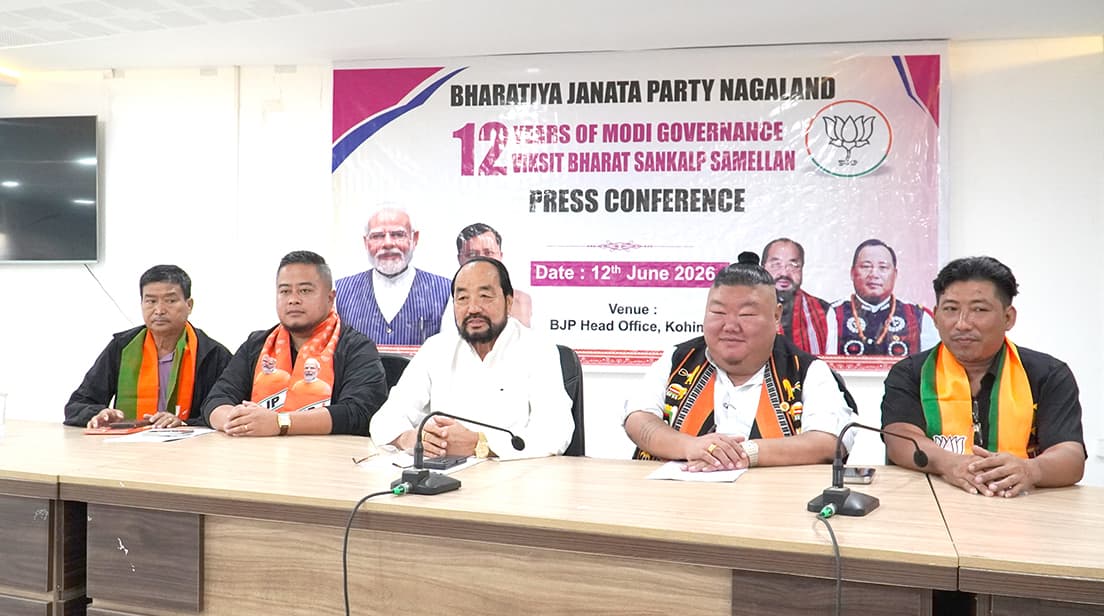
KOHIMA — BJP leaders in Nagaland on Friday highlighted the achievements of Narendra Modi during his 12 years in office, describing the period as one marked by public welfare, development, economic growth, infrastructure expansion and India's rising global stature.
Addressing a press conference at the BJP State Office in Kohima, Deputy Chief Minister and BJP Legislature Party leader Y Patton was accompanied by Minister for Tourism and Higher Education Temjen Imna Along, Advisor for Information and Public Relations and Soil and Water Conservation Daochiier I Imchen, and party workers.
Patton noted that on June 10, 2026, Modi became the longest-serving elected Prime Minister of India with an uninterrupted tenure of 4,399 days, surpassing the record of India’s first Prime Minister, Jawaharlal Nehru.
He said the Modi government’s 12 years in office have been dedicated to trust, development and public welfare, reflecting a commitment to the aspirations of 140 crore Indians.
He said several welfare schemes, infrastructure projects and digital initiatives undertaken during this period had contributed to lifting nearly 250 million people out of multidimensional poverty while strengthening India’s digital public infrastructure.
The deputy CM further stated that under Modi’s leadership, India emerged as the fastest-growing major economy and strengthened its position as the voice of the global south.
Patton said the Prime Minister had worked with the spirit of “Nation First”, focusing on empowering youth, women and farmers while driving progress in infrastructure, digital innovation, social welfare, economic growth and national security.
Highlighting key achievements of the government over the past 12 years, he said more than 81 crore people receive free food grains every month, while over four crore houses have been built under the Pradhan Mantri Awas Yojana.
He added that more than 10.5 crore rural households have been provided tap water connections under the Jal Jeevan Mission.
He also pointed to women-centric initiatives, stating that over 32 crore women have opened Jan Dhan bank accounts, around three crore women have become “Lakhpati Didis”, nearly 10 crore toilets have been constructed, and over 91 lakh self-help groups have been strengthened nationwide.
Patton said approximately two crore youth are expected to receive skill training, while more than INR 40 lakh crore has been disbursed through the Mudra Loan Scheme.
He added that over 10,000 startups have been recognised and supported under various government initiatives.
In the healthcare sector, he said more than 70 crore people are covered under health insurance schemes and over 60 crore people are receiving free treatment benefits.
He further highlighted farmer-focused measures, including direct income support exceeding INR 4.3 lakh crore under the PM-KISAN scheme, distribution of 44 crore soil health cards and crop procurement worth INR 26 lakh crore at the minimum support price.
Patton also cited major infrastructure developments undertaken during the period, including 26 greenfield expressways, more than 1,100 kilometres of metro rail networks, expanded railway infrastructure and an increase in operational airports from 74 to 164.
On national security and defence, he said India’s defence exports have crossed INR 38,400 crore.
Patton further stated that India had achieved universal financial inclusion through digital public infrastructure such as the Unified Payments Interface (UPI), while large-scale housing, sanitation and tap water programmes had improved living standards in both rural and urban areas.
‘Sabka Vikas’ shaped India’s growth — Along
Minister Tourism and Higher Education Temjen Imna Along described Modi’s 12 years in office as laying a strong foundation for a developed India.
Along said the period represented not merely a change in government but a resurgence in national consciousness, giving a new direction and identity to India’s social, economic, cultural, spiritual and global character.
He said Modi’s governance philosophy, rooted in the vision of “Sabka Saath, Sabka Vikas”, later expanded to include “Sabka Vishwas” and “Sabka Prayas”, and had become the foundation of the country’s development agenda.
According to Along, governance under Modi had prioritised service over power, ensuring that the benefits of development reached people at the grassroots level.
He also emphasised women’s empowerment initiatives and described the Nari Shakti Vandan Act as a landmark step towards increasing women’s participation in democracy.
The minister further highlighted the government’s approach to national security, citing its policy of zero tolerance towards terrorism, efforts to strengthen border security and initiatives aimed at achieving self-reliance in defence production.