[caption id="attachment_204058" align="aligncenter" width="565"]
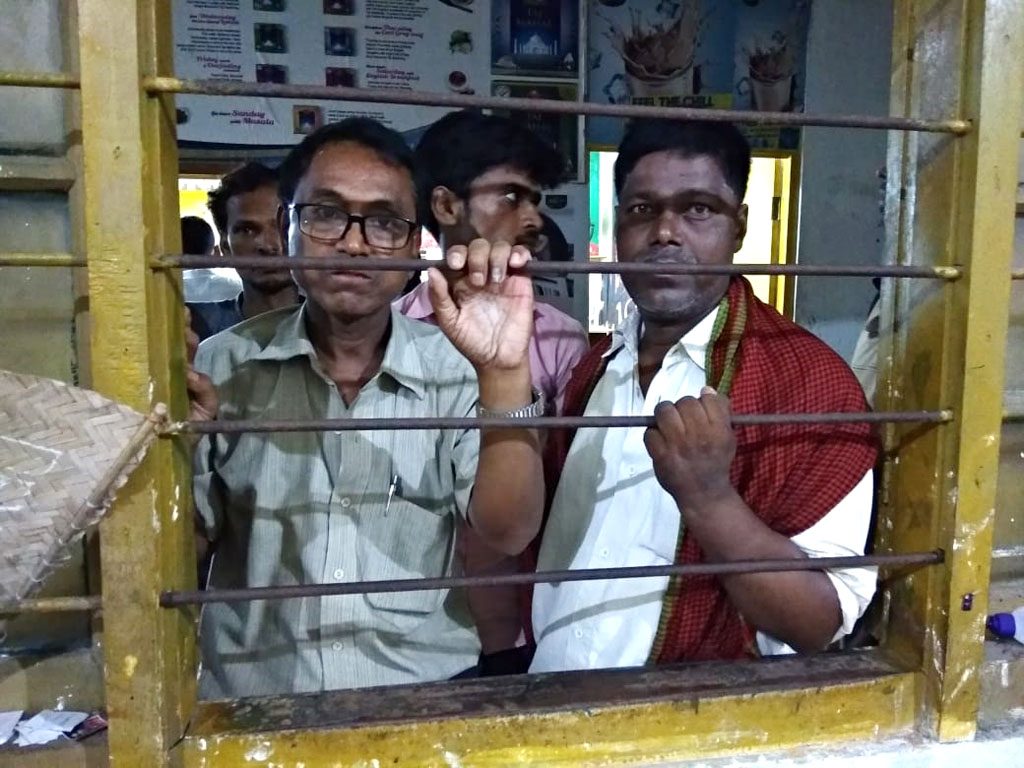 A group of people from other states in queue to collect Inner Line Permit form from the deputy commissioner’s office in Dimapur. (EMImages)
[/caption]
Dimapur, Aug. 30 (EMN): Within a month of Assam publishing its National Register of Citizens’ (NRC) draft, the Nagaland government has increased enforcement of the Inner Line Permit (ILP).
More than 40 lakh people did not make it to the list of the NRC draft in Assam when it was published on July 30. It sent an alarm across neighbouring states about a possible influx of illegal immigrants. Nagaland state authorities, civil society organisation, and students’ bodies swung into action to check the entry of illegal immigrants into the state.
Panels put foot down on influx of immigrants
The Naga Tribes Council has formed a joint committee on prevention of illegal immigrants and has submitted a representation to former Chief Secretary Temjen Toy. The state government has also set up a committee led by commissioner-secretary to chief minister Abhishek Singh to look into the issue.
Speaking to
Eastern Mirror over telephone, the commissioner-secretary said: “We (the committee) are listening to everyone and are getting everybody’s views, in which a lot of NGOs have given their comments as well.”
“We will come to a system which is like a full-proof that does not allow any illegal immigrants to come in and where it does not require any harassment to the legal system,” he added.
The commissioner said that a delegation led by former deputy commissioner of Dimapur Kesonyu Yhome, which was sent to Arunachal Pradesh and Mizoram to study the ILP system, had submitted a report.
“Our objective is that nobody whose name is not in NRC will ever get an ILP. So we have to have a full-proof system which does not allow any illegal immigrants to come in,” Singh said.
The deputy commissioner (DC) of Dimapur Sushil Kumar Patel told
Eastern Mirror that the administration was “taking lot of precautions” when issuing ILP forms in the district.
“If somebody is coming from Assam, he or she has to produce an authorised NRC copy issued by their district administration. Even if they produce all the papers, we are sending the documents back to their respective districts in Assam and verify whether documents they had produced were issued by the authorities concerned,” said Patel. He added that the gaon bura, councils and leaders in Dimapur and its surrounding areas have been directed to refrain from providing shelter to illegal immigrants, as they would not come to the state if they had no place to stay.
However, he said that there was no issue with regard to renewal of ILP provided that they come with a local guarantor.
Speaking about the BEFR Act of 1873 section three, which deals with punishment of ILP defaulters, Patel said that penalty for violating the law is not severe and those living in Dimapur require ILP only when they want to move out to other parts of Nagaland. He said that the authorities can issue the document but are not authorised to check illegal immigrants.
The chief judicial magistrate of Dimapur, Ajongba Imchen, said that the BEFR Act of 1873 was toothless as its violation comes under bail-able offence. He added that the ILP should be either implemented in the entire state or scrap it altogether.
According to Dimapur police, 15 ILP offenders have been arrested in the district since July 30. However, 13 of them got bail and two are still in detention. It added that a case has been registered against four defaulters.
The information and publicity secretary of the Naga Tribes Council, Theja Therieh, has said that everyone, from government establishments to civil society organisations to the public, should be involved in checking the possible influx of immigrants.
“Though we blame each other, it all comes back to working things out together,” he told Eastern Mirror. He added that the government, civil organisations, students’ unions, and the public particularly in the ILP-free zone of Dimapur, have extended cooperation in tackling the ILP issue.
“This time around we feel that there will be a change. We are very hopeful,” he said.


