Says the Northeast states should not be turned into a ‘dumping ground of illegal immigrants’
[caption id="attachment_184432" align="alignnone" width="550"]
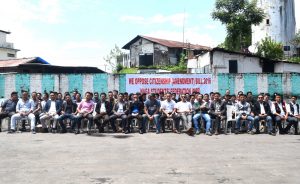 Students protesting the Citizenship (Amendment) Bill at Kohima on Monday. (EM Images)
[/caption]
Our Correspondent
Kohima, May 21 (EMN): To support the North East Students’ Organisation’s (Neso) voice of dissent against the Citizenship (Amendment) Bill of 2016, the Naga Students’ Federation (NSF) also organised a sit-in protest in front of the Raj Bhavan at Kohima town on May 21, from 11 am to 1 pm.
The federation also submitted through Governor BP Acharya a representation to Rajendra Agarwal, a Member of Parliament and the chairman of the joint committee on Citizenship (Amendment) Bill 2016.
The NSF's general secretary, Imtiyapang gave a brief overview of the Citizenship (Amendment) Bill. He explained why the indigenous peoples from the Northeast states were against it. He said that the proposed amendment to the Citizenship Act of 1955—introduced in the Lok Sabha on July 19, 2016—seeks to allow ‘illegal migrants belonging to the Hindu, Sikh, Buddhist, Jain, Parsi or Christian religious communities coming from Afghanistan, Bangladesh and Pakistan’ eligible for Indian citizenship.
Terming it a ‘draconian Act,’ Imtiyapang maintained that India wants to burden the Northeast states with the bill 'which will give rise to more influx of illegal immigrants.' Saying that the Northeast states is not a 'dumping ground' for ‘illegal immigrants,’ Imtiyapang asserted that the NSF will neither accept nor allow any law that ‘takes away the rights of the indigenous people in the Northeast states.’
“This bill is a threat to our very existence and national security,” said Imtiyapang and cited the example of Tripura where, he claimed, ‘illegal immigrants comprising of 60% of the population has taken over the indigenous people.’
Declaring that the Bill also seeks to reduce the aggregate period of residence required in India to be eligible for Indian citizenship from 11 years to six years, he said that the NSF will ‘fight for its rights till the last breath and until the Bill is recalled once and for all.’
The NSF highlighted in its representation ‘the crisis’ arising out of unabated influx of ‘illegal migrants from Bangladesh’ which has brought about serious demographic changes in the Northeast region in particular, and other parts of the country in general.
The organisation also reminded that the NSF had consistently represented to the government of India the continued and unabated influx of refugees and undocumented migrants from neighbouring countries, which further threatened the existence of indigenous people in respect to their cultural, social, economic, and political identity.
Despite repeated appeals and representations from the Neso and its member organisations, the representation stated, the Bill was introduced in the Lok Sabha on July 19 2016, and further referred to a joint parliamentary committee on August 12 2016.
“Needles to say, the Bill seeks and intends to amend the Citizenship Act, 1955 by conferring Indian citizenships to illegal migrants on religious preference especially to those illegal immigrants who have come from Afghanistan, Bangladesh and Pakistan.
“The Bill is a mockery to the spirit of secularism enshrined in the preamble of the Indian constitution and it further violates Article 14 of the Constitution that guarantees citizen’s right to equality. The Bill also violates the provisions of the Assam Accord 1985 which fixed 1971 as the cut-off year for any illegal immigrants to be granted citizenship of India; anyone who came after that was an illegal immigrant irrespective of religion,” the representation read.
It stated the Neso had, time and again, reiterated the need to update the National Register of Citizens (NRC) of 1951, and to delete the names of ‘illegal foreigners’ from the national electoral census. Besides, the Neso had urged for effective implementation of the Assam Accord and other statutes which are meant to safeguard the interests of the indigenous peoples of the region.
To this end, it asserted, the NSF as the apex student body representing ‘the youth and the students’ community in particular, and the Nagas inhabiting the states of Nagaland, Manipur, Assam, Arunachal Pradesh and overseas shall stand outright to oppose and denounce the proposed Bill until it is recalled once and for all.’
It has appealed to the members of the JPC to ensure that the proposed bill is recommended as ‘anti- national and detrimental to the very existence of the good citizens of the country.’


