[caption id="attachment_198131" align="aligncenter" width="565"]
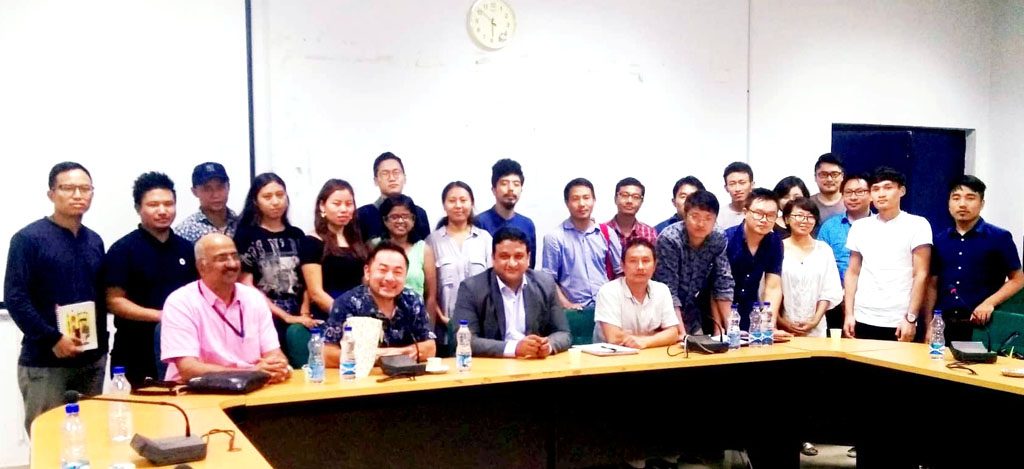 People interact during the discussions in New Delhi.
[/caption]
Dimapur, July 29 (EMN): The Naga Scholars’ Association (NSA) conducted a second research scholars’ discussion on July 27 to mark the resumption of scholarly activities.
The event was held at Jawaharlal Nehru University’s campus in New Delhi.
Delivering welcome address, the president of the association Dr. Zuchamo Yanthan said that the main objective for conducting a colloquium was to enable the young Naga scholars to get positive inputs and constructive criticism before submitting any research papers either in a form of PhD thesis or in research journals and books. Yanthan added that it was conducted to augment the confidence level of the young scholars.
A press release received from the association on Sunday informed about the event.
Ngonamai Holang, a PhD scholar from JNU, spoke on the existing dynamics of power relations between the dominant power and the rising powers. His paper was titled ‘China, India and United States: A Theoretical Critique,’ in which he made a critical assessment to capture the dynamics of shifts in balance of power between the three states.
According to the updates, Holang’s paper highlighted that the main reason for the failure to capture the power rivalry between the United States, and the rising powers, India and China was because of the failure to take into account the alternative narrations, particularly theories that are emerging from the side of the rising powers.
It was also mentioned that the role of India with China or US, goes beyond the proverbial role of power balancing, but finds little or no mention except for the balance of power theory
Meanwhile, another PhD scholar from JNU, Makan Yaoreipam spoke about the transformation of rituals and cultural practices among the Tangkhul Nagas.
His dissertation, “Death and personhood: Exploration on Mortuary Rituals, Transformation and Ontology of Tangkhul Nagas,” focuses on the transformation brought about by the Christian missionaries in terms of rituals and cultural practices, particularly on dead practices.
It is an exploratory study on how result of transition from the pre-Christian to the current practices informed by a Christian belief gives rise to a transmutation in the very idea of a Tangkhul personhood.


