[caption id="attachment_115116" align="alignnone" width="560"]
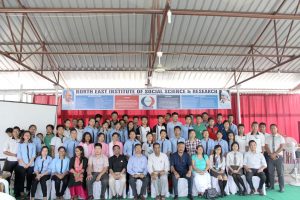 Students of the NEISSR and speakers of a seminar on peace building that the institution organised on May 13, in Dimapur.
[/caption]
Dimapur, May 13 (EMN): The dynamics of ‘peace-building in Nagaland’ was once again at the centre of a panel discussion that was conducted in Dimapur on Saturday. The discussion was an initiative of the Northeast Institute of Social Science and Research (NEISSR) of Dimapur.
The panellists were Rev Dr Wati Aier, convenor of Forum for Naga Reconciliation (FNR); P Leonard Aier, principal of City Law College, Dimapur; and Liangsi Niumei John, director of Care-Centre for Environment and Rural Poor Trust, Dimapur.
According to Rev Dr Wati Aier, ‘peace building without an authentic encounter with god or the divine will not be fruitful’. He was asked to speak on “Restoring spirituality for peace-building in Nagaland.”
He felt that it was not as much about ‘restoring’ as ‘implanting’ spirituality in the Naga context of peace-building. Stating that he would choose to speak from his approximately 10-years of association with the FNR, Aier observed that the Naga people have ‘filtered god according to our needs and wants’.
According to the reverend, “Faith should not be reduced to metaphysics. The vertical (relation between god and man in terms of faith) should be translated into the horizontal context too.” That persuasion, he pointed out, was the difference between ‘humanist peace-building’ and ‘Christian peace-building’.
In the context of the Naga people as well as the northeast region, Aier said, spirituality “means we must go beyond our tribal and ethnic identities into an arena of universal humanhood.” Spirituality in said context means ‘loving, accepting and recognizing’ the other person for who they are, he said.
Another speaker, P Leonard Aier spoke about “political willpower and peace-building in Nagaland.” He was brutal in his observation that the refusal of the ‘political and social leaders’ of Nagaland today to own up to their mistakes has thrown the state into anarchy.
“There is anarchy in the Naga society today. There is no governance. Earlier our social system was based on moral values, ethics and principles. But now the political players have degenerated our social democracy,” he said.
In an insightful observation, he said that the number of corrigendum (corrections) issued in the local newspapers soon after a politician makes a statement was an indication of how the entire social system was functioning without any principled foundation. “We are all responsible for it. We cannot clap with one hand”.
Unless we have a social democracy, he suggested, we cannot have a stable political democracy. “Our political and social leaders do not admit their mistakes not realizing that their actions are destroying our society”.
Delivering yet another fascinating observation, the former-fighter-pilot-turned-law-teacher said that the arching ‘paradox’ of Naga society today was that multiple confrontations taking place within the society ‘reveals more of internal dissention than unity and brotherhood’.
Liangsi Niumei John spoke on the subject of ‘contribution of women towards peace-building in the Naga society’. Reciting from a written presentation, unlike the other two speakers, she said that women have always been considered as “ambassadors of peace” even during the head-hunting years.
A former official of the Naga Women Hoho of Dimapur, she said also that the NWHD was at the forefront in the years between 2008 and 2010 while demanding that the coverage of ceasefire agreement between the government of India and Naga political groups be “without territorial limits”.
Before the panel discussion, a short documentary called ‘Nagaland: A quest for peace,” an initiative of the trainees of Peace and Conflict Transformation Studies under NEISSR, was released by Rev Fr Chacko Karinthayil. He was also the moderator for the panel discussions.


