[caption id="attachment_180988" align="alignnone" width="550"]
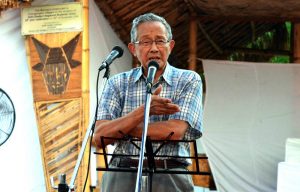 FNR member, Niketu Iralu speaking in New Delhi.
[/caption]
Dimapur, May 4 (EMN): With the clock rapidly running down on a likely solution to the Indo-Naga talks, the Forum for Naga Reconciliation (FNR) has in a rare statement outlined its position by pointing out that ‘Naga nationalism does not lie in protecting our borders, but in bridging divides urgently’.
“We are not looking beyond our borders for precedents. Obsessed with borders we have not erected, we are self-victimising of others’ making. Naga nationalism does not stop at our borders. Naga nationalism can proliferate and our minds need imagination and creative politics,” said the convenor of the FNR, Rev. Dr. Wati Aier during an open public interaction held at India’s national capital New Delhi on Friday.
This was the first of its kind to be held in New Delhi. “Personally, I take this as a speech of immediate concern. Naga history is made out of common dreams, turning points, common memories,” said Aier.
Recalling the forming of the FNR on March 15, 2008 by 39 Naga organisations from all across Naga areas, Aier informed that given the ‘intricate’ situation and problem, the FNR was conceived ‘in this urgent context’.
Senior FNR member and renowned peace activist Niketu Iralu said that what the FNR was doing through its work was to get the Nagas to re-examine themselves. “Unless we do that, our society has become impossible to function,” he said and pointed out that ‘reconciliation is the only thing we have to do if we are to have a future’.
Meanwhile, the FNR during the public interaction informed that a total of 267 meetings were held with the Naga National Groups between April 2008 and November 2014.
Further, in an attempt to clarify its scope and area of work, the FNR maintained that its first objective was to enter where daily factional killings were rampant and senseless; and termed the earlier years as ‘truly an exigent moment’.
The FNR also reiterated its position on Naga reconciliation saying that it was ‘a process and that it had no intention of side-lining the issue of justice’.
“Inducing justice before its time could be suicidal,” the FNR maintained. At the same time, it made it clear that ‘with justice in mind’, the FNR had intentionally worked with the signatories of the Covenant of Reconciliation (CoR) at the highest level of leadership.
“From the end of 2009 to the middle of 2011, in the search of creating the space for admittance of wrongs and forgiveness towards the Journey of Common Hope for a shared future, the FNR has engaged with our Naga Political Groups (NPGs),” Aier shared.
On the idea and vision behind celebrating Naga Day on January 10 of every year as announced, the FNR cautioned that if Nagas do not develop ways to publicly confront the emotional consequences of hatred, jealousy, attitudes of superiority, and division, these consequences will continue to burn ‘us to annihilation’.
“Naga Day implored Nagas to think generously outside of the box of colonial frontiers—a tool par excellence of divide,” stated the FNR.
“Walking the Naga Day is to locate our place, and offer everyone the chance to participate in the transformation, by finding a common strength to remake our world.”
The public interaction on May 4, which was held at Nagaland House, had a lively discussion on pertinent issues related to Naga reconciliation, tribal identity, the important question of justice and dialogue. The interaction was moderated by student leaders from Delhi, Akhum David Longkumer and Kapesa Pfokrelo. The programme was chaired by FNR member Dr P Ngully.
At the time of filing this news report, FNR members were engaged in more interaction with other groups including students from Jawaharlal Nehru and Delhi University; Naga Students’ Union Delhi; and Naga Peoples’ Movement for Human Rights, Delhi.
The public interaction will continue on Saturday with other Delhi based Naga organisations.


