[caption id="attachment_215454" align="aligncenter" width="565"]
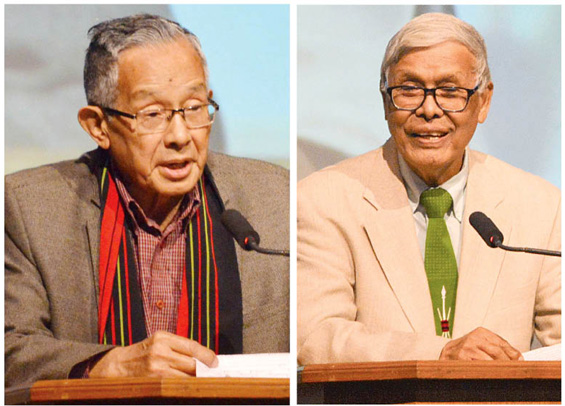 Niketu Iralu and Tuishem Shishak
[/caption]
Our Correspondent
Kohima, Oct. 30 (EMN): The lead-in general public meeting to the centenary celebration of the Naga Club, organised by the recently revived Naga Club, at the RCEMPA Hall in Jotsoma on Tuesday elicited lukewarm response as half of the seats in the hall remained unoccupied and most of the tribal heads did not turn up.
However, the poor attendance did not dampen the mood of the occasion as most of the speakers collectively voiced the need for forgiveness and healing of the Naga heart to carry forward the legacy of oneness the Naga Club had in 1929 asserted.
Peace activist Niketu Iralu said that the Naga Club has rightly started celebration of the club’s formation one hundred years ago; and most appropriately, on Wednesday, the younger generation of the Naga people, led by the Naga Students’ Federation will celebrate the legacy that has come down from that historic beginning.
“The beginning of the Naga Club was the seed; the legacy is the seedling whose growth has produced the struggle of the Nagas for their aspirations and the society we have today. We rejoice that all Nagas are commemorating with gratitude what we have achieved together so far. The Naga Club and the legacy of the club that the NSF considers its responsibility to defend describe much of our modern history. We will come to see that together the two institutions representing the old and new generations are doing the right thing, at the right time, the right way for our people,” Iralu stated in his three-minute address at the public meeting.
He felt that the differences expressed during the past weeks were understandable. “Our shared concern for the greater good of our people will enable us to reach out to one another and restore the damaged relationships,” the pacifist asserted.
Reminding that the Nagas were a loosely related group of peoples becoming a nation with determination, he pointed out that they have come and settled down in a very beautiful, resource-rich land in the deep interior of the Asian continent.
He further went on to add that the Naga people should not forget that they have a legacy that can destroy them if they ‘thoughtlessly pollute and damage its health’ by selfishness and use of violence and other unsustainable methods to solve problems. The common duty, he said, is to nurture the health of the Naga tree, not fight over its fruits which will lead to destruction. Iralu stated that this 100th year is the moment when each Naga can decide to be fully responsible for the healthy growth of their people.
“We have come this far. What our future will turn out to be will be decided by the quality of the thinking, living and character today’s Nagas will demonstrate,” he said in conclusion.
Rev. Dr. Tuisem Shishak, founder and principal emeritus of Patkai Christian College, admitted that he was ignorant of many things including Naga politics. He expressed that the Naga Club was formed in 1918 in Kohima although he still did not know the original purpose of forming the club. However, he pointed out that he found a profound political expression in the memorandum to the Simon Commission submitted in 1929.
He offered tributes to the original members of the Naga Club, whoever they were, without forgetting all those Nagas who kept the memory of the club alive to the present day.
“To me, what is most crucial is this: if it were not for the Naga Club, the memorandum to the Simon Commission might never have seen the light of day. But thank God, it did!” he stated.
Shishak said it was because of the Naga Club and its memorandum to the Simon Commission that the Naga National Council (NNC), as a cultural and political institution of all the Nagas, was formally founded in 1946.
Amidst much suffering at the hands of the Indian Army, NNC grew as a political institution in the 1950s and 60s because e Nagas of the day were united in their commitment to achieve political freedom for all Nagas, he remarked.
“Today, the Nagas are as divided as ever, each group pursuing its own selfish ends. Today the Indian rupee can buy and sell Nagas for any purpose. Today the Nagas (underground and overground) have become lovers of money. Today we are pursuing our political battle without God and we are being defeated on all fronts,” Shishak lamented.
Making it clear that by simply observing or celebrating the Naga Club centenary will not do any good for the Naga cause, he stated that what the Naga needed to do now was to get down on their knees and beg for God’s mercy.
The president of the freshly revived Naga Club, Krurovi Peseyie stated that pioneers of the club have, through their historic 1929 representation to the Simon Commission, founded a great legacy of Naga national political foundation and passed it on to the present and future generations, and the legacy of which, ‘even the more civilised neighbouring countries could not imagine then.’
He reiterated that as per records of Naga Club, “we can clearly know that the Naga Club has never been defunct, but only remained inactive sometimes.” With the imminent approach of the club’s centenary, he said some ‘well meaning and concerned Naga elders’, after having several consultative meetings, held a meeting of Naga tribes on June 2, 2017 at the Naga Club Building in Kohima and elected some office bearers on ad hoc who were regularised on August 17, 2018 by the “tribal representatives.”
Asserting that Naga Club stands committed to the founding members’s principle of: ‘the Naga Club belongs to the Naga people as a whole’, Peseyie stated that the Naga Club would remain as the fountain of unity and aspiration.
“Let the Naga Club be not inked with any unclean hand and feet. The noble deeds of the Naga Club founders and the signatories of the famous memorandum of 1929 are worthy of honour and remembrance for all times, now and in the days to come, in our journey towards self determination,” he said.
On the occasion, Khyomo Lotha, who was the caretaker of the Naga Club during 1964-69, also delivered a brief reminiscence of the club. Forgiveness of past differences in the name of the club’s centenary celebration and bringing the Naga people together as one family were the crux of the opinions shared by the speakers. The main centenary celebration of the Naga Club is scheduled to be held on Nov. 29 at Khuochiezie Ground in Kohima.


