[caption id="attachment_215636" align="aligncenter" width="565"]
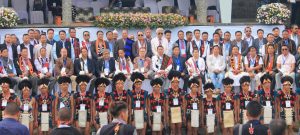 NSF leaders and guests at the Commemoration of 100th year of Naga Club at the Naga Solidarity Park in Kohima on Wednesday.
[/caption]
Our Correspondent
Kohima, Oct. 31 (EMN): A gathering of Naga youths numbering about four-thousand affirmed to honour the legacy passed down by the pioneers of the Naga Club that all Naga, cutting across geographical boundaries, were one people. 2018 is the centenary year of the foundation of the Naga Club. The Naga Students’ Federation (NSF) commemorated the occasion at the Naga Solidarity Park in Kohima on Wednesday.
The honoured guest at the event, Philippus Petrus Visser, a United Nations (UN) consultant on Peace Building & Dialogue, remarked in his address that the NSF’s theme for the occasion ‘celebrating the legacy’ reverberated with power, but raises the question as to what that legacy is.
Clarifying that he was not in Nagaland to talk about the Naga struggle nor did he represent any organisation, Visser said he was here to share ‘some experiences’ in the hope that they might resonate with the Naga people and the latter might draw some insights and lessons.
Visser pointed out that he was fixated to the notion of ‘unity’ when he first read the declaration/submission of the Naga people to the Simon Commission (in 1929 by 20 members of the Naga Club). He expressed that a lesson learnt from his knowledge of working in different contexts with people struggling for independence, autonomy, self determination or political freedom was the extreme difficulty to retain unity in a struggle.
He said the power of the vision that is bent on privilege and identity should never be underestimated, as he recalled the case of the world’s youngest nation South Sudan, which became free on 9 July 2011. Visser stated that the people took to the streets dancing and revelling in the independence. However, almost two and a half years later in 2013, a civil war had erupted there with political leaders declaring their own armies. This year on the 9th of July, the independence celebrations there were cancelled because the country’s sovereignty had become too unstable and the people had experienced too much suffering.
Another lesson to be learnt, according to him, was the relationship between political leadership and the communities—they need each other.
Visser felt that the Naga people are on the brink of one of the most risky periods in any political struggle: the period of transition. In this phase, he said, with ‘the common enemy’ gone, the scars of war and struggle were bound going to surface- jealousies, greed, competition for positions etc. will come to the fore.
The peace activist asserted that the challenge and task of the Naga leadership at the moment was to cast their minds forward to the next hundred years because they have dreams and aspirations of the Naga people to fulfill.
“We must think of a two hundred years legacy: a hundred years back and a hundred years forward,” he added.
Guest speaker of the occasion, Tapan Bose, former secretary general South Asia Program for Human Rights, who shared his journey with the Naga people recounted his association with the Naga from the 1980s.”
He felt that in the 20 years of ceasefire, the people were forgetting the kind of repressive lives they had, where every day people were killed and tortured.
“Police would come into your home anytime and take away anyone. The people were killed and questions were never asked. Those were the days,” Bose recalled.
“Nagas are no longer talking about being separate from India, Nagas are talking about being a part of a shared sovereignty with India. The concept of shared sovereignty which our Prime Minister talked about is a facade statement. The issue of shared sovereignty has to be concretised in terms of laws, in terms of Constitution alignment, in terms of protection,” Bose asserted.
“The whole argument about Nagas are not united is a false argument. Is India united? People have the right to retain their identity. India keeps talking about unity in diversity. There is unity in diversity among the Nagas, so why don’t you recognise and give up the whole debate of unity. It is actually a (state) ploy because, by constantly harping on the question of unity, they keep on dividing the Naga family. By constantly harping on the issue of integration and inclusion, they keep on dividing the people and they will decide on who they will talk to and who they will not talk to,” Bose said.
In his keynote address, convener of the organising committee of the commemorative programme Neingulo Krome stated, “Today as we all join our hearts and souls to re-affirm the pledge of our ancestors, we re-iterate that the land of the Nagas straddles across the boundary lines which the British, without consulting the Nagas, drew to demarcate the territories of India and Burma (Myanmar). These imaginary lines runs through the middle of villages and even houses.’
“However, we are all here cutting across national and international boundaries, representing all these geographical regions in manifestation of what our ancestors and pioneers of the Naga Club stood for since a 100 years ago and that will be so for all times to come.”
Representatives of Nagas of Myanmar, Northern Nagas from Arunachal Pradesh, South Nagas, Western Nagas also participated in the event.


