[caption id="attachment_82427" align="alignnone" width="500"]
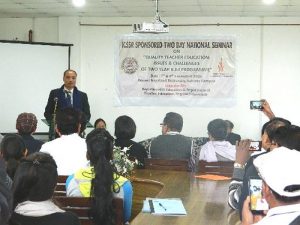 Minister Yitachu addressing the national seminar on quality teacher education at Nagaland University, Kohima Campus, Meriema on Monday.
[/caption]
KOHIMA, NOVEMBER 7 : Out of the more than 24,000 government teachers serving in Nagaland, about 42% of them (10,080 teachers) are untrained while 15% of the government schools across the state – numbering 172 schools – are run by single teachers.
These depressing figures were presented by Minister for School Education and SCERT Yitachu at the inaugural programme of the two-day national seminar on “Quality Teacher Education: Issues and Challenges of two-year Bachelor of Education (B.Ed)” at Nagaland University, Kohima Campus in Meriema on Moday.
The seminar is being organised by the department of Teacher Education and department of Education under Nagaland University, Kohima Campus, Meriema under the sponsorship of Indian Council of Social Science Research (ICSSR).
The dismal factors revealed by statistics above, according to Yitachu, have become a major deterrent to achieving quality education in Nagaland. He acknowledged that Right to Education has brought immense infrastructure development beside opening and upgrade of new schools, which in turn creates recruitment opportunity for teachers.
But this process, he regretted, has also created a huge gap for imparting quality education. This has resulted in increase in the number of school dropouts and decrease in student enrolment in government schools, according to the minister.
There are 622 schools (30% of the total) in Nagaland that have registered less than 30 students for this academic session, Yitachu informed. He observed that the gap is also widening because of the high number of unqualified teachers in the Education department.
Recruitment of teachers, the minister said, has become a tool to solve the problem of employment rather than to impart quality education. He also attributed the decline in quality education to the No Detention Policy, where students continue to get promoted to high classes despite poor performance.
Underlining the need to improve the education system with emphasis on quality, Yitachu said much depends on the quality of teachers’ education system while teachers have to commit themselves to be professionally trained.
In order to bring positive change in the society, Yitachu said teachers should be truthful, sincere and have an attitude to bring transformation in the society.
He stated that measures are being initiated in Nagaland to train all the untrained teachers. In-service teachers are being allowed to undergo B.Ed training by employing substitute teachers by the government during their training period, he said.
Dean, Faculty of Education, Sri Venkateswara University, Andhra Pradesh, Prof P A Reddy, in his keynote address, stressed on the need to improve teachers’ education programme. He said the programmes should be based on the need of quality education of the particular state while teaching should not be a mere means of employment but a profession.
He also maintained that like any other profession, teaching also requires training so that teachers can have the maximum knowledge about educating students.
Dean of School of Humanities and Education, NU, Prof Buno Liegise said that if teachers are incompetent, insincere and use proxy the society cannot progress. She said that quality teachers will inspire good leadership through quality education.
Highlighting the objective of the seminar, Dr M Rajendranath Babu said it aims to create awareness on innovative teaching strategies and skills for sustenance of quality in B.Ed programme.
Emphasis is also being given on development of relationship between theory and practices in teacher education and also to integrate information, communication and technology in teacher education, he said.
Dr Babu also maintained that the two-day seminar would also emphasise the need for enriched syllabus in two years B.Ed programme to produce globally competent teachers and also enable the participants to understand the importance and functioning of B.Ed programme comprehensively.


