


Minister Salhoutuonuo Kruse seeks greater flexibility under MIDH for horticulture in the Northeast.
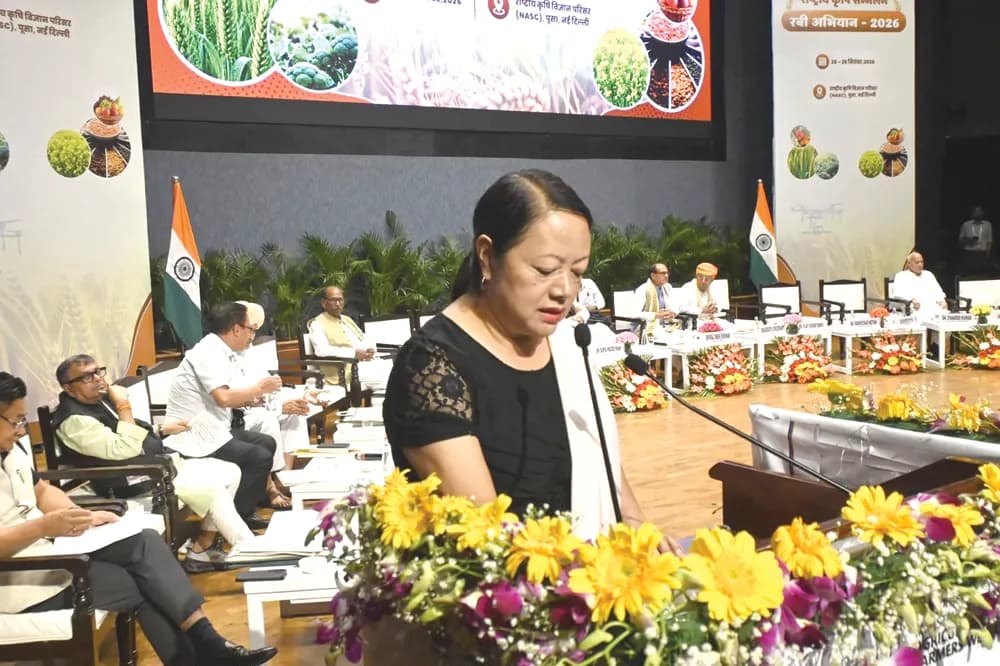
KOHIMA — Minister for Horticulture and Women Resources Development Salhoutuonuo Kruse has called for greater flexibility in the implementation of the Mission for Integrated Development of Horticulture (MIDH) in the Northeastern states, citing the region’s distinct geographical, agro-climatic, and socio-economic conditions.
Kruse made the appeal while addressing the Ministry of Agriculture and Farmers Welfare’s National Conference on Agriculture for Rabi Campaign 2026 at Bharat Ratna C Subramaniam Auditorium, NASC Complex, Pusa, New Delhi, on Tuesday.
Speaking on behalf of the Government of Nagaland, she highlighted the significant potential of horticulture in the Northeast, citing its diverse agro-climatic conditions, rich biodiversity, favourable climate, and traditional farming knowledge. She said the region has potential for a wide range of fruits, vegetables, spices, and other high-value horticultural crops.
For Nagaland, she said horticulture could help diversify livelihoods and improve farmers’ incomes, pointing to indigenous products such as Naga King Chilli, Naga Tree Tomato, and Naga Cucumber as products with strong regional identity and market potential.
Kruse said these products could be further developed through appropriate production, processing, branding, and market support. She also highlighted the potential for organic and natural horticulture in the Northeast, along with processing and value addition of crops, including pineapple, kiwi, passion fruit, ginger, turmeric, and vegetables.
However, she pointed to difficult terrain, scattered settlements and landholdings, inadequate connectivity, high transportation costs, and limited storage and cold-chain infrastructure as major challenges to horticultural development in the region.
She stressed the need to strengthen the entire horticulture value chain, from quality planting material and production to aggregation, post-harvest management, processing, value addition, branding, marketing, and exports.
Kruse called for greater support for irrigation and water management, nurseries and mother blocks, protected cultivation, post-harvest and cold-chain infrastructure, processing and value addition, transportation, and market linkages.
On GI-tagged and indigenous products, she said geographical identity and regional branding could help commercialise unique products of the Northeast.
However, she underlined that GI registration should be supported by production, quality planting material, processing, value addition, packaging, branding, market promotion, and market access so that farmers can benefit from such initiatives.
She also drew attention to the impact of climate change on agriculture, saying changing crop calendars, water availability, pest and disease incidence, and productivity were already affecting farmers.
To address these challenges, she advocated protected cultivation, climate-resilient varieties, water conservation, integrated pest and disease management, soil-health management, and other climate-smart technologies.
The Nagaland minister said the key issue she wanted to place before the Union government was the need for greater flexibility in implementing MIDH in the Northeastern states.
She pointed out that the geographical, agro-climatic, and socio-economic conditions of the Northeast differ significantly from those of the plains, and therefore a uniform approach to cost norms, admissible components, and implementation models may not always reflect the actual requirements of farmers in the region.
She also sought flexibility for states to reallocate funds among admissible components based on field requirements, as well as greater freedom in selecting crops and varieties according to local suitability, market demand, and emerging opportunities.
According to Kruse, such flexibility would enable the Northeastern states to use available resources more effectively and address farmers’ actual needs, while helping shift from a fragmented approach towards an integrated and commercially viable horticulture value chain.