


Temjen Imna Along flags Nagaland’s human resources crisis, calling for education reform, skill development and sustainable livelihoods.
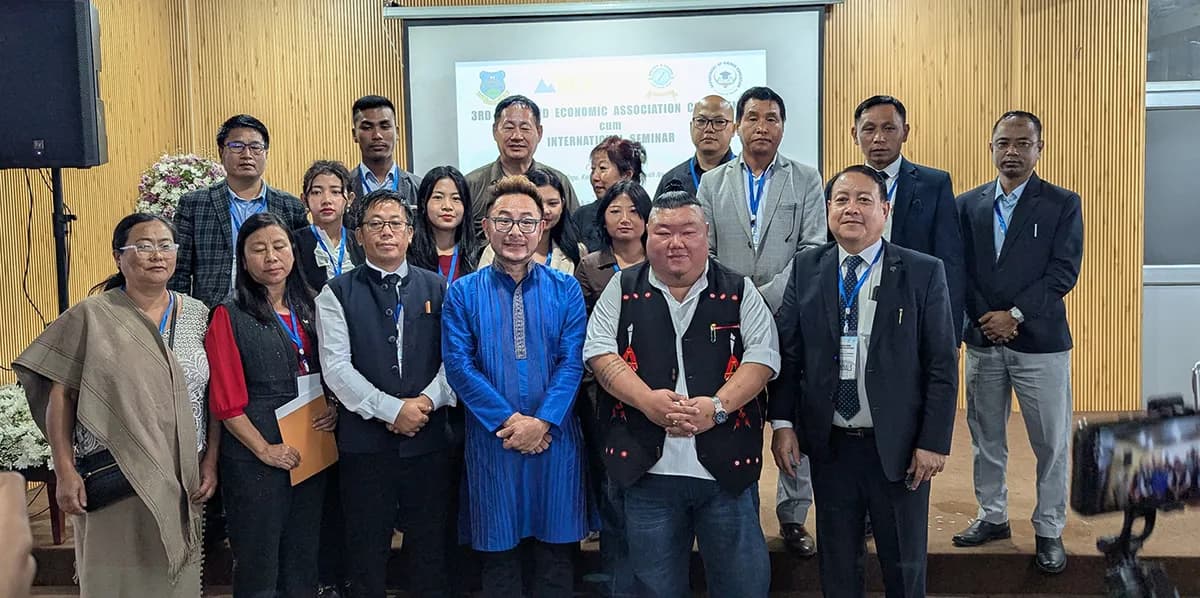
KOHIMA — Minister of Higher Education and Tourism Temjen Imna Along on Friday said Nagaland was facing a human resources crisis, stressing that development in other sectors would have limited value unless the state upgraded the quality and capabilities of its human resources.
He was addressing the third Nagaland Economic Association (NEA) conference and international seminar on the theme ‘Refocusing Human Capital Development: Challenges and Opportunities’ at Kohima College, Kohima.
Along said Nagas were not contributing sufficiently to the state’s social reform structure, but were largely absorbing ideas and influences from outside.
He emphasised the need to transform education in Nagaland through appropriate curricula, studies and learning approaches to bring meaningful change.
Describing Nagaland as economically unsustainable, the minister said modernity and technological interventions had encouraged people to pursue what they saw rather than seek knowledge.
He said civilisation depended on sustainability, mutual support and collective progress, adding that economic development in the state should be rooted in the pursuit of knowledge, hard work and inclusivity.
Citing statistics, Along said Nagaland was among the country’s most literate states but continued to face high unemployment.
He pointed to the competition among graduates and postgraduates for Grade-IV posts, attributing the situation partly to years spent on non-progressive activities rather than productive pursuits.
He maintained that Nagaland’s future could not be shaped by government policies and laws alone, but depended on its citizens.
He expressed concern that significant human resources were being expended on agitations, propaganda and tribal issues.
The minister called for developing human resources whose worth was measured not by financial wealth but by the values, knowledge and capabilities individuals cultivated.
He also spoke about the empowerment of women in Nagaland and raised concerns over local businesses being overtaken by illegal immigrants.
Prof. Zuchamo Yanthan, Library and Information Secretary at the School of Social Sciences, Indira Gandhi National Open University (IGNOU), New Delhi, said the state’s greatest resource was its people.
He said education should not merely produce degree holders but equip individuals with skills to identify opportunities and translate them into development.
Yanthan identified the paradox of an educated yet unemployed population as one of Nagaland’s biggest challenges.
While the state had no shortage of qualified and talented individuals, he said, opportunities and support systems had not grown at the same pace as educational attainment.
Observing that people had long depended on the government for employment, he said the government could not provide jobs for everyone.
He stressed the need for a change in mindset, urging people to move from degrees to skills, skills to capabilities, job seekers to opportunity creators, and ideas to enterprises and sustainable livelihoods.
He said the state’s future depended not merely on financial resources and educational qualifications but on developing capable individuals who could create opportunities and generate employment for others.
NEA president Dr. Vitsosie Vupru said the association was a young organisation with around 50 life members and 100 annual members.
He said one of the key objectives of organising the conference was to critically examine the state of human capital development in Nagaland, including the profile of educated youth, the structural barriers they faced and emerging opportunities for enterprise growth.
Researchers, scholars, educators and students attended the one-day conference, which also featured paper presentations.