


Counsellor Metshelo Akami discusses student mental health, counselling challenges and career opportunities in Nagaland.

DIMAPUR — For Metshelo Akami, counselling began with a natural inclination to listen to people and understand their struggles. What started during his Bachelor of Divinity studies at Baptist Theological College, Pfutsero, gradually developed into a professional calling centred on helping individuals navigate emotional difficulties, make decisions and improve their mental well-being.
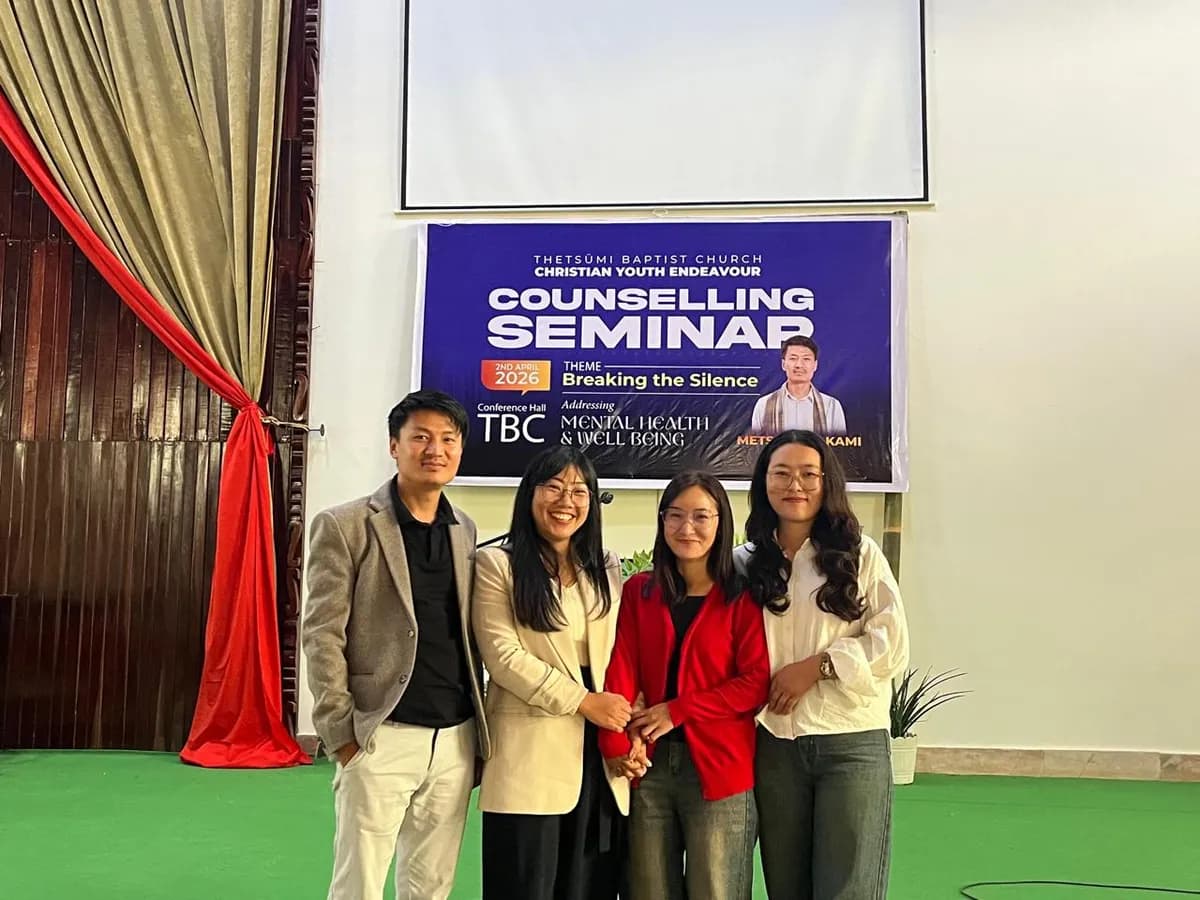
Currently serving as a counsellor at the Lapiye Centre for Mental Well Being and Tetso College, Akami works closely with young people facing academic stress, anxiety, career uncertainty and other personal challenges.
He holds a Master’s degree in Counselling and Psychotherapy from Thomas Mar Athanasius Institute of Counselling, Kottayam, and is pursuing PhD research at Martin Luther Christian University, Shillong, focusing on healthy parent-child relationships through traditional moral and ethical conduct and counselling approaches.
In this interview with Eastern Mirror, Akami discusses the mental health challenges facing students and offers guidance to young people interested in pursuing counselling as a career.
How did your journey into counselling begin?
I started my counselling journey while I was doing my Bachelor of Divinity at Baptist Theological College, Pfutsero. I have always personally enjoyed listening to people and showing empathetic responses as they share their struggles. It came naturally to me.
Gradually, I realised something important - that I needed to differentiate the different cases presented by clients, whether it is a physical, spiritual, or emotional problem, and address them rightfully. Listening alone was not enough; right understanding was needed.
Therefore, I pursued my Master’s degree in Counselling and Psychotherapy from TMAIC, Kottayam. After that, I was able to properly understand what a person is going through and attend to them effectively with careful guidance.
It is evident that a good number of people are suffering from mental health challenges, but unfortunately, we are unaware of it and often have no idea how to seek help. In this situation, I am pleased to be an agent in bringing mental well-being to society as a whole, and in particular in schools, colleges and churches, which are good platforms to bring change.
How would you explain counselling to students, and how is it different from giving advice?
If I were to explain counselling to young readers, I would say this: counselling is a talking therapy. It is really interesting as we understand people, their emotions and thought patterns, and their problems.
Counselling can be individual, couple, family or group counselling. It is one way we can administer help and guidance to someone undergoing problems like stress, anxiety, depression, trauma, and other psychological difficulties.
Counselling provides a safe and non-judgemental space where a client expresses their emotions, navigates negative thought patterns, replaces them with positive healthy thinking, develops coping skills and goal setting, moves towards self-actualisation and restores the real self to move forward in life.
I want to clear a common misunderstanding: counselling is not advice-giving. Counselling is a process where a counsellor assists and guides an individual in understanding their problems, managing their emotions, taking decisions and finding solutions in their inner and social difficulties. In simple terms, it is a talking therapy through mutual conversation.
What qualifications and skills are needed to become a counsellor in Nagaland, and what career opportunities are available?
Many students ask me what qualifications they need to become a counsellor. To some extent, anyone can offer counselling support because we all have skills like listening, being non-judgemental, empathy, genuineness, and confidentiality. But to be a professional, we need more than that.
Whether a teacher or student, I am sure basic counselling skills are taught in some academic curricula. We also have diploma courses in counselling and psychology and Master’s degrees in counselling or psychology from theological or secular institutions. These are some ways to become a counsellor in our state.
In addition to theoretical knowledge, a good number of real, practical counselling sessions are vital for counsellors.
Students interested in this field can focus on subjects like psychology and counselling. They can pursue a diploma in basic counselling skills, a Master’s in clinical and pastoral counselling, marriage and family counselling, pastoral care counselling, a Bachelor’s or Master’s in psychology or clinical psychology, or certificates in career counselling, parenting counselling, palliative care, and many more.
Schools, colleges, hospitals, prisons, rehab centres, old age homes, orphanages, special needs centres, churches, and NGOs are good platforms to practise counselling skills.
Beyond degrees, a good counsellor needs skills like trust-building, good listening, empathy, genuineness, positive self-regard, emotional intelligence, and ethical conduct. Practical experience is just as important as having degrees.
How have your expectations of counselling changed since becoming a counsellor?
At first, I thought the counselling profession was just having a conversation systematically with clients — where we listen to their problems and resolve them together by developing goals and coping strategies.
But in reality, as professionals, we need to be flexible and competent enough with different people and their presenting problems.
As a counsellor, firstly, we need to take care of our own mental well-being and resolve our own problems. It can be overwhelming when we are not mentally stable, and sometimes the counsellor and client have the same unresolved problem which can distort the counselling process.
What does your role at Tetso College involve, and how do you support students with emotional and career concerns?
My work is more focused on personal counselling and career guidance, where clients share about their stress, academic challenges and anxiety.
When a student comes with both career confusion and emotional struggle, I first try to identify which one is bothering the client the most. But logically, taking care of mental well-being comes first. A career is equally important, but a person needs to be stable and composed emotionally; only then can we move forward with other things like a career. It is likely that the emotional state may be affecting the person’s career decisions or vice versa, but taking one problem at a time is important.
What are the most rewarding and challenging aspects of being a counsellor?
The most rewarding part of this profession, which people outside do not see, is the moment of healing. It feels good when I can really help someone through understanding and guiding them about their problem. Some clients, even after undergoing several medical check-ups and taking medication, could not find real relief – but through counselling, some were able to find hope and begin their healing process.
The most challenging part is the word “mental” itself. Most people perceive counselling as something only for mentally ill persons. Therefore, more awareness programmes are necessary to educate people, because counselling is vital for all of us, for our mental well-being.

What challenges do students commonly face, and are they becoming more open to counselling?
Some common concerns brought up by students today are behavioural problems like gaming and social media addiction, tobacco consumption, academic stress, less motivation and lack of academic goal-setting, low self-esteem, depression and anxiety.
I would say students here are more open to counselling than before, as more awareness programmes are being organised. Still, many remain ignorant despite our efforts. We really need to change our mentality and open up for mental health care, because our emotional health is as important as physical health.
What advice would you give students who feel overwhelmed or uncertain but hesitate to seek help?
If I could give one message to a student sitting alone and confused about their future right now, I would say this:
As a student, it is apparent that during developmental and academic transition, you might get stuck or confused about your goals and your ideal self. It may be due to low self-esteem, repeated failure, lack of motivation or academic performance. This may lead to a fight-or-flight moment where isolating oneself becomes a common response.
For a short period, it is quite fine because we need space at times. But prolonged or repeated episodes of sitting alone and isolating oneself can lead to negative consequences, which may even lead to suicidal intention. Therefore, the best way is to recognise such moments and talk to someone who can be the right person, such as a counsellor.
From my experience, I would say every individual goes through hard times, but no matter the weight of the problem, there is potential in every individual to become a better person. You can either change the situation or change your way of dealing with the situation. As long as you are willing to change, it is possible to change the majority of your life moving forward.
You do not have to carry your burden alone. Sometimes, healing begins simply by being heard.