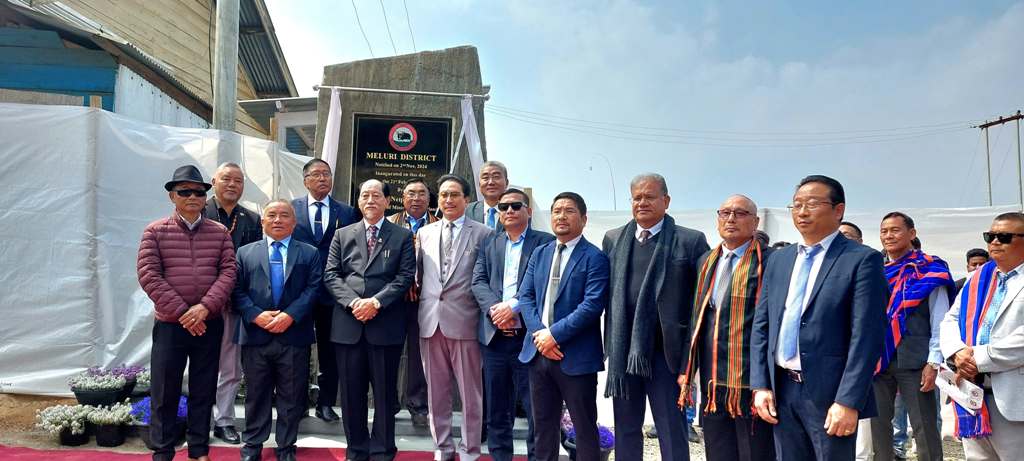
Chief Minister Neiphiu Rio and other legislators on Friday
during the unveiling of a monolith to mark the inauguration of Meluri district.
(EM Images)
MELURI — Chief
Minister Neiphiu Rio on Friday officially inaugurated Meluri district—making it
the 17th district of Nagaland.
During the inaugural programme held at Meluri public ground,
the chief minister named the district as ‘Land of Fortunes.’ He congratulated
the Pochury tribe for realising their dream of a separate district.
Rio further acknowledged the Chakhesang Public Organisation,
which did not object to the creation of Meluri district. He encouraged them to
continue the brotherhood among themselves and with the rest of the Naga tribes.
He reiterated that in his tenure thus far, the state
government has created nine new districts.
The chief minister explained that the ‘Land of Fortunes’
sobriquet has been given after due consultation because of the district’s
wealth in terms of mineral deposits, biodiversity, the beautiful Shiloi Lake,
and Tizu River—where the government is proposing a waterway to connect to the
Chindwin River—besides the international connection to Southeast Asia through
Myanmar and the Trade Centre.
He said that the district has plenty of opportunities to
offer, in addition to the people's hard-working nature, kindness, and
hospitality.
Projecting that the Pochury tribe has a total population of
around 30,000, he stated that literacy is high, with more than 150 government
officers from the tribe. He maintained that their rich culture, heritage, and
numerous economic activities can contribute to development, not only for
themselves but for the whole state.
Informing that the administrative centre is coming to their
doorstep, he stated that while the government will do what is necessary,
development requires public participation and support, too.
Recalling that he had once slept at the Laruri Bridge, Rio
said the cargo ships can go underneath without risk because the bridge is quite
high, and the water volume is good. He cautioned that while villages can
develop as needed, they must not destroy the river through pollution and the
use of dynamite or batteries for fishing.
He pointed out that Nagaland’s cultural richness has
contributed significantly to its growing tourism sector. The annual Hornbill
Festival, which once attracted a few thousand visitors, has now expanded
exponentially. In December last year, more than 2.6 lakh visitors purchased
tickets to Kisama Heritage Village, the festival venue, with a substantial
number of international tourists also attending.
Tourists are drawn to Nagaland not because of its ability to
imitate others but due to its deep-rooted cultural heritage, vibrant
traditions, and commitment to preserving and promoting indigenous identity, he
said.
Rio reminded that the state has introduced welfare
initiatives to ensure citizens' well-being, such as the Chief Minister Micro
Finance Scheme to encourage entrepreneurship, the Chief Minister’s Health
Insurance Scheme (CMHIS), and insurance for the loss of a breadwinner, along
with financial assistance in case of accidents resulting in disability.
He urged government departments, public leaders, and political
parties to reach the grassroots, ensuring that every citizen understands and
benefits from state initiatives aimed at accelerating Nagaland’s growth.
He asserted that while the government has introduced
numerous welfare programmes, the citizens must actively participate to reap the
benefits.
Also, the chief minister pointed out that the protracted
Naga political issue has hindered major projects and central investments,
limiting the state’s progress despite the government working towards a
resolution to ensure that Nagas can participate in economic growth.
He lamented the division within the Naga society and
political groups and asserted that bridging these differences is essential for
lasting peace and collective progress.
“Despite these challenges, Nagaland remains one of the
safest states, with low crime rates and a secure environment for women. While
occasional incidents occur, the state is relatively better off than many
others,” he added.
Review of PAP, FMR curbs
Reiterating that the state Cabinet meeting held on January 6
had decided to write to the Ministry of Home Affairs seeking a review of the
re-imposition of Protected Area Permit (PAP) and Free Movement Regime (FMR), he
said that there has been no response from the Centre yet.
In this regard, Rio urged the civil society organisations to
voice their concerns, ensuring that decisions reflect the people's sentiments.
While Manipur and Mizoram have staged protests over border restrictions, he
said Nagaland seeks to have its concerns heard in Delhi through collective
representation.
Amid these developments, the chief minister cautioned border
residents to remain vigilant due to rising insurgency and illegal activities,
including the smuggling of drugs and arms. While challenges persist, Rio was optimistic
about Nagaland’s future and the readiness of its youth to move forward.
He also viewed that Nagaland must shift its focus beyond
politics to economic development at individual, community, district, and state
levels. He maintained that the state remains dependent on central funds,
limiting its financial independence. He stated that properly harnessing its
natural resources could not only sustain Nagaland but also contribute to the
nation’s economy.
Rio had also unveiled a monolith near the NST Complex,
Meluri, as a mark of official inauguration, followed by the inauguration of the
Multi-Discipline Sports Stadium.
Other speakers include Minister of Power and Parliamentary
Affairs, KG Kenye; Chief Secretary Dr. J Alam; and Advisor for N&RE and
NSDMA, Z Nyusietho Nyuthe.