Journalists asked to take correct messages to people at local level
[caption id="attachment_154320" align="alignnone" width="550"]
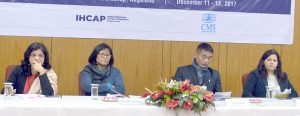 Resource persons at the three-day media workshop on ‘Climate Change Reporting’ which got underway on December 11 at Hotel Japfü, Kohima.
[/caption]
Kohima Bureau
Kohima, Dec. 11 (EMN): Bringing together policy makers, scientists, subject experts and Nagaland-based journalists under one platform particularly keeping in view that journalists play a significant role in shaping public opinion and attitude, a three-day media workshop on ‘Climate Change Reporting’ got underway on December 11 at Hotel Japfü in Kohima. The event is being jointly organised by Delhi-based Centre for Media Studies (CMS), Indian Himalayas Adaptation Programme (IHCAP) of Swiss Agency for Development and Cooperation (SDC), Department of Science and Technology, Government of India, and the Nagaland State Climate Change Cell.
“The need to disseminate scientific research and development in climate change issues to all the stakeholders remain a major problem due to the gap between the media and the scientific community,” said Dellirose M Sakhrie, state secretary of department of science and technology, who inaugurated the three-day workshop.
While highlighting the implications of climate change to humanity worldwide, the official pointed out that Nagaland has also been going through the process of climate change and a scientific projection indicates that the state will experience an increase in annual average temperature between 1.6 and 1.8 degrees Celsius. She reminded that an intensive scientific study by India’s North East Climate Change Adaptation Programme (NECCAP) in 2012 confirmed that the region is suffering from the impact of climate change adding its impact on people, fields and livestock is devastating and set to get worse.
“The government of Nagaland has taken a very systematic and proactive approach towards the formulation of the state action plan to address climate change, and in line with this the Nagaland state climate change cell was established in April 2017 under the department of science and technology to especially undertake the projects within the objectives of the National Mission for Sustaining the Himalayan Ecosystem under the National Action Plan on Climate Change (NAPCC),” Sakhrie stated.
She informed that the newly created state climate change cell would soon review the Nagaland State Action Plan on Climate Change in selected sectors. The climate change cell would also undertake vulnerability and risk assessment due to climate change in the agro-forestry sector; undertake institutional capacity building, particularly for government departments and stakeholders. It would also create a climate change repository and knowledge portal for institutes/universities, public, civil societies and all sectoral line departments for assisting decision makers in framing appropriate policy interventions.
“Sensitisation and training to media is necessary to take correct messages about climate change to people and motivate them to take action at the local level,” said Annu Anand, head of advocacy at CMS, in her brief address.
She informed that the Kohima workshop is the sixth in series with five such workshops held before in Almora (Uttarakhand), Imphal (Manipur) and Gangtok (Sikkim), Shillong (Meghalaya) and Aizawl (Mizoram). The objective of these workshops is to improve qualitative reporting on climate change in the media, Anand said, and remarked that around 200 journalists from the above states have been trained.
She also announced the launch of a media fellowship programme under which four fellowships will be awarded to journalists to write about climate adaptation in the Indian Himalayan Region and invited journalists from Nagaland to apply for the same.
Dinesh C Sharma, managing editor of India Science Wire, said journalists must appreciate that climate change is not an event but a process. He said the challenge in climate change reporting is to link local environmental stories to bigger platforms, and further encouraged the media fraternity to link local stories to larger discussions on climate change.
The senior journalist also gave a brief background on how climate change, earlier called global warming, has became a global challenge through anthropogenic activities and recording a rise in global temperature by 1 degree Celsius during the last 100 years.
“India saw a rise in 0.60 degree Celsius over the last 112 years while the North East India recorded a rise in temperature from 1.8 to 2.1 degrees Celsius in just a span of 30-40 years between 1970s and 2010s,” he said, quoting official figures. Sharma also pointed out that in Nagaland, four districts namely Wokha, Zunheboto, Tuensang and Phek have seen an increase in minimum temperature of over 1.6 degree Celsius.
Talking about the state of preparedness including mitigation strategies and adaptation policies, he said the three most impacted areas were agriculture, water resources and livelihoods particularly of the rural populace which makes a majority of the total population in India, the north east and even Nagaland. Sharma also shared successful climate change adaptation stories from the north east states such as Mizoram surpassing Assam as major producer in Muga silk, Sikkim’s revival of drying springs through existing livelihood and rural development schemes.
All in all, he underscored that climate change is a story beyond environment as it involves/impacts science, water, agriculture, forests, energy, livelihood, communities, migration/urbanisation, health public policies, politics, economy and business, international relations, diplomacy, civil society etc.
Supongnukshi, chief conservator of forests and state nodal officer for climate change, gave an overview of the state climate action plan and underlined the role of media as well as civil society and the church in promoting adaptation solutions in the state.
Shimpy Khurana, communications officer IHCAP, acknowledged that Nagaland has taken a leadership role in understanding the importance of climate change and its impact on growth and development and has taken noteworthy steps to deal with impending climate stress on natural ecosystems.
Under ICHCAP, she said, “training of state climate change cell on application of risk and vulnerability assessment framework will be undertaken and finally a map of vulnerability and risk assessment for Nagaland will be developed.”
The participants will be undertaking a field visit on December 12 of the workshop, while the third day will see a panel discussion/round table session on bridging the gap between media, scientists and the civil society.


