


Manipur Governor visited Dzükou Valley on July 7, where SAPO highlighted the importance of preserving the valley's rich biodiversity and indigenous stewardship.
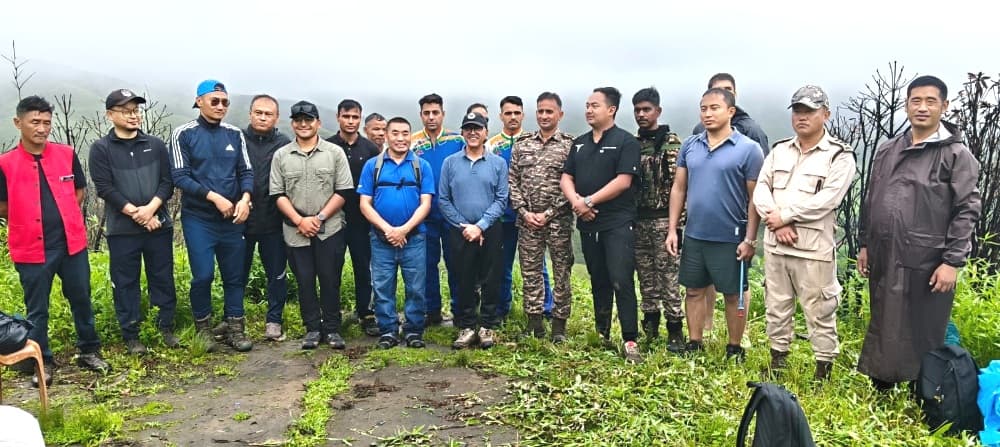
KOHIMA — Governor of Manipur Ajay Kumar Bhalla visited Dzükou Valley on Tuesday.
He was guided by the Southern Angami Public Organisation (SAPO) and accompanied by Deputy Commissioner of Kohima B Henok Buchem, medical officer (MO), CHC Viswema, members of Viswema Village Council and other officials.
According to SAPO vice president Zakieleto Tsükrü, the purpose of the governor's visit was sight-seeing, as Bhalla had long desired to visit the valley since the time he was holding the additional charge of Nagaland.
Tsükrü said the SAPO president and executive members received Bhalla in the morning and felicitated him before taking him to Dzükou Valley. The delegation returned at around 3 pm.
He said the governor had initially planned to visit with his family but, due to unpleasant weather, came alone with his delegation.
The governor also expressed to SAPO that he was impressed by Dzükou Valley's preserved ecosystem, clean air and water.
In his welcome address, SAPO president Tepul Hopovi stated that the governor's expedition into "our highlands transcends ceremonial protocol and symbolise convergence of stewardship and landscape, of governance and guardianship."
He said the path to Dzükou Valley is formidable, "yet it is precisely this inaccessibility that has rendered the valley an ecological sanctum, untouched by the predations of modernity."
He said that since antiquity, their forebears have enshrined Dzükou as a living covenant and a biodiversity haven of undulating bamboo meadows, endemic flora and crystalline watersheds.
Hopovi maintained that the Southern Angamis have been the custodians of Dzükou in Nagaland since time immemorial.
He said that though they are the custodians of this natural asset, it belongs to all nature lovers to protect, preserve and promote its eco-biodiversity.
"Today, under the aegis of the Government of Nagaland, we perpetuate this sacred stewardship," he said, adding that they had invited Bhalla not merely to see Dzükou, but "to witness the ephemeral bloom of the Dzükou Lily, and to stand in an amphitheatre of silence where the earth herself seems to meditate."
"Let this journey reaffirm a shared truth: that the Northeast's most enduring wealth lies not in extraction but in preservation," he said, adding that true development harmonises aspiration with ecology and progress with posterity.
"May Dzükou stand as a lodestar for climate-resilient, community-led conservation, a model where indigenous wisdom and statecraft coalesce," he said.