


A Sümi body has demanded recall of the latest Sümi Bible translation, alleging errors, distortion of language, and blasphemous alterations.
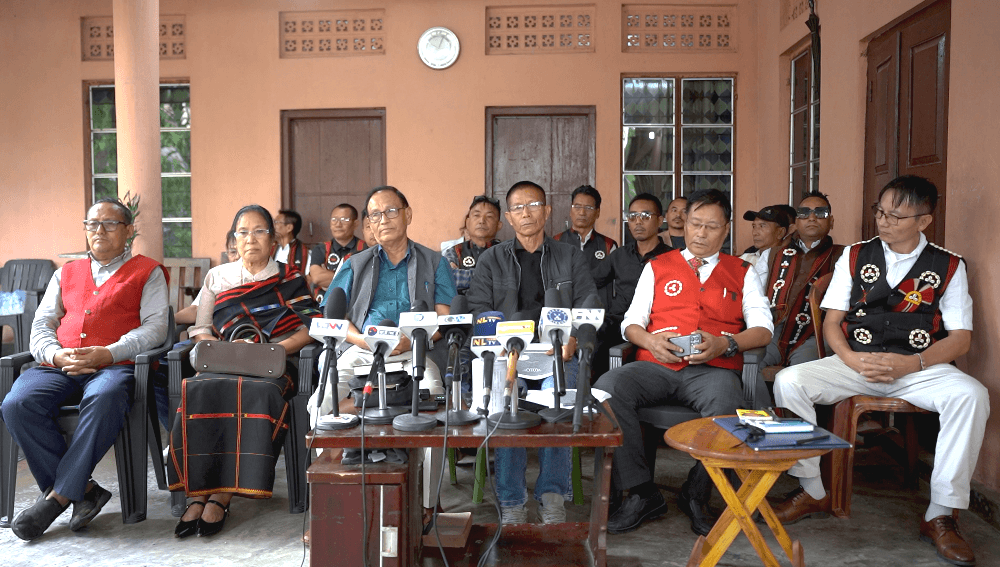
DIMAPUR — The Society for the Preservation of the Sümi Language has demanded that the Bible Society of India (BSI) recall all copies of the latest Sümi Bible translation, cease future publication, and refund buyers, calling it “polluted” and “blasphemous” at a press conference held in Dimapur on Thursday.
Failure to comply will invite civil and criminal legal action, they warned.
Retired pastor Rev. Heniji Zhimomi condemned the latest Sümi Bible translation, saying it falls short of conveying God’s word accurately.
“This is about the holiness of God and the pollution of His word,” he said and stressed that God’s word must remain pure and unchanged.
He, however, alleged that the Bible Translation Committee has altered the text by removing and adding parts.
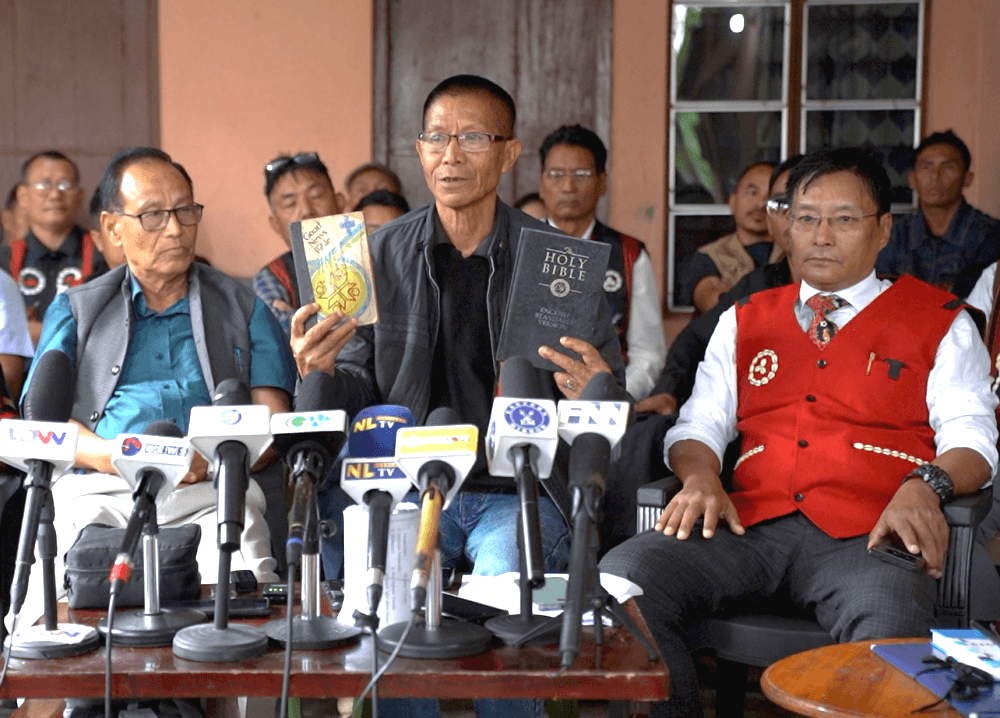
The Reverend recounted the history of the Sümi Bible, noting that the first translation—the Book of Mark—was done in 1928, and that the Bible has since been revised over ten times.
“However, never in the history of the Sümi Bible translation has the wording been as corrupted as it is now,” he said.
Zhimomi criticised changes to nouns in the Bible, adding, “If you sit with other tribes and change the nouns, it is no longer the Bible. Stay true to the original.”
He recalled a past resolution where key Sümi bodies—the Sümi Kukami Hoho, Sümi Students’ Union, Sümi i Literature Board, and Sümi Bible Translation Committee—jointly agreed that the Sümi Bible needed proper revision and correction.
WATCH MORE:
“All our Sümi associations and organisations were there and agreed errors should be corrected and a better version released,” he said.
“But when it was finally released, it came without correcting previous mistakes. This is an insult to the Sümi Hoho and to the entire Sümi community.
This will never be accepted. This new Bible should not be used officially or to guide believers in churches until corrections are made,” he added.
He further stated that the BSI’s policy is to produce translations in “easy-to-read” language, and demanded that the “polluted” Bible be suspended.
Convenor of the Society, Akheto Chishi, expressed deep anguish, saying, “For the Sümi tribe, it has come to a point where we can no longer read the Sümi Bible in the Sümi language.”
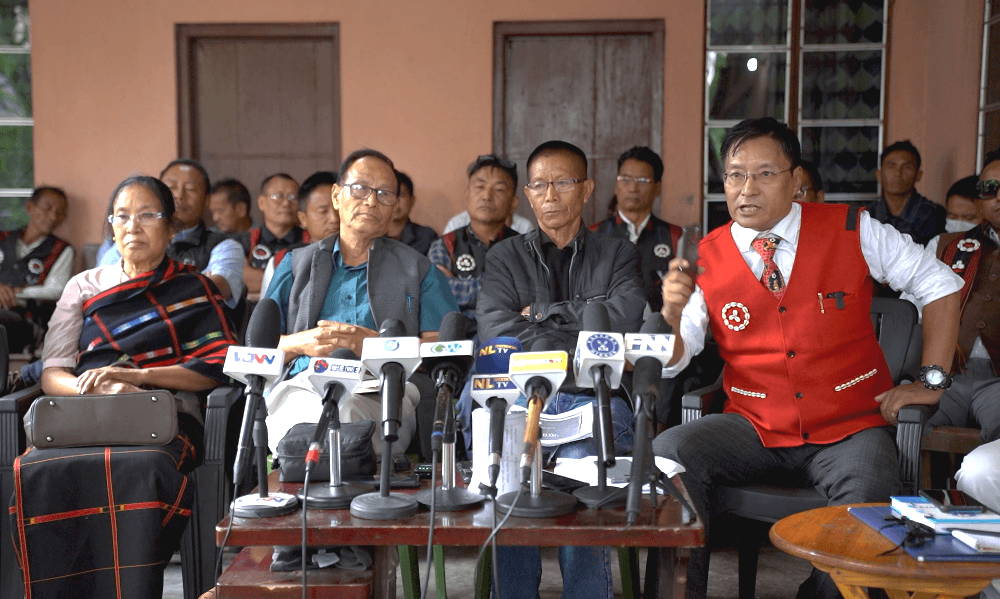
He described the situation as “a matter of great sorrow for the entire Sümi community.”
He alleged that names of places and objects used for over 100 years have been altered and that an “Anglo-Sumi Bible Dictionary” was created to guide the translation.
“They made a dictionary first and then translated the Bible based on that dictionary. Because of this, the Sümi language has been changed and everything has become confused,” he said, adding that the group has sought corrections since 2012.
Chishi cited examples of what he called “disturbing changes” in the translation. “A word used for a metal like ‘gold’ has been converted to ‘iron’.
Similarly, an animal like a ‘fox’ has been changed to a ‘dog’. They changed ‘fig’ to ‘sycamore’. This is not right; our own words must be used,” he said.
He also criticised the blending of English and Sumi phonetics. “If we are reading in the Sümi language, it should be readable as Sümi. The Bible should reflect our pronunciation and vocabulary,” he said.
He lamented that despite repeated appeals since 2012 to Sümi Hoho and translation authorities, concerns were ignored, and warned that inconsistencies between the Bible, school textbooks, and hymn books would create confusion.
Advisor to the Society, Kahuto Chishi, said that Sümi Hoho, the Literature Board, Sümi Totimi Hoho, and the Sümi Bible Editorial Board had earlier agreed to print 5,000 copies for proofreading and corrections, but alleged that the process was not followed.
“They did not accept feedback. Now they are saying they will give us six months to provide corrections. Sümi Hoho has asked for one year. For that period, people will be reading a defective Bible,” he said.
He questioned what would happen to copies already sold and whether they would be replaced.
He also criticised church leaders for supporting the Bible’s use.
Chishi alleged that the translation violates Section 298 of the Bharatiya Nyaya Sanhita (for defiling a sacred object), Article 29(1) (right to conserve language and culture), and consumer protection laws by selling a defective product without offering replacements.
Also, the convenor warned that the translation is “bringing division among the Sümi people, distorting our language and blaspheming our religion,” and asserted that they would pursue all necessary steps.
He further alleged that the translation is a “commercial venture” linked to funds exceeding INR 2 crore, with “fabricated and twisted words.”
Since their appeals went unheard, the group has approached the BSI directly, holding it responsible as the publisher.
They have submitted a letter demanding recall of all copies and a halt to future publications.