 Eastern Mirror Desk
Dimapur, March 17:
Eastern Mirror Desk
Dimapur, March 17: All eyes are on the East zone—Bihar, Jharkhand, Odisha and West Bengal—ahead of the 17th Lok Sabha polls not only because the region has 117 parliamentary seats but also for the presence of two political parties not in alliance with the BJP-led National Democratic Alliance (NDA) and Congress-led United Progressive Alliance (UPA).
While Bihar and Jharkhand are NDA bastions as far the last Lok Sabha election results are concerned, the Biju Janata Dal (BJD) in Odisha and Trinamool Congress (TMC) in West Bengal have kept political analysts and common people alike guessing by not joining any pre-poll alliances led by the BJP and Congress. These two parties could turn into kingmakers in case of a hung Lok Sabha, depending on performance.
West Bengal
The TMC was once UPA’s biggest ally but its relationship severed ever since the party’s supremo and chief minister of West Bengal Mamata Banerjee pulled out of the alliance a couple of years ahead of the previous Lok Sabha election. So much has changed since with the Congress and the Left getting closer and TMC standing on its own. Banerjee has of late hinted at willingness to join hands with like-minded parties to deny BJP from coming to power for the second term. However, nothing is concrete at the moment.
The TMC seems to be facing factionalism issue with some big names from the party having switched camps, and it is to be seen if the development will affect the party’s performance in the upcoming elections.
The party has been at loggerheads with the BJP for a while and it worsened after the recent friction between the West Bengal Police and the CBI over the chit fund scams. The state will go to the polls in seven phases: on April 11, 18, 23 and 29, and May 6, 12 and 19.
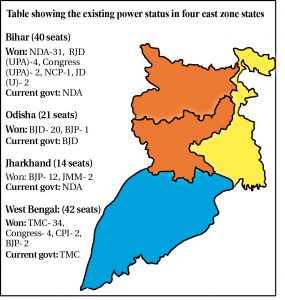
West Bengal, which is currently ruled by TMC, has 42 parliamentary seats. In the last general elections, the TMC won 34 seats, while Congress won four, and CPI and BJP won two each.
Odisha
The Biju Janata Dal (BJD) was an ally of the BJP-led NDA; contested both Lok Sabha and state assembly elections together several times but its chief and current chief minister of Odisha Naveen Patnaik pulled the plug ahead of the 2009 general elections. The party has kept the option open this time and it is to be seen if it joins the camps of NDA or UPA, or stay away from both in case of a hung parliament.
The state, which sends 21 MPs to the Lok Sabha, will go to the polls next month and polling will be held in four phases – on April 11, 18, 23 and 29. In the last general elections held in 2014, BJD won 20 seats and BJP won one.
Odisha is currently ruled by BJD.
Bihar
JD(U) supremo and current chief minister of Bihar Nitish Kumar has been with the NDA since 1998, except for four years when he pulled out of the alliance and led the Grand Alliance with Rashtriya Janata Dal (RJD) and Congress between 2013 and 2017. He is once again back in NDA’s fold but it is to be seen if it will change the political landscape in the state. Polling for the upcoming elections will held in Bihar in seven phases - on April 11, 18, 23 and 29, and May 6, 12 and 19.
Out of the state’s share of 40 seats in the Lok Sabha, the NDA won 31 in 2014 with BJP winning 22, Lok Jan Shakti Party (LJP) – 6, and Rashtriya Lok Samta Party (RLSP) – 3, while RJD (UPA) won 4, Congress (UPA) – 2 and Nationalist Congress Party (NCP) – 1. The JD (U), which was not an ally of NDA then, won 2 parliamentary seats.
The state is currently ruled by NDA.
The BJP won 12 out of the 14 MPs that the state sends to the Lok Sabha in 2014 polls, while the Jharkhand Mukti Morcha (JMM) won 2. The party have the advantage in the upcoming general elections too as it is in power in the state. However, the scenario is different this time around as the JMM, Congress, RJD, Left Front and Jharkhand Vikas Morcha (Prajatantrik) have formed the grand alliance to take on the NDA. The polling in the state will be held in four phases – April 29, and May 6, 12 and 19.
NDA is currently ruling the state.
The 17th Lok Sabha elections will be will be held in seven phases starting April 11 till May 19, and the counting of votes will be done on May 23. More than 900 million people will vote to elect 543 parliamentarians.


