


A seminar on orality and indigenous systems of the Lothas was held in Wokha, discussing cultural preservation, weaving traditions, and oral history.
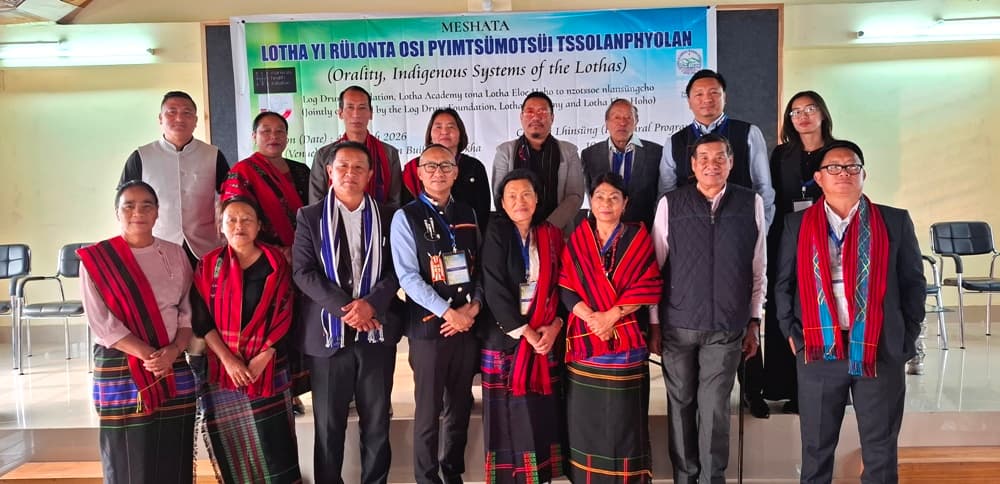
WOKHA — The LogDrum Foundation, Lotha Academy, and Lotha Eloe Hoho jointly organised a one-day seminar on orality and indigenous systems of the Lothas at the VDB building, Wokha, on Wednesday.
The inaugural programme was chaired by Dr. N Janbemo Humtsoe, Vice President of Lotha Academy, while Thungbeni Ngullie, President of Lotha Eloe Hoho, delivered the welcome address.
Delivering the keynote address, Mmhonlumo Kikon of LogDrum Foundation reminded the gathering that such discussions are highly recommended, as Lotha history has been handed down through oral traditions. He expressed that the programme was a true reflection of traditional practices passed down through generations.
However, he lamented that with changing times, society has failed to preserve its ancestral practices. He cautioned that neglecting the first form of information transmission would weaken Lotha culture.
Also read: Vande Mataram row deepens: Nagaland Christian body rejects MHA directive
Kikon further stressed that it must become a mass movement for the Naga community in general. He observed that cultural amnesia, identity crises, and the loss of traditional knowledge systems are evident among the present generation due to distractions from global ideas and technological forces.
He highlighted the need to preserve indigenous systems to strengthen identity and hoped that such exercises would reinforce local and traditional knowledge. He also spoke on cultural archiving and revival, urging the community to safeguard Lotha oral history and institutions as a mark of responsibility.
The author of the book “The Story of Our Threads” (Oying Motsü), Abeni TCK, shared insights on how Lotha women have historically shouldered the responsibility of imprinting cultural thoughts and processes through weaving, which were worn by both men and women. She highlighted that preserving and continuing traditional usage should be the core value of the Lothas, as it carries ideas, emotions, and values.
She informed that around 3,000 Naga traditional attires are preserved at the Pitt Rivers Museum in London, including 80 belonging to the Lothas. She opined that the loss of much traditional attire among the Lothas may be linked to displacement and settlement issues following Indian Independence and the Naga political movement, which led to the burning of villages.
Many villagers fled to forests, which may have contributed to the decline in weaving practices. She encouraged womenfolk to continue research into Lotha traditions and recover lost clothes through references from earlier documents to keep the heritage alive.
In the afternoon session, chaired by Penthungo T Lotha, Secretary of Lotha Academy, Rev. Dr. Ezamo Murry, former principal of Eastern Theological College (ETC) Jorhat, spoke on the transition from oral to written traditions. He encouraged maximum translation of the Lotha language, except for names and places, and lamented that socio-political progress has weakened language usage and cultural direction.
Thungjamo Tsanglao, former Chairman of the Lotha Literature Committee, shared on the practice of traditional tiger hunts among early Lotha tribes.
He elaborated on the technical aspects of how villagers gathered to capture and kill tigers, which was both a matter of pride and a means of protecting people and livestock.
Dr. Libemo Kithan, Associate Professor at Mt. Tiyi College, Wokha, spoke on Lotha village formation. He appreciated the initiative to keep oral traditions alive through collaborative efforts. Briefing the congregation on his published research “Naga Village Formation” with a focus on the Lotha Nagas, he noted that extensive elaboration requires time but expressed hope that more such traditional discourses would follow for deeper discussions.
The event culminated with a declaration to preserve Lotha culture, acknowledging that oral history is a source of knowledge. The organisers affirmed their commitment to archiving such history.