


Livingstone Foundation Group of Institutions scales six highest peaks in Nagaland in a simultaneous expedition promoting peace and eco-tourism.
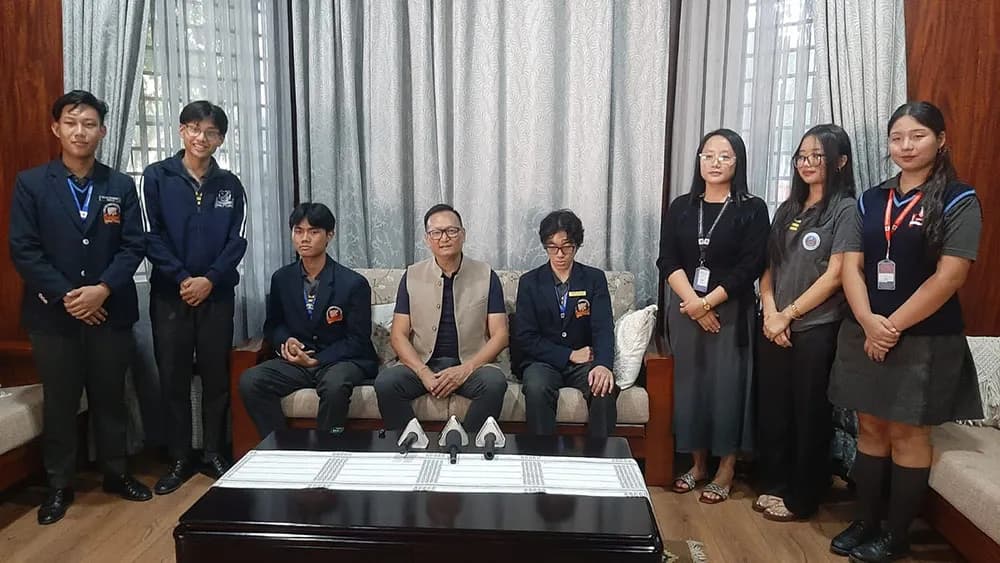
DIMAPUR — In a first-of-its-kind initiative in Nagaland, the Livingstone Foundation Group of Institutions (LFGI) has scaled the six highest peaks in the state through a simultaneous expedition involving students and mentors from its school, college, and nursing institutions.
The expedition was undertaken on October 19 on the theme "Beyond the Peak: Discovering Strength Within", with an aim to spread the message of peace, unity, and prosperity, while highlighting new horizons for eco-tourism across Nagaland.
The expedition teams successfully scaled the six highest peaks of Nagaland, which include Mount Saramati in Kiphire district, Mount Khelia King in Noklak district, Mount Mol Len in Meluri district, Mount Japfü in Kohima district, Mount Pauna in Peren district, and Mount Kapamoudzü in Phek district.
Addressing a press conference at Livingstone Foundation International at Thahekhu/Kevijau, Dimapur, on November 7, Chairman of Livingstone Foundation Group of Institutions Dr. Andrew Ahoto Sema stated that the initiative was conceived to promote the state beyond individual districts and highlight its natural beauty and tourism potential.
He said the six teams, comprising students and mentors, were assigned to different peaks across six districts and successfully completed the climbs simultaneously.
He noted that the expedition required extensive preparation, particularly for the more challenging routes, including Mount Saramati and Mount Khelia King, adding that participants underwent physical training for two to three months before the expedition. The training included daily running, walking, and sports activities.
Highlighting the climb to Mount Khelia King, he described it as particularly challenging due to its steep terrain, high altitude, and largely unexplored trekking route. According to his mobile GPS reading, the peak stood at approximately 3,476 metres, compared to Mount Saramati at around 3,800 metres.

He also highlighted Mount Khelia King's natural beauty, perennial water sources, and rhododendron vegetation, describing it as a largely unexplored destination with considerable tourism potential.
He said the institution, established in 1988, has always encouraged innovative and unconventional approaches to education, stressing that learning should go beyond textbooks to include adventure, practical skills, and experiential activities, which could encourage other schools in Nagaland to adopt different approaches.
Students and mentors who participated in the expedition also shared their experiences, describing the climbs as physically demanding but rewarding. They recounted challenges such as exhaustion, swollen feet, heavy backpacks, leeches, poor mobile connectivity, and navigating through darkness.
Alemmeren Jamir, a Class 11 student who climbed Mount Mol Len, described the expedition as a new challenge that helped him discover his potential. He said teamwork and mutual encouragement among participants helped them overcome difficulties and successfully reach the summit.
Khaplem, a Class 10 student and the youngest participant in the expedition, who climbed Mount Japfü, said the experience taught him that conquering a mountain was not about age but about strength, preparation, and determination.
A mentor from the Mount Japfü team said several students initially struggled and considered giving up, but encouragement from fellow students and mentors helped everyone reach the summit. She said the experience taught them that the greatest achievement was discovering the strength within themselves.
Dr. Andrew stated that the expedition was completed over approximately five days, with advance teams travelling ahead to the more distant peaks to ensure that all six teams could undertake their climbs simultaneously.
He further stressed the importance of introducing experiential learning and adventure-based activities in educational institutions, stating that education should extend beyond classroom learning and equip students with practical skills and confidence.
He encouraged aspiring trekkers to undergo proper physical training and carry adequate equipment, including first-aid supplies, sufficient water, food for emergencies, whistles, and essential survival gear, particularly when exploring remote and uncharted routes.