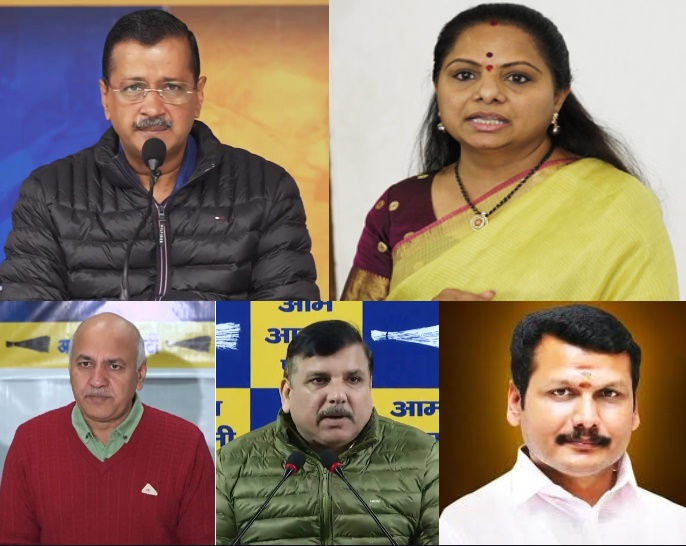
Arvind Kejriwal, K Kavitha, Manish Sisodia, Sanjay Singh,
Senthil Balaji
NEW DELHI — As 2024 nears its end, here are the key verdicts of the Supreme
Court granting bail to influential politicians who were arrested by the Central
Bureau of Investigation (CBI) or the Enforcement Directorate (ED) on corruption
or money laundering charges.
Bail to Arvind
Kejriwal
In September this year, the Supreme Court directed former
Delhi Chief Minister Arvind Kejriwal to be released on bail in connection with
the corruption case linked to the alleged liquor policy scam.
While turning down his distinct plea challenging arrest
by the CBI, Justice Surya Kant, heading a two-judge Bench, ordered Kejriwal's
release on bail but restrained him from making any “public comments on merits
of the case” pending trial before the court.
“The terms and conditions imposed by the coordinate Bench
in the ED matter shall apply in this case also. The appellant (Kejriwal) shall
remain present before the trial court on each and every date of the hearing
unless granted an exemption. He shall fully cooperate with the trial court for
expeditious completion of trial proceedings,” added the Justice Kant-led Bench.
In a judgment passed on July 12, another bench headed by
Justice Sanjiv Khanna (now CJI) opined that former Delhi CM Arvind Kejriwal may
be released on interim bail in the money laundering case, given the fact that
the right to life and liberty is sacrosanct, and he has suffered incarceration
of over 90 days.
The 2-judge Bench, also comprising Justice Datta,
referred to a larger bench Kejriwal’s plea challenging his arrest and
subsequent remand by the ED in the alleged liquor policy scam for an
authoritative pronouncement on the questions of law involved.
In the same judgment, the Justice Khanna-headed Bench had
asked Kejriwal to take a call on stepping down from the CM post.
"We are conscious that Arvind Kejriwal is an elected
leader and the Chief Minister of Delhi, a post holding importance and
influence. We have also referred to the allegations. While we do not give any
direction, since we are doubtful whether the court can direct an elected leader
to step down or not function as the Chief Minister or as a Minister, we leave
it to Arvind Kejriwal to take a call," it said.
Earlier, in view of the 2024 general polls, a bench
headed by Justice Khanna had ordered then CM Kejriwal to be released on 21-day
interim bail in the money laundering case and had asked him to surrender on
June 2.
Imposing a slew of conditions, Justice Khanna-led Bench
asked Kejriwal to not visit his office or secretariat, while out on interim
bail. It clarified that the grant of interim relief should not be treated as an
expression of opinion on the merits of the case or the appeal pending before
the apex court.
As per the SC order, Kejriwal was prevented from signing
official files unless it was required and necessary for obtaining
clearance/approval from the Lt Governor.
Bail to Manish
Sisodia
In August this year, the Supreme Court had granted bail
to the senior AAP leader and former Delhi Deputy Chief Minister Manish Sisodia,
saying that he cannot be kept behind bars for an unlimited period of time in
the hope of a speedy completion of trial in the alleged excise policy case.
Pronouncing the verdict on Sisodia’s bail pleas, a Bench
presided over by Justice BR Gavai Gavai had said: "In the present case, in
ED as well as CBI matter, 493 witnesses have been named and the case involves
thousands of pages of documents and over lakh pages of digitised
documents."
"It is thus clear that there is not even a remotest
possibility of the trial being concluded in the near future. In our view,
keeping the appellant behind bars for an unlimited period of time in the hope
of speedy completion of the trial would deprive him of the Fundamental Right of
Liberty given under Article 21 of the Constitution."
The Bench, also comprising Justice KV Viswanathan, held
that on account of a long period of incarceration running for around 17 months
and the trial not having commenced, Sisodia had been deprived of his right to a
speedy trial.
Rejecting the contention that Sisodia, if granted bail,
may tamper with the evidence, the Supreme Court had said that the prosecution case
majorly stems from documentary evidence, which has already been seized by the
CBI and the ED.
The SC refused to accept Central agencies’ submission
that Sisodia should not be allowed to visit the Delhi Chief Minister’s Office
or Delhi Secretariat.
"The appellant (Sisodia) shall surrender his
passport with the Special Court. The appellant shall report to the
Investigating Officer every Monday and Thursday between 10-11 a.m. and the
appellant shall not make any attempt either to influence the witnesses or to
tamper with the evidence," it said.
In an earlier judgment delivered on October 30 last year,
the top court had denied bail to the former Deputy Chief Minister but said that
if the trial proceeds slowly in the next three months, he may apply for bail
afresh.
Recently, the top court allowed a plea filed by Sisodia
seeking relaxation of the bail condition requiring him to report to the
Investigating Officer semi-weekly.
“We do not find the said condition is necessary and the
same is therefore deleted. However, it is directed that the applicant (Sisodia)
shall regularly attend the trial court,” it ordered.
Bail to Sanjay
Singh
In April this year, a bench headed by Justice Sanjiv
Khanna (now CJI) granted bail to AAP Rajya Sabha member Sanjay Singh in
connection with the money laundering case linked to the alleged excise policy
scam.
Noting that the ED had no objection to Singh being
released on bail, the top court clarified that it has not made any comments on
merits.
"Concession shall not be cited as precedent. Sanjay
Singh is entitled to continue with political activities," it said.
The apex court added: “... we must record that concession
made on behalf of ED has been made before commencement of arguments. We clarify
we have not made any comments on merits.”
Bail to K Kavitha
In August, the Supreme Court granted bail to BRS leader K.
Kavitha in connection with the corruption and money laundering cases linked to
the alleged Delhi liquor policy scam.
A bench presided over by Justice B.R. Gavai directed
Kavitha to regularly attend the trial proceedings and cooperate with the
expeditious disposal of the trial.
“The appellant is directed to be forthwith released on
bail in both (CBI and ED) cases on furnishing bail bond of Rs 10 lakh each. She
shall not make any attempt to tamper with evidence or influence the witnesses.
The appellant shall deposit her passport with the trial court,” ordered the
Bench, also comprising Justice KV Viswanathan.
The SC Bench clarified that it made no observations on
merits while releasing Kavitha on bail and such observations will not prejudice
the conduct of trial.
Kavitha, the daughter of BRS chief and former Telangana
Chief Minister K. Chandrasekhar Rao, was denied bail by the Delhi High Court on
July 1.
A bench of Justice Swarna Kanta Sharma said that the
material collected in the course of the investigation revealed that she was one
of the chief conspirators in the entire conspiracy relating to the formulation
and implementation of the now-scrapped new excise policy.
Bail to Senthil
Balaji
In September this year, the Supreme Court ordered senior
DMK leader V Senthil Balaji to be enlarged on bail in connection with a money
laundering case linked to an alleged cash-for-jobs scam, considering that he
has been incarcerated for more than 15 months, when the maximum sentence for
alleged offences may extend up to 7 years.
However, a bench headed by Justice Abhay S. Oka refused
to accept the contention that the deposit of Rs 1.34 crore cash amount in his
bank account was remuneration received as MLA and agriculture income.
The Bench, also comprising Justice A.G. Masih, said, “It
will be very difficult to hold that there is no prima facie case against the
appellant (Balaji)” in the complaint filed by the Enforcement Directorate (ED)
under the Prevention of Money Laundering Act (PMLA).
The apex court noted that in three scheduled offences,
there are more than 2,000 accused and the number of witnesses proposed to be
examined exceeds 600.
It said that “even in ideal conditions, the possibility
of the trial of scheduled offences concluding even within a reasonable time of
three to four years appears to be completely ruled out.”
“Even if the trial of the case under the PMLA proceeds,
it cannot be finally decided unless the trial of scheduled offences concludes.
In the facts of the case, there is no possibility of the trial of the scheduled
offences commencing in the near future. Therefore, we see no possibility of
both trials concluding within a few years,” it added.
The Supreme Court recorded that the trial of the
scheduled offences and the consequent PMLA offences are “not likely to be
completed in three to four years or even more” and if Balaji’s detention is
continued, it will violate his fundamental right to speedy trial guaranteed
under the Constitution.
Recently, the top court raised eyebrows over the
immediate induction of Balaji in the Tamil Nadu Cabinet headed by Chief Minister
M.K. Stalin after he was granted bail.
A bench of Justices Abhay S. Oka and A.G. Masih was
hearing an application seeking recall of its decision which had enlarged Balaji
on bail on the ground that he may influence the case witnesses in his capacity
as a minister in the CM Stalin-led Cabinet.
Balaji, who walked out of jail after spending over 450
days behind bars, was sworn in as minister on September 29 and assigned the
portfolios of Electricity, Excise and Prohibition in the Tamil Nadu government.