Dimapur, July 2 (EMN): Departments of Political Science and History of KROS College organised an intra-departmental debate competition on the topic “Should ULB elections be put into practice in Nagaland” on July 1, which was moderated by Kelühol Tase.
The programme was chaired by Teithuvi Zho of the Department of History. Ms Huvili Kits and Bangang Phom emerged as the first and second winners respectively. Cash prizes and certificates were awarded to the winners.
[caption id="attachment_124325" align="alignnone" width="565"]
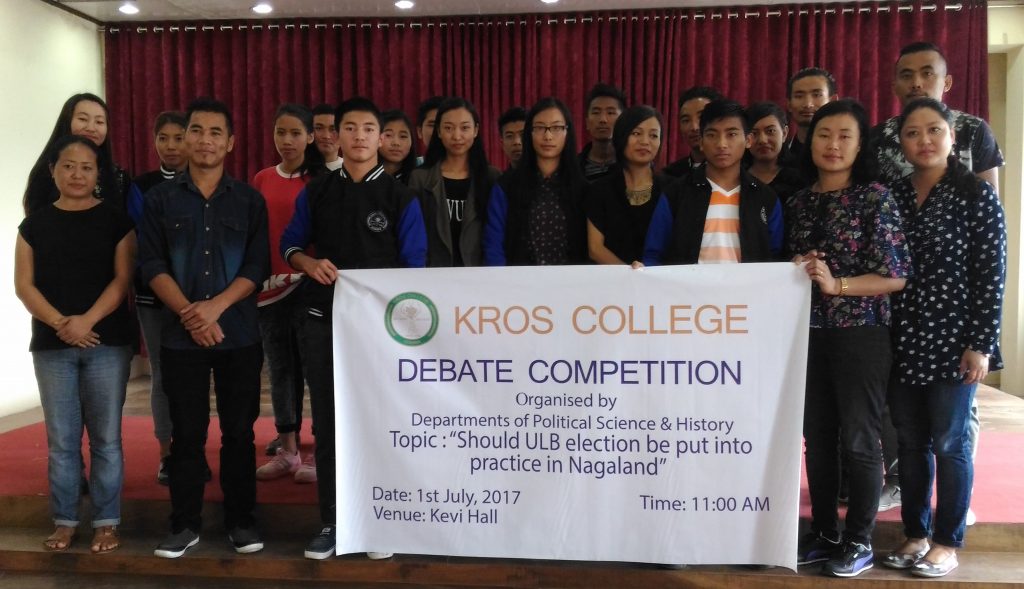
Participants pose for group photo after the intra-departmental debate competition on July 1.[/caption]
The judges of the competition were Chubatoshi Jamir, Assistant Professor Department of History; Mrs Watichila Imchen, HoD, Department of Sociology; and Ms Bonnie Lasuh, HOD Department of English. The vote of thanks was delivered by Mrs Avelu Resuh, HOD Department of History. The debate concluded that ULB elections be put into practice in Nagaland.
The origin of local self-government had very deep roots in ancient India. On the basis of historical records, excavations and archaeological investigations, it is believed that some form of local self-government did exist in the remote past. In the Vedas and in the writings of Manu, Kautilya and others, and also in the records of some travellers like Magasthnese, the origin of local self-government could be traced back to the Buddhist period. The Ramayana and the Mahabharata also pointed to the existence of several forms of local self-government such as Paura (guild), Nigama, Pauga and Gana, performing various administrative and legislative functions and raising levies from different sources.
Local government continued during the succeeding period of Hindu rule in the form of town committees, which were known as ‘Goshthis’ and ‘Mahajan Samitees.’ In many states local bodies have become weak and ineffective on account of variety of reasons, including the failure to hold regular elections, prolonged super sessions and inadequate devolution of powers and functions. As a result, Urban Local Bodies (ULBs) are not able to perform effectively as vibrant democratic units of self-government.


