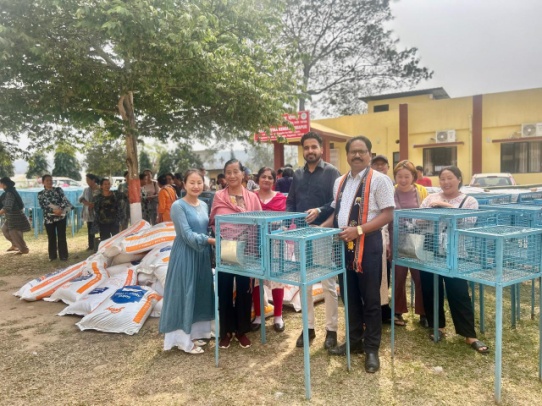
Officials and farmers after the training on organic rabbit
farming-cum-inputs distribution programme on Friday.
- DIMAPUR — With an
aim to promote sustainable livestock farming in Nagaland with a particular
focus on organic rabbit farming as an alternative source of meat, ICAR Central
Sheep and Wool Research Institute (CSWRI), in collaboration with the Krishi
Vigyan Kendra (KVK), Dimapur, organised a comprehensive
training-cum-distribution programme on Friday.
- An update from KVK Dimapur stated that Dr. Arun Tomar,
director of ICAR CSWRI, and Dr. Ranjeet Godara, nodal officer of North Eastern
Hill (NEH) programme, highlighted the benefits of organic rabbit farming by
emphasising its potential to provide a reliable, sustainable and healthy meat
source.
- It mentioned that rabbits, due to their high reproductive
rate, efficient feed conversion ratio (FCR) and adaptability, are considered an
ideal livestock species for small-scale farming. They are a resilient and
prolific species, making them an excellent option for local farmers seeking
alternative protein sources.
- The training session, which was attended by a total of 30
farmers including 27 female and 3 male, was designed not only to educate
participants about the benefits and techniques of organic rabbit farming but
also to provide them with the necessary resources to start their own
operations. It stated that each participating farmer was given two rabbits (one
male and one female), two rabbit cages and 75 kg of rabbit feed to get them
started on their farming journey.
- Dr, H Kalita, HoRC, ICAR Research Complex for NEH Region,
Nagaland Centre, in his address, told the farmers that even if they face
setbacks in other livestock ventures, they cannot fail in rabbitry as the
investment is significantly lower, reducing financial strain and making it a
practical choice.
- It further stated that the initiative was part of a broader
effort to enhance sustainable agricultural practices and empower local farmers
with innovative, eco-friendly farming techniques, ensuring a steady and
continuous meat supply while contributing to the overall development of the
region.


