[caption id="attachment_146161" align="alignnone" width="550"]
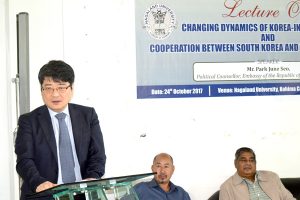 Juneseo Park Political Counselor, Embassy of Republic of Korea, delivering a lecture at Nagaland University, Meriema on October 24.
[/caption]
Our Correspondent
Kohima, Oct. 24 (EMN): With Korea and Nagaland having great potentials for development and cooperation for mutual benefit, Korea is willing to expand development assistance such as scholarship to the youths of Nagaland and to support introduction of Korean language course at Nagaland University.
This was said by Juneseo Park, Political Counsellor, Embassy of Republic of Korea, New Delhi on his visit to Nagaland University, Kohima Campus Meriema on October 24.
Delivering a lecture on ‘changing dynamics of Korea- India relations and cooperation between South Korea and the state of Nagaland’, Park has stated his willingness and felt that if the youths of Nagaland get an opportunity to study in Korea they can make a great contribution to expanding bilateral cooperation between two peoples.
Stating that Nagaland and Korea has many things in common like the mountainous areas, cultural similarities, architectural styles and artefacts, Park maintained that this cultural proximity of Korea and Nagaland has given a solid foundation for a great bilateral cooperation potential.
He also recounted a Korean legend that when the ancient kingdom of Korea was destroyed by Chinese invasion about 1,300 years ago, the refugees had settled in this region, because Nagaland has a very similar landscape as their lost fatherland.
Similarly, he said Kohima suffered heavy fighting in World War II as commemorated by memorials at the Kohima War Cemetery.
From ancient times, he pointed out that Nagaland as a trading route between the Indian subcontinent, China and Southeast Asia was central to international economic activity and also a witness to wars.
Likewise, he said with Korea strategically located between China and Japan had suffered from imperialism, aggression, colonisation and war.
Therefore Korea has shared the historical memories of Nagaland regarding imperialism, aggression, colonization and war.
In this context, Park said Korea has a great sympathy for Nagaland and have a great solidarity and close friendship towards the people of Nagaland.
Presently with Korea as the first former development assistance recipient to become a development aid donor, he pointed out that Koreans have a great advantage to help other people and countries, ‘because Korean has the same memories and experience of poverty, suppression, colonial occupation and war.’
Park who is from South Korea said the country's official development assistance has been increasing rapidly and will continue to do so wherein it has granted free aid donations amounting to more than USD 200 millions. Korea also has opened 10 billion dollar line of credit to India, he informed.
Though Nagaland is primarily an agrarian economy at present as the Koreans in the past, Park was optimistic that things will improve for better as Nagaland acts as India's ‘Gateway to the East’- the land route for trade between India and Burma and other Southeast Asian countries.
He also reiterated that Korea is now pushing ahead with the political and economic cooperation with India very strongly.
Park said he was very impressed with the Nagaland State Museum exhibiting ancient weaponry, a ceremonial drum and other traditional Naga cultural artefacts and was surprised to see lots of cultural similarities between Nagaland and Korea.
He was also delighted that many people in Nagaland are now big fans of Korean films and music, and have adopted various elements of Korean culture too.
Towards this, he said the cooperation between Korea and Nagaland is starting now and called for the support and cooperation of the state government and the people to work together for a bright future.


