[caption id="attachment_180436" align="alignnone" width="550"]
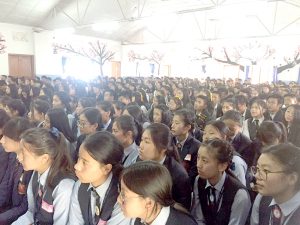 Section of students attending the one-day mentorship programme on April 28 at Mezhur Higher Secondary School, Kohima.
[/caption]
Dimapur, May 2(EMN): An initiative of the World Economic Forum, the Kohima Hub of the Global Shapers Community, organised a daylong mentorship programme on April 28 at the Mezhur Higher Secondary School in Kohima.
The programme was especially organised with an aim to provide a platform to students from classes X, XI and XII to interact with young Naga professionals from diverse fields, who would mentor and guide the students in exploring different opportunities that exist in their areas of interest. About 400 students from different schools in Kohima attended the programme.
Apart from the first combined session, students were given an option to attend a second session of their choice. There were eight different sessions including fashion, teaching and research, government, law, medicine and engineering, media and production, music, and social service and entrepreneurship.
In the combined session, Limabenla Jamir, founding curator of the Kohima hub, spoke on the importance of understanding changing contexts as the gap between what students were taught in schools today and what they would actually need in the future is ever-increasing. She underscored a four-step career-planning tool namely having self-awareness, occupational awareness, well-informed decision-making, and taking action to achieve one’s goals. She further encouraged the students to inculcate perseverance and grit in pursuing their dreams.
The session on fashion was mentored by Leno Kense Vihienuo, who illuminated the students on emerging diverse job opportunities in the fashion industry. Besides being a model, she highlighted that fashion industry offers other jobs like, designing, photography, styling, writing, etc.
Kilangsungla Pongener and Veralu Vero mentored the session on teaching and research. Sharing from their experiences as teachers, they spoke on the far-reaching impacts that a teacher could have in the lives of their students and the joys and rewards that come with it. Students were briefed on the various educational requirements needed for different exams and also research degrees that could be pursued in different universities.
Kekhrie Mezhur, mentoring the students interested in the government sector, encouraged them to be well informed of the contexts that they live in and to develop their perspectives and opinions by engaging in more meaningful conversations. He has highlighted the importance of creating a sense of ‘service orientation’.
In the same session, Abeinuo Jasmine Ashao challenged the students to set goals in their lives by setting the bar high for themselves. Speaking from her experiences as a young administrator, she spoke about the rising competition in procuring a government job. She gave tips to the students about how to stay updated with current affairs by developing simple habits such as reading newspapers regularly.
In the session on law, Kezhosano Kikhi mentored the students on how to better understand the workings of the law system, giving insights on the prospects of becoming a lawyer. Being in the profession that gives opportunity to fight for justice, Kikhi shared her experiences in the field of social, economic and human rights justice. She spoke on how it takes patience to become an established lawyer but with passion, commitment and determination.
Dr. Ruyangulie Paphino and Talisunup Jamir mentored the session on medicine and engineering. Both mentors shared from their personal experiences of being students in their fields and the challenges that they had to face. They shared on the importance of not being bogged down by the mental and emotional stress that comes with pursuing such degrees.
Talisunup shared on the benefits of utilising one’s time judiciously and being resilient in the face of setbacks, while Dr. Ruyangulie stressed on the need to remain focused on one’s aims and to keep other interests as hobbies.
Mentoring students in the media and production session, Sanen Kichu spoke about the practical and technical aspects of filming and production, while Wungchipem Raman challenged the students to push themselves to be creative and original. Students were also shown different tools and gadgets that are used in filming and production.
In the session on Music, Nungshienla Yaden stressed on having knowledge of classical music. Citing examples from the works of Bach and Mozart, she spoke on how classical music has served as fundamentals for music and the evolution of various genres, influencing musicians of all kinds even today. Mele Pucho shed light on the changing music scene in Nagaland and also the need for formal music education.
Mentoring students in the NGOs and entrepreneurship session, Shiroi Lily Shaiza, the current curator of Kohima Hub, and Kevisa Khamo shared about how an entrepreneur should look at any problem and turns it into an opportunity.
The students were encouraged to start early by nurturing habits that would make them into successful entrepreneurs by waking up early, being disciplined, being curious, being honest, saving even a little bit from their pocket money, etc.
The Kohima Hub of the Global Shapers Community hoped to organise such programmes in the future by creating platforms, where students could connect with young or experienced professionals so that a culture of mentorship could be sustained.


