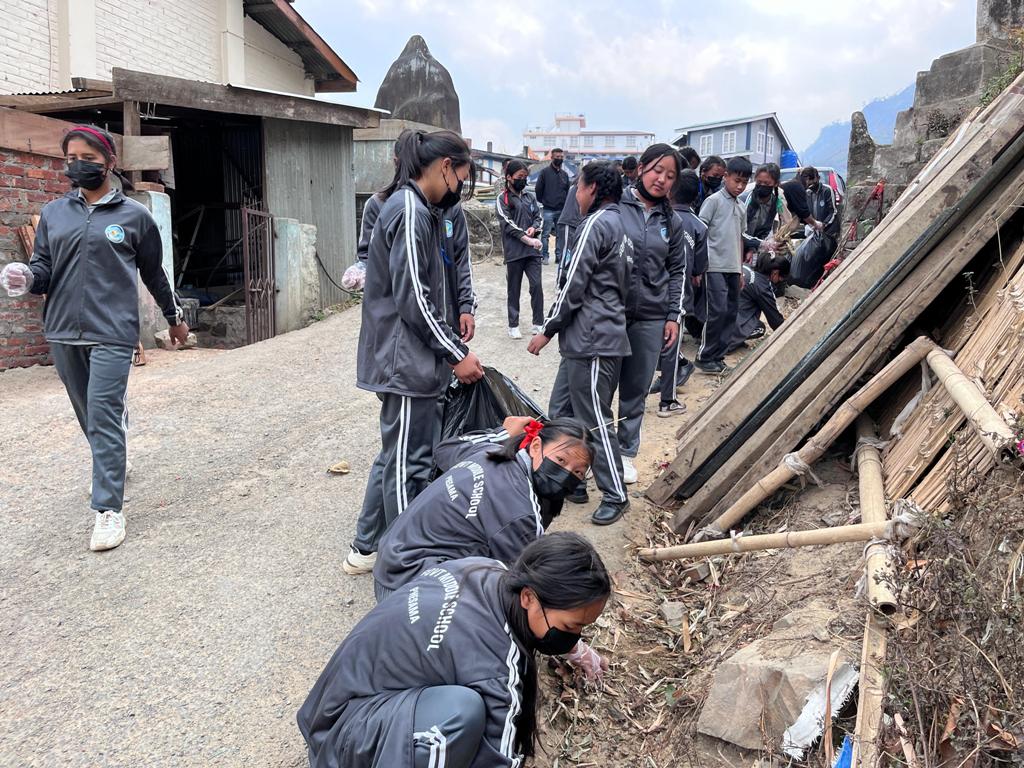
Kohima forest division organises various activities
Kohima forest division organises various activities
Kohima forest division, in collaboration with divisional management unit (DMU) of Nagaland Forest Management Project (NFMP), organised awareness on forest fire and cleanliness drive
Students of Government Middle School (GMS) are seen during
the cleanliness drive in Phesama on Tuesday.
DIMAPUR — The
Kohima forest division, in collaboration with divisional management unit (DMU)
of Nagaland Forest Management Project (NFMP), organised awareness on forest
fire and cleanliness drive at Government Middle School (GMS) in Phesama on
Tuesday.
An update from the division stated that students from Class
VI to VIII and teachers of GMS, Phesama, attended the programme.
During a brief presentation on forest fire, Shekali Holo,
capacity building, IEC and documentation expert at NFMP, DMU, Kohima,
highlighted on natural causes of forest fires such as lightening and volcanic
eruptions and man-made causes of forest fire, which included unattended fire
camps, discarded cigarette butts, uncontrolled jhum burning, malicious or
criminal purposes among others.
She also mentioned about the Dzukou forest of December 2020
and January 2021, which destroyed around 200 acres of old-growth forest. She
also briefed on the main causes of fire incidents in Nagaland, which are mostly
caused by electrical short circuit, unattended cooking and careless disposal of
flammable materials.
In addition, she also highlighted on preventive measures of
forest fire such as keeping ignitable objects far from fire, careful disposal
of hot charcoal, dousing campfires till cold.
The chairperson for the programme, N Manikho, data entry and
computer operator at DMU, Kohima, highlighted the importance of creating
boundaries for jhum burning and establishment of fire lines to prevent the
spread of fire. Mentioning that students can be powerful agents of change
through advocacy, activism and positive initiatives, he encouraged the students
to spread the message on preventive measures to people around them.
Following the awareness on forest fire, a cleanliness drive
was conducted within the school premises, where the students as well as the
teachers took part by collecting the sweet wrappers, plastic materials and
other wastes.
Altogether, 34 students and 7 teachers took part in the
programme.
In a separate programme, the Kohima forest division, in
collaboration with Nagaland Bee Keeping and Honey Mission (NBHM), organised a
one-day capacity building on apiculture for the residents of New Kigwema and
Mitelephe villages on March 17 at the New Kigwema village council hall.
In the technical session, resource person and member of
NBHM, Neilazonuo Terhuja, gave a general introduction on bee keeping, species
of bees, their importance and scope.
She also highlighted on apiary management techniques such as
apiary establishments, site selection and tools and equipments. In addition,
she explained the importance of crop pollination, which plays a crucial role in
not only enabling the creation of fruits and seeds but also in supporting
various ecosystems.
Another resource person and NBHM member, Mhathung Tsopoe,
spoke on swarming of the bees and its control, upkeep and care of bee hives. He
also highlighted on process of establishment of colony division.
The resource persons also demonstrated on various types of
bee equipment such as bee veil, smoker, queen cage, comb foundation sheet etc.
Besides, various uses of honey, its benefits, techniques of honey collection
were highlighted to the participants.
Altogether, 30 participants from New Kigwema and Mitelephe
villages took part in the training.