With 6.43 lakh people living in urban areas accounting for 32.49% of the Nagaland’s total population, principal secretary of Law and Justice and Fisheries and Aquatic Resources Y Kikheto Sema flags urban migration rate
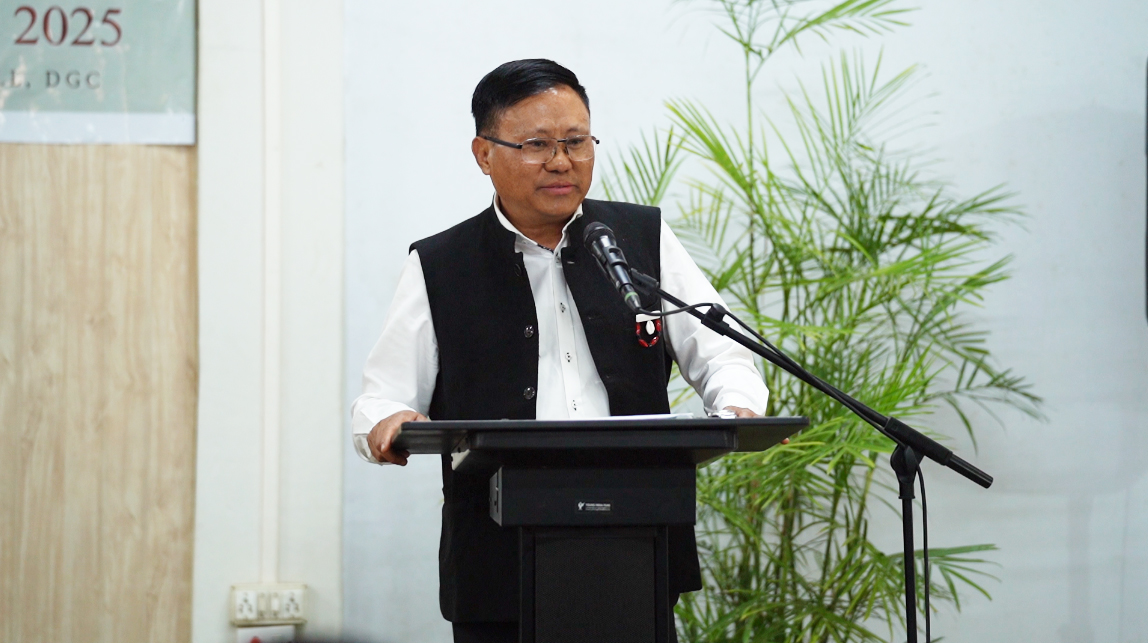
Y Kikheto Sema speaking during a seminar at Dimapur
Government College on Friday.
DIMAPUR — Very
soon, half the population of Nagaland will be living in urban areas, as people
continue to migrate to towns and cities for better education, jobs, healthcare
and other facilities, said Y Kikheto Sema, principal secretary of Law and
Justice and Fisheries and Aquatic Resources.
He was speaking on the topic, “Strengthening urban local
bodies within existing legal framework in the face of internal and external
politics” at a seminar organised by the Department of Political Science, Dimapur
Government College, in collaboration with Alumni and IQAC, DGC, at Dimapur
Government College, on Friday.
On urbanisation scenario, the official said Nagaland has
witnessed a high migration rate, with 6.43 lakh people living in urban areas,
as per the Census 2011, which accounts for 32.49% of the state’s total
population. This is a significant spike from 3,093 urban population in 1901,
before it increased by 18.4 times since the attainment of Statehood in 1963.
While terming this trend is a sign of progress, Sema said
urbanisation also comes with challenges like traffic congestion, slums,
unplanned urban outskirts, inadequate housing, power shortages, water scarcity,
urban poverty, waste management issues, pollution, and flooding.
Maintaining that effective urban governance relies on
devolution of three key elements -- functions, funds, and functionaries – he
said none of these can work efficiently in isolation. He added that society
cannot progress in the presence of external and internal politics, and too many
organisations.
He went on to urge the councilors, who were elected to
municipal/ town councils last year, to win the trust of the public as well as
educate them about their duties and responsibilities.
Also speaking at the seminar on the topic “Urban Local
governance: Citizens’ Perspective”, the Publisher and Editor of The Morung
Express, Dr. Akum Longchari, said that most ULBs in Nagaland could face
challenges as the governance is still influenced by traditional leaders and
customary laws, while formal governance structures are in place in larger urban
centres like Kohima, Dimapur, and Mokokchung.
The ULBs are still transitioning out of the interregnum
period, he said, adding that a holistic and strategic road map is required for
effective transition.
Some of the emerging challenges during this transition
period, he said, were management shift from top down to bottom up and building
social cohesion.
Longchari touched upon issues like the process of
electioneering in the state being reduced to ‘economic exchange of power,
money, goods and services, which has effectively silenced people’s voices’, and
politics of promises and forgetting.
Some of the limitations faced by the ULBs are poor urban and
local governance caused by the absence of strategic planning and governance,
lack of infrastructure, government’s control, insufficient administrative
machinery, financial constraints and unplanned and limited urbanization, he
said.
He went on to say that the councillors should publicly and
consistently demonstrate their clear intent and commitment to delivering
efficient, effective and equitable governance through words and actions.
In order to progress, the foundational values, intentions of
the governance model and power structures in the state need to be identified
and engaged in ways that address the people’s basic human needs and honour the
fundamental human rights, he said. “If not, the genuine pursuit of inclusive
human development will remain nothing more than an empty slogan with failed
promises.”
Governance is about transforming the nature of institutions
and making them more inclusive, accountable, responsive, humanistic,
democratic, and people-oriented, he continued.