


KG Kenye highlights democratic freedoms, Article 371A and constitutional values at the National Youth Parliament Competition 2026
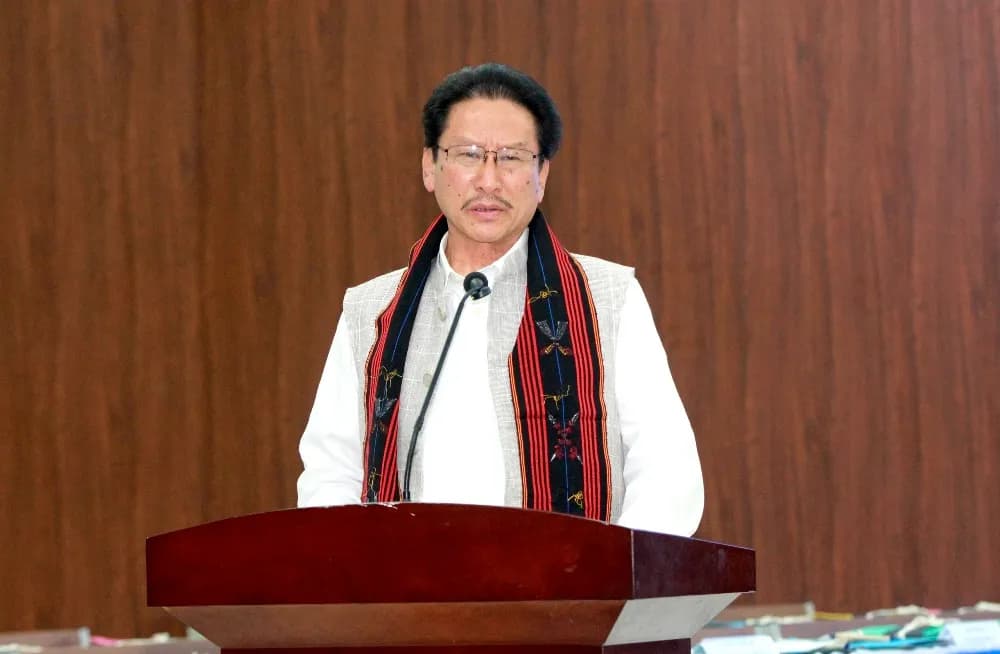
LUMAMI — Minister for Power and Parliamentary Affairs KG Kenye on Tuesday addressed the 18th National Youth Parliament Competition 2026 at the I Ihoshe Kinimi Hall of Nagaland University, Lumami, underscoring India’s democratic journey, Nagaland’s special constitutional position under Article 371A, and the importance of responsible leadership among the youth.
Reflecting on India’s democratic evolution, Kenye noted that the country had transitioned from more than 500 princely states under monarchical rule into a democratic union after the adoption of the Constitution drafted under the leadership of Dr. BR Ambedkar.
Despite early scepticism and literacy rates of around 60 to 70 per cent at the time of Independence, India has sustained a secular and vibrant democracy for nearly 78 years across diverse cultural, linguistic and political landscapes, he said.
On Nagaland’s unique status, the minister recalled that the state joined the Indian Union in 1960 through a political agreement as the 16th state, unlike other states that acceded through Instruments of Accession.
Also read: Minister KG Kenye calls for unity, collective leadership in Chizami Range
It was initially administered under the Ministry of External Affairs before being transferred to the Home Ministry in 1972.
Under Article 371A, any Act of Parliament relating to religious and social practices, customary law, administration of criminal justice, and ownership and transfer of land and resources requires a resolution of acceptance by the Nagaland Legislative Assembly before it can be applied in the state.
The Speaker chairs the state house committee that examines the applicability of such central laws, a committee that functions co-terminus with the five-year tenure of the Assembly, he added.
Kenye also advised the young participants on the value of free speech in a democracy.
He urged them to exercise the right responsibly, avoid its abuse, and speak up for those facing systemic suppression.
Effective public speaking, he said, demands passion, conviction, conciseness within strict time limits, and clear articulation to engage audiences.
Earlier, Prof. (Dr.) Anupam Kurlwal, Professor and Head, Department of Law, MDU Centre for Professional and Allied Studies, Gurugram, outlined the history of the National Youth Parliament Competition in his concept note.
Read more local news: KG Kenye urges eastern Nagas to utilise FNTA opportunity wisely
Nagaland University is participating in the national-level competition for the first time. Strong performance and podium finishes in such competitions remain one of the most effective ways for the university to build its national visibility and institutional branding, he observed.
The scheme aims to foster democratic awareness, mutual respect for differing opinions, active listening and the tolerance required to accept mistakes and hear the opposition, he informed.
Participants gain foundational knowledge of key constitutional provisions, including Article 14 (Right to Equality), Article 21 (Right to Life and Personal Liberty) and Article 32 (Constitutional Remedies).
Students also learn legislative procedures for passing bills, the accountability of the executive to the legislature, and official protocols.
In the competition format, student members assume parliamentary roles such as Speaker, Prime Minister, Leader of the Opposition and Home Minister, thereby experiencing the responsibility of representing constituencies of 10 to 12 lakh people.
Prof. Bendang Ao, Vice-Chancellor In-charge, welcomed the dignitaries and students and underlined the university’s commitment to academic excellence and the nurturing of responsible citizens.
Democracy thrives, he said, when young citizens think critically, express their views respectfully, value diverse opinions and place national interest above all.
He also highlighted Nagaland’s own vibrant democratic culture, in which every village functions and takes decisions through democratic processes, and described politics as the foundation of a civilised society rather than mere political manoeuvring.
Following the student performances, the six best speakers were announced: Phalwani (Badge 09), Alika (Badge 02), Akimeni NK Newmai (Badge 01), Vemutulu (Badge 08), Phuhton (Badge 04) and Ilihon K Chishi (Badge 26).