


Minister for Power and Parliamentary Affairs, KG Kenye urges student leaders to revisit history and safeguard Naga interests.
Share


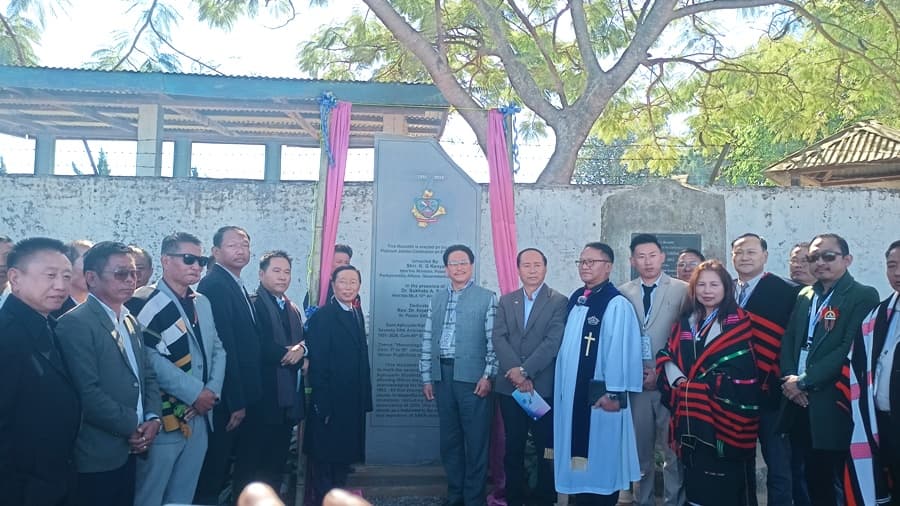
PUGHOBOTO — Minister for Power and Parliamentary Affairs, KG Kenye, on Thursday urged student leaders to revisit history, understand their legacy, and actively safeguard the interests of the Naga people.
The minister was addressing the platinum jubilee-cum-49th biennial conference of the Sümi Aphuyemi Kiphimi Küqhakulu (SAKK) held at Pughoboto town, Zunheboto district.
Kenye said 2026 should mark a turning point for the Naga people, expressing hope that God would fulfil Naga aspirations in all spheres of life.
Reflecting on the evolution of student bodies, he recalled that in the absence of tribal organisations, civil societies and NGOs in earlier times, a small group of educated youths came together to form the Kohima Sadar Students’ Union. Through this platform, he said, understanding was built between the hills and the plains, disputes were resolved and social harmony restored.
Observing that the early 19th and 20th centuries witnessed several skirmishes, Kenye credited student leadership, particularly the Kohima Sadar Students’ Union, for restoring peace and understanding, and paid tribute to past leaders for their contributions.
He said earlier student leaders served as watchdogs and custodians of land and people, citing Dimapur, Nagaland’s only commercial city as one of the most critical historical challenges faced and addressed by Naga leadership.
Kenye said while past leaders had played their role, the present generation must remain grateful to the public that stood firm in safeguarding Naga territory and interests amid challenges and encroachment.
Maintaining that political status may evolve, he asserted that Naga society, its people and interests remain constant and that geopolitical boundaries should not be compromised. Rather, he said, Nagas should continue to aspire to include land, territory and people.
Highlighting key milestones in the Naga political journey from the Nine Point Agreement to the 16 Point Agreement and the inclusion of Article 371(A), Kenye said the people had accepted the realities of the time.
He said Naga society today stands at a crossroads and urged students to acknowledge the sacrifices of parents and elders that enabled widespread access to education. While noting unemployment challenges despite rising educational attainment, he observed that Nagaland remains among the fastest-growing societies in terms of education.
Kenye opined that the generation of the 1940s and 1950s was the most productive due to clarity of purpose, while the present generation risks becoming unproductive due to internal divisions and vested interests.
Sharing from his experience since the 1980s, he remarked that student leadership roles have diminished due to the emergence of multiple organisations and the division of responsibilities. However, he reminded students that their relevance remains intact due to the legacy they have inherited.
“Your role as watchdogs, guardians and custodians of society still carries great responsibility,” he said, urging them to study history and understand issues that remain relevant today.
Kenye further told student leaders that many goals remain unachieved and called on them to understand the Inner Line Permit (ILP) system, rooted in the Bengal Eastern Frontier Regulation Act of 1873. He said the British introduced the regulation after recognising the distinct identity of the Naga people and sought to protect their land, culture and social systems through strict enforcement.
Referring to political changes in the subcontinent, he said safeguarding Naga interests continues to be a challenge but remains achievable through the full implementation of protective measures.
He also urged students to study the Register of Indigenous Inhabitants of Nagaland (RIIN) in depth, before mobilising public support.
Greetings were delivered by Angami Students’ Union president Diezevisie Nakhro and SKK vice-president Kheto Ayemi. Welcome address was delivered by former SAKK president Vixepu Swu, while the presidential address was delivered by SAKK president Hutoka Assumi.
The programme was chaired by former SAKK president Hetovi Kappo. Special jubilee prayer was offered by Rev. Vibo Sumi, executive secretary, NCRC Sumi headquarters, Pughoboto. The jubilee souvenir was released by former SAKK president Hokheho Kiho.
Minister Kenye also unveiled the jubilee monolith in the presence of MLAs Dr. Sukhato A Sema, Dr. Neisatuo Mero and Jwenga Seb, along with other dignitaries and leaders.
Blend progress with values — Vikheho Swu
Former minister and chairman of the NPF Central Farmers Wing, Y Vikheho Swu, urged the Aphuyemi students to aim high while keeping old values of justice and righteousness.
Swu was addressing the inaugural of the 49th biennial conference of the SAKK on January 7. He recalled his journey with SAKK, urging parents and elders to instil success habits in students, saying home is the first support and learning place.
He lauded the Aphuyemi’s thirst for knowledge, urging them to amplify it at home, khel, and village to uplift their people and Naga society. Citing Switzerland’s kiwi and New Zealand’s pork (Hornbill Festival 2025 partners), he encouraged Aphuyemi people to explore entrepreneurship for sustenance."
Further, Swu urged the gathering to stay united as one people instead of identifying oneself as being “from this range, that range” and encouraged them to look up to God and fear doing the wrong thing.