[caption id="attachment_196849" align="aligncenter" width="565"]
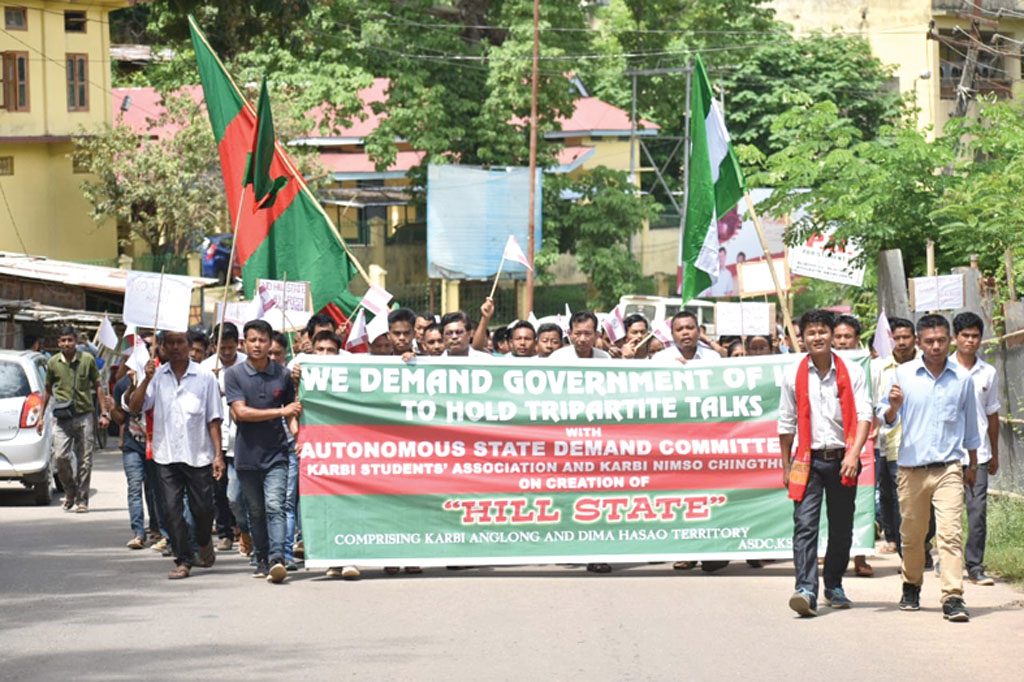 A number of organisations in Karbi Anglong have demanded talks with the Union government to create an autonomous state.
[/caption]
Our Correspondent
Diphu, July 23 (EMN): The Autonomous State Demand Committee (ASDC), Karbi Students’ Association (KSA) and Karbi Nimso Chingthur Asong (KNCA) jointly submitted a memorandum to Rajnath Singh, Union Minister for Home Affairs, Government of India, North Block New Delhi through the deputy commissioner of Karbi Anglong here on Monday, July 23 urging to hold a tripartite talk for the creation of a hill state comprising of Karbi Anglong district, West Karbi Anglong district and Dima Hasao District.
The memorandum stated that, the erstwhile hill districts of Assam have already become separate states. The need of having an administrative setup completely separate from Assam was articulated by all the hill tribals since independence.
The hill people were quite aware that Autonomous District Councils under the sixth Schedule of the constitution of India would not adequately protect the culture, society and economy of the hill tribals. The fear of being overwhelmed by other people in Assam led to the mobilisation of the hill tribals leaders leading to the demand for the separate states.
The persistent demands could convince the successive union government and subsequently the states of Nagaland, Mizoram, Arunachal Pradesh and Meghalaya were created.
It is also mentioned, during the time of creation of the Autonomous State of Meghalaya through the Assam Reorganisation (Meghalaya) Act 1969, the then United Mikir and North Cachar Hills district (present Karbi Anglong, West Karbi Anglong, and Dima Hasao district) were given the option to join Meghalaya along with the
United Khasi and Jantia Hills district and Garo hills district. The elected representatives at that time chose to remain in Assam as they were promised that administrative changes will be made to enhance the powers of the Autonomous District Councils and more funds will be allocated to expedite development.
Article 244 (A) was also inserted to the constitution of India through the Constitution (22nd Amendment) Act, 1969 which provided that the parliament may ‘form within the state of Assam an autonomous state’ comprising the remaining hill districts whenever it is required.
The memorandum also stated, the developments show that the two remaining hill districts remained neglected as ever.
The promise for more power and more funds never fulfilled. Formation of an Autonomous state for these hill areas, despite demands for it was never by the government.
A few examples elaborated that the discrimination against the people of Karbi Anglong and Dima Hasao is quite serious, continuously depriving the benefits of development that other people have been enjoying.
There is huge disparity of government funding between the hill area of Assam and other states like Mizoram, Meghalaya and Nagaland. In the 9th Plan outlay Karbi Anglong and North Cachar Hills received INR 1400 per capita investment, Mizoram received INR 11000 per capita investment. The combined population of Karbi Anglong and North Cachar Hills district, according to 1991 census was 8,13,524 that of Mizoram was 6,89,756.
The area having about 25% less population gets almost 10 times more funds. Again in the 10th Plan outlay, 2002-2007, the Government of India earmarked INR 3,000 crores for Meghalaya, INR 2,228 crores for Nagaland and INR 2,300 crores for Mizoram. But the hills area of Assam received less than INR 800 crores of plan funds. The continuous marginalisation, deprivation and discrimination compelled the people of the hill to organise a mass movement for the creation of an
Autonomous state under the banner of the Autonomous State Demand Committee (ASDC) and Karbi Students’ Association (KSA) from 1986 after agitation for about a year, a formal memorandum was submitted to the then Prime Minister of India on May 18, 1987 in New Delhi. It may be mentioned the movement gathered strong support from all section of the society.
Many rounds of tripartite talks were held with the union and the state government. After many years of continuous agitation and talk with the government , a Memorandum of Understanding (MoU) was signed between the Assam Government, represented by the chief minister and leaders of the ASDC, KSA, NCHSF (North Cachar Hills Students’ Federation), DSU (Dimasa Students’ Union) on April 1, 1995 in New Delhi in presence of the union home ministers.
The MoU among others, provided for transferring legislative powers to the Autonomous Councils on 14 subjects by amending the Sixth Schedule to the Constitution, giving more to say to the council on the law and order administration, regularisation of funding mechanism and extending the “Jurisdiction of the two Councils for the exercise of execution powers’ over 30 departments, added the memorandum.
However, the memorandum also stated regrettable that many important clauses of this MoU have not been implemented till now, Reminder and subsequent discussion with the government did not improve the situation.
It can be recalled that the government had also signed a Memorandum of Settlement (MoS) with an armed organisation, who had similar demand in 2011. This MoS too remains unexecuted.
The memorandum was signed by Holiram Terang, President ASDC, Jotson Bey, General Secretary ASDC, Suren Hanse, President KSA, Jemson Timung General Secretary KSA and Merina Beypi , President KNCA and Kajek Tokbipi, General Secretary KNCA.


