


Press Club of India President Sangeeta Barooah Pisharoty said journalism has weakened due to corporate control while addressing the Kohima Press Club silver jubilee.
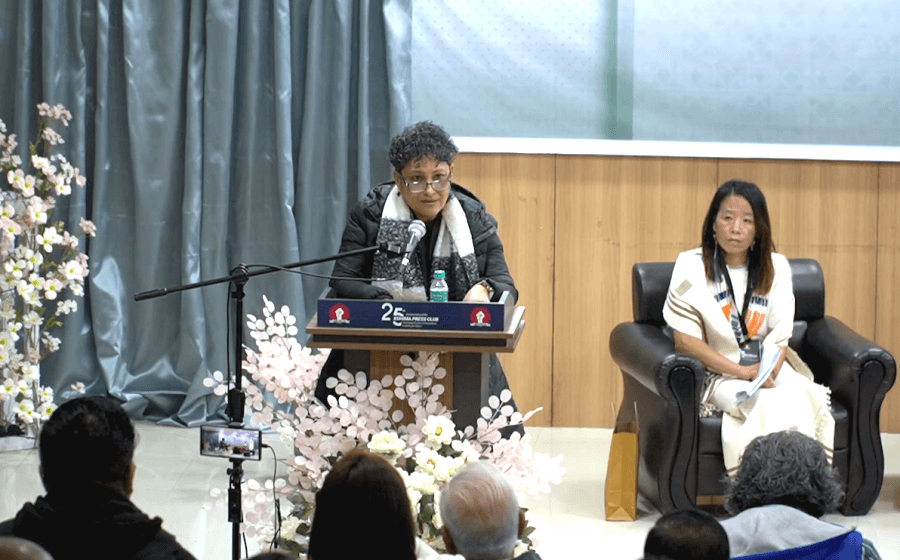
KOHIMA — President of the Press Club of India, Sangeeta Barooah Pisharoty, on Tuesday said journalism in India has weakened over the last two decades due to the corporate model of financing and political influence, leading to a loss of editorial independence.
Addressing the silver jubilee celebration of the Kohima Press Club (KPC) at the Capital Convention Centre, Kohima, she said that in the last 20 years there has been a downfall in journalism mainly because of corporate houses and politicians entering the media space, controlling money and eroding the voices of editors.
She said journalism has never been easy, although India is a democratic country, and added that in her 30 years of experience she has seen journalism going on a downward spiral. She said the faulty financial model of practising journalism in India has led to corporate houses entering the arena, where editors have lost their freedom to act as they should.
She said the media began serving the government of the day, at the Centre or in the states, mostly to serve business interests and not journalism. She added that the line between journalism and public relations has nearly merged, and lamented that most TV channels today do not speak about issues that concern the public.
She said that in the early years after Independence, although industrial houses funded newspapers, the reins remained with editors and journalistic freedom was rarely compromised. She said this was because both owners and editors respected and acknowledged that the press has a social duty. She added that, sadly, over the last two decades there has been a gradual crumbling of those values across the country.
Pisharoty said it is the press that keeps elected members accountable to the public by asking questions, and that the allegiance of the press should lie only with the public interest. She said the job of the press is “to keep democracy vibrant by keeping the government of the day accountable.”
She further said that although India is the largest democratic country, “we have failed to do the most basic thing that would have kept the spine of media houses intact.”
The PCI president further said that a number of laws and rules are being introduced in the country to weaken journalism. She cited the Digital Personal Data Protection Act, saying that in the name of privacy and digital security, journalistic exemption has been taken away, denying information that the public deserves to know.
WATCH MORE:
She said the dilution of the Right to Information is another challenge, and that new laws and rules are making journalism more difficult and challenging media freedom. She also said technology is a growing challenge, threatening to take away many newsroom jobs, and added that digital media is taking on the challenge of journalism, with the possibility that only digital media may exist in India 30 to 40 years from now.
She appealed to the public to support independent media not just by reading and circulating stories but also by financing and subscribing to them. She said that if money comes from the public and not corporates, journalists would be answerable only to the public.
As president of the Press Club of India, she said upholding the rights of journalists without pressure would be her first priority. She said her team aims to set up a legal cell to help journalists across the country who face cases for their journalism and are left by their owners to fight alone. She also said the Press Club of India plans to organise free workshops to train journalists on technology and digital security.
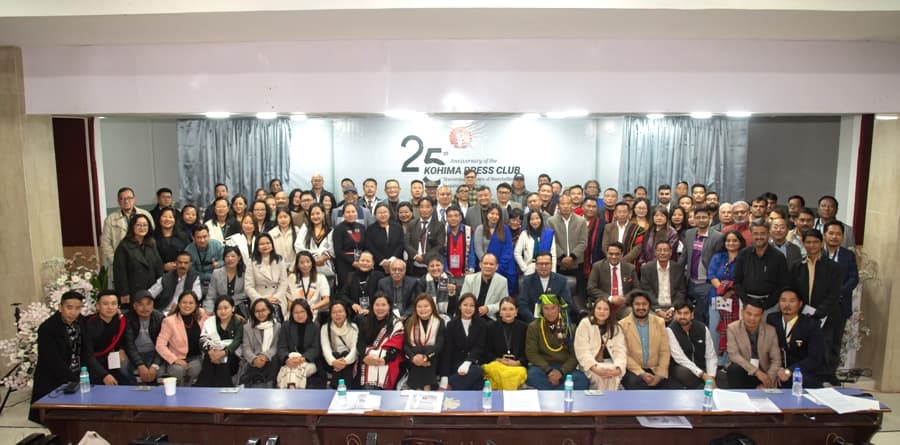
The KPC celebrated its 25th anniversary silver jubilee on Tuesday under the theme “Traversing 25 years of storytelling: Inspiring the future”, with Pisharoty as the guest of honour in the morning session, along with guests from Northeastern states and other well-wishers.
KPC president Alice Yhoshü, in her address, spoke on the history and formation of the club, saying journalism in Nagaland existed as early as the 1930s, while conversations to form a press club began in the early 2000s. She said the club was formally launched on January 28, 2001, after several rounds of informal meetings among journalists in Kohima.
She said the Kohima Press Club has consistently nurtured the principles of the Fourth Estate, promoting ethical standards, professional fellowship, media education and critical public interest dialogue. She added that the club also maintains alliances with government agencies whose actions directly affect the media.
Yhoshü said the Kohima Press Club undertakes charity work through visits to homes, hospitals and other institutions on Republic Day and Independence Day every year, and said the club has grown to 66 members.
Former vice-president of KPC, Vibou Seyie, in her speech, spoke on her experiences as a journalist, saying working in the media is a rare and honourable privilege that gave her a platform to connect with people. She said journalism is stressful and does not pay well, but encouraged journalists to practise ethical journalism at all costs.
She also expressed hope that the new KPC office building would be a welcoming space for healthy dialogue.