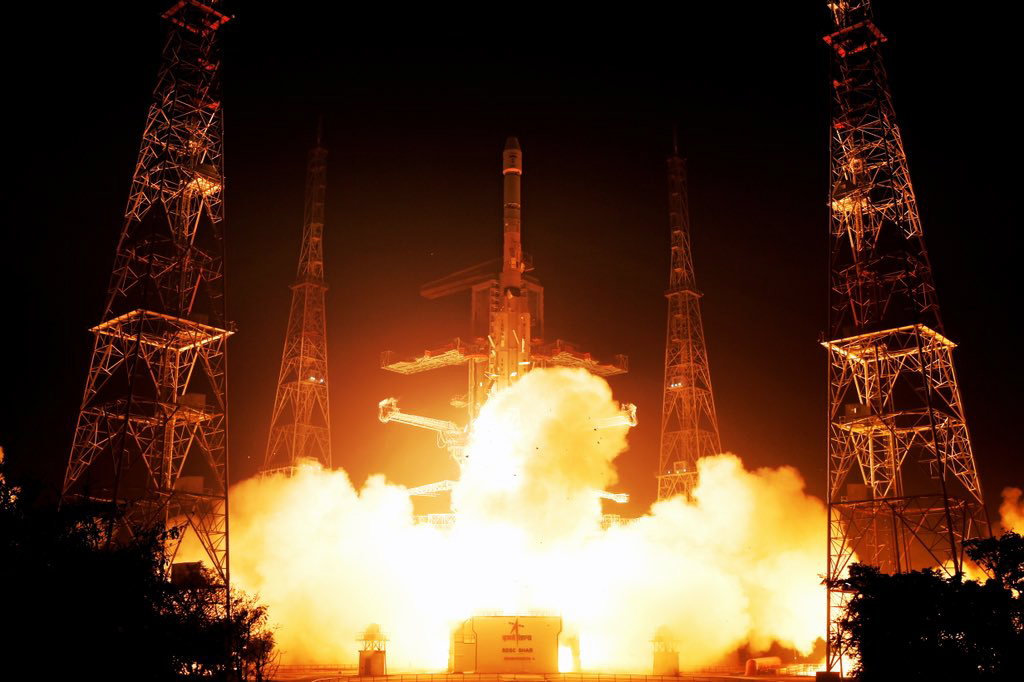
ISRO's PSLV-C60 carrying SpaDeX and its payloads, lifts off
from the first launch pad at Satish Dhawan Space Centre, in Sriharikota, Andhra
Pradesh, Monday, Dec. 30, 2024. (PTI Photo)
SRIHARIKOTA
(ANDHRA PRADESH) — The
Indian Space Research Organisation (ISRO) on Wednesday achieved a historic
milestone with its 100th mission and revealed an ambitious future plan of
crossing the next 100 launches in five years.
Starting off with the SLV in 1979, the space agency
crossed the 100-mission mark after 46 years, but what stands out is the PSLV's
dominance through the years with 62 missions.
The Polar Satellite Launch Vehicle (PSLV) has turned out
to be ISRO's most trusted rocket, thanks to its unmatched reliability.
While PSLV has been used for 62 missions, GSLV with
indigenous cryogenic upper stage comes next with 17. LVM3 (Geosynchronous
Satellite Launch Vehicle MkIII--the heaviest rocket) with 7 and SSLV (Small
Satellite Launch Vehicle) 3, follow suit.
The others are Reusable Launch Vehicle, TV (Test Vehicle)
and PAT (Pad Abort Test).
PSLV, often dubbed as the "trusted workhorse of
ISRO" by scientists, has been used consistently to inject various
satellites into precise Low Earth Orbits. The vehicle which is 44.4 metre tall
is equipped to take payloads of up to 1,750 kg to Sun-Synchronous Polar Orbits
of 600 km altitude.
However, on account of its unmatched reliability, ISRO
said PSLV was also used to launch various satellites into Geosynchronous and
Geostationary orbits, like satellites from the IRNSS constellation.
The PSLV comes in four variants -- PSLV-CA, PSLV-DL,
PSLV-QL, PSLV-XL.
The first launch of PSLV was PSLV-D1 launched on
September 20, 1993. It was an unsuccessful attempt. However, the rocket made
its first successful launch in October 1994 and later emerged as the most reliable
and versatile launch vehicle of ISRO.
Some of the significant missions that were successfully
launched by PSLV include the ambitious Chandrayaan-1 in 2008 and Mars Orbiter
Spacecraft in 2013. Scientists describe the Chandrayaan-1 and Mars Orbiter Mission
as the 'feathers in the hat' of PSLV.
The Sriharikota spaceport situated about 135 km east of
Chennai has two launch pads and incidentally the first launch pad came into
service from September 1993 by launching a PSLV/IRS-P1 mission. The second launch
pad also commenced operations, from May 2005 with the launch of
PSLV-Cartosat-1, ISRO officials said.
GSLV, has given ISRO a run for its money, thanks to the
challenging technology behind the rocket.
So much so, some repeated failures prompted GSLV to be
called 'naughty boy,' but things have since changed.
However, the flawless weather observation satellite
INSAT-3DS mission last year prompted the ISRO to virtually heave a sigh of
relief over the challenging GSLV rocket technology, with one of the scientists
quipping the "naughty boy has matured into an obedient, disciplined
boy."