


Iranian Supreme Leader Ayatollah Ali Khamenei was killed in a major attack by Israel and the United States, Iranian state media confirmed early Sunday

DUBAI (AP) — Ayatollah Ali Khamenei, who assembled theocratic power in Iran over the decades as its supreme leader and sought to turn it into a regional powerhouse, bringing it into confrontation with Israel and the United States over its nuclear programme while crushing democracy protesters at home, has died. He was 86.
Iranian state media reported the death early Sunday, after a major attack launched by Israel and the United States. US President Donald Trump said hours earlier that Khamenei had been killed in the joint operation.
Khamenei dramatically remolded the Islamic Republic since he took the reins after the death of Ayatollah Ruhollah Khomeini in 1989. Khomeini was the fiery, charismatic ideologue who led the overthrow of the shah and installed rule by Shiite Muslim clerics tasked with spreading religious purity. It fell to Khamenei, a stodgier figure with weaker religious credentials and a leaden demeanour, to turn that revolutionary vision into a state establishment.
Updates: Ayatollah Arafi named Iran's interim Supreme Leader
Israel Defense Forces shares how Khamenei was killed in heart of Tehran

He ended up ruling far longer than Khomeini. He greatly expanded the Shiite clerical class and built the paramilitary Revolutionary Guard into the most important body underpinning his rule. The Guard became a military and business behemoth, the country's most elite force and head of its ballistic missile arsenal, with hands across Iran's economic sectors.
But the strains became harder to contain. Political repression and the faltering economy fuelled successively bigger waves of mass protests. Anger over the 2022 death of Mahsa Amini, detained for not wearing her mandatory headscarf properly, escalated into demonstrations against social restrictions. In early January, hundreds of thousands marched in cities across the country, many chanting, “Death to Khamenei.”
Khamenei responded with the deadliest crackdown seen in nearly 50 years of clerical rule as security forces opened fire on crowds, killing thousands.
At the same time, the Mideast wars sparked by Hamas' Oct. 7, 2023, attack on Israel set in motion the collapse of the regionwide “Axis of Resistance” built by Khamenei. Israel and Iran attacked each other directly for the first time in 2024. I srael struck Iran again in June 2025, as it and the United States targeted the country's nuclear program and killed top military officers and nuclear scientists. Iran retaliated by sending missiles and drones at Israel.
Khamenei's death raises questions about the future of the Islamic Republic.
The 88-seat Assembly of Experts, a group of mostly hard-line clerics, will choose Khamenei's replacement. But no clear successor is in place.
As he launched the bombing in February, US President Donald Trump called on Iranians to “take over your government.
From a questioned start to a hard-line grip on Iran
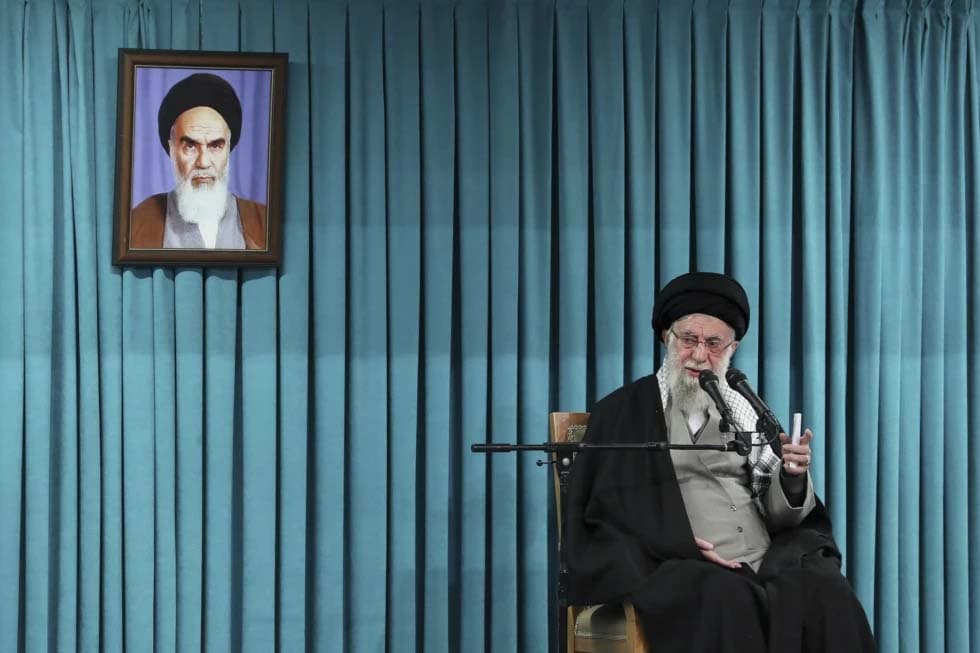
Ali Khamenei was born into a religious family in the northeastern holy city of Mashhad, a hotbed of revolutionary fervor during the struggle against the Western-allied shah, Mohammad Reza Pahlavi.
Like many other Iranian leaders, he studied under Khomeini at the seminary in the holy city of Qom, south of Tehran, in the early 1960s, before the Khomeini's exile to Iraq and France.
Khamenei joined the anti-shah movement, facing time in both prison and in hiding. When Khomeini returned to Iran in triumph in February 1979 and proclaimed the Islamic Republic, Khamenei was appointed to the secretive Revolutionary Council. In 1981, he was elected Iran's third president; that same year, a bombing by opponents left him with one hand paralyzed.
With his thick, heavy-framed glasses, Khamenei lacked the steely gaze and fiery aura of Khomeini, the father of the Islamic Revolution. He fell far short of Khomeini's religious scholarship, holding the relatively low rank of “hojatolislam” in the Shiite clerical hierarchy.
After being named supreme leader after Khomeini's death, he bounded overnight to the level of grand ayatollah, at the top of the hierarchy, and for years had to deal with skepticism over his credentials.
Khamenei acknowledged the doubts with humility. “I am an individual with many faults and shortcomings and truly a minor seminarian,” he said in his first speech in his new post.
Despite his lack of charisma, Khamenei stabilized Iran after the 1980s war with Iraq and governed for over three decades — far longer than Khomeini.
Hard-liners considered him second only to God in his authority. Khamenei created an ever-growing bureaucracy of Shiite clerics and governmental agencies that blurred responsibilities and left him as the ultimate arbiter. As Iran questioned whether to keep the Revolutionary Guard after the war with Iraq, Khamenei came to its rescue and allowed the paramilitary force to gain a powerful grip on Iran's economy. He also used a system of appointees to undercut the civilian government elected by its people.
Nuclear programme advances to near-weapons-grade levels
The supreme leader remained deeply suspicious of the US, referring to it as the “Great Satan” even after President Barack Obama came into office in 2009, offering dialogue and a fresh start.
He shrugged off UN sanctions and pushed ahead with Iran's nuclear program, which the US and its allies say hid a secret project to build a nuclear weapon up until 2003. Khamenei issued a verbal fatwa, or religious ruling, that nuclear weapons are un-Islamic, but vowed the country would never give up its right to develop what he called a peaceful nuclear energy program.
Under Iran's 2015 nuclear deal with world powers, Tehran agreed to drastically reduce its stockpile and enrichment of uranium in exchange for the lifting of economic sanctions. But only three years later, Trump in his first term unilaterally withdrew Washington from the accord, arguing it didn't go far enough.
Protests and demands for change intensified
Khamenei's first major challenge came in 1997, when pro-reform politicians gained control of parliament and cleric Mohammad Khatami was elected president by a landslide, riding a large youth vote. The reformists demanded a loosening of the strict social rules imposed by the revolution and called for improved ties with the outside world, including the US.
Khamenei-backed hard-liners moved to contain the liberal movement, fearing it would eventually call for an end to clerical rule. Khamenei stopped parliament from loosening restrictions on the media in an unusually overt intervention. Clerical bodies blocked other key liberal legislation and banned many reformist lawmakers from running for reelection, ensuring a return of hard-liner control in the 2004 elections.
Although Khamenei struggled to preserve the ideological purity of the Islamic Revolution, Iran's government has largely failed to rid the country of Western influence. Satellite dishes, banned in theory, crowd Tehran's rooftops. Banned social media sites are widely used, even by some prominent politicians, despite being blocked.
Protests erupted again in 2022 over the death of Amini, a young woman detained for not wearing her hijab, or headscarf, to the liking of authorities. More than 500 people were killed and tens of thousands arrested when security forces crushed the demonstrations again.
In late December 2025, new economic protests erupted and would grow into what appeared to be the biggest protest movement ever. Hundreds of thousands across the country took to the streets, overtly demanding an end to the Islamic Republic.