[caption id="attachment_210958" align="alignnone" width="550"]
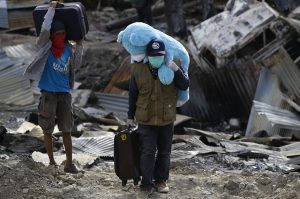 A man carries a teddy bear and other belongings he recovered from his toppled houses at the earthquake-hit Balaroa neighborhood in Palu, Central Sulawesi, Indonesia on Saturday Oct. 6, 2018. Search teams pulled bodies from obliterated neighborhoods in the disaster-stricken Indonesian city of Palu on Saturday as more aid rolled in and the government said it was considering making devastated areas into mass graves. (AP/PTI)
[/caption]
Jakarta, Oct. 6 (IANS): Indonesian authorities on Saturday raised the death toll in the devastating earthquake and an ensuing tsunami in Sulawesi Island to 1,649.
National Disaster Management Agency spokesperson Sutopo Purwo Nugroho said that among the victims, 1,413 were from Palu city, the hardest-hit in twin disasters, Xinhua news agency reported.
"Most of the victims were found in Palu and they were hit by tsunami, particularly in the coastal areas near Talise beach," the spokesman said.
The remaining deaths were reported in the districts of Donggala, Sigi, Parigi Moutong and Pasang Kayu. Relief aid started arriving in the more remote areas of Sulawesi Island.
Assistance was being provided by local authorities and non-governmental organisations in Donggala and other cut off areas such as Sigi, Red Cross spokesperson Iris Van Deinse said. Work on restoring the power supply to affected areas was ongoing.
The quakes and the tsunami also left 2,549 people injured, with 265 people still missing. The number of people taking shelter in makeshift tents stand at 62,369 now, the spokesperson said.
In Palu, banks and businesses reopened and the chaos surrounding the distribution of food, water and gasoline during the initial aftermath of the tragedy, had ended.
Bodies were still being removed from the other worst affected areas, such as the village of Petobo -- about 7 km southeast of Palu -- and Balaroa, where NGO workers estimated that over 1,000 people could still be buried.
Disease fears as more bodies found in Indonesia disaster
Rescuers picking through the grim aftermath of Indonesia's quake-tsunami issued a fresh public health warning Saturday as more decaying corpses were unearthed from beneath the ruined city of Palu.
Officials said Saturday the death toll had climbed to 1,649 with more than a thousand maybe still missing in the seaside city on Sulawesi island, after the region was hit by a powerful quake and a wall of water.
Hopes of finding anyone alive a full eight days since the disaster have all but faded, though the search has not been officially called off.
There are fears that vast numbers of decomposing bodies could still be buried beneath Petobo and Balaroa -- two areas virtually wiped off the map.
"Most of the bodies we have found are not intact, and that poses a danger for the rescuers. We have to be very careful to avoid contamination," Yusuf Latif, a spokesman for Indonesia's search and rescue effort, told AFP from Palu.
"We have vaccinated our teams, but we need to be extra cautious."
Security minister Wiranto, who like many Indonesians goes by one name, said eventually the worst-hit areas would have to be declared mass graves and left untouched.
"We have to make a decision as to when the search for the dead will end. Then, we later must decide when the area will be designated a mass grave," he told reporters late Friday.
Thousands of survivors continued to stream out of Palu to nearby cities in the aftermath of the disaster. Hospitals remain overstretched and short on staff and supplies.
In Karawana village, nurse Iyong Lamatowa can offer little more than antibiotics and pain killers to treat those flocking to a makeshift clinic with badly-infected wounds.
Survivors have ransacked shops and supply trucks in the hunt for basic necessities, prompting security forces to round up dozens of suspected looters and warn that they will open fire on thieves.
Hundreds of people Saturday rushed a truck carrying gas cylinders for cooking, with long and desperate queues quickly forming.
One supermarket that opened its doors refused to allow people inside, instead passing goods through the door as armed troops stood watch.
A convoy of five hundred trucks laden with donated food, cooking oil and other essentials was on its way to Palu, agriculture minister Amran Sulaiman said in the devastated city on Saturday.
"Palu's ordeal is the grief for all of us and that's why everyone is lending a hand to help," he said.
The United Nations said Friday it was seeking USD 50.5 million "for immediate relief" to help victims of the devastating quake and tsunami in Indonesia.
After days of delays, international aid is slowly making its way to the disaster zone, where the UN says almost 200,000 people need humanitarian assistance.
Getting vital supplies to the affected areas has proved hugely challenging, with the number of flights able to land at Palu's small airport still limited, leaving aid workers facing gruelling overland journeys.
Oxfam had sent water treatment units and purification kits to Palu and Swiss aid teams on the ground were providing drinking water and emergency shelter, both said in statements Saturday.


