By Mithilesh Kumar Sinha | EMN
India’s economic growth bounced back in the July-September quarter to reverse a five-quarter slowdown as businesses overcame the teething troubles of the newly launched goods and services tax (GST) regime and shock demonetization of high-value currency. Gross domestic product (GDP) grew 6.3 per cent in the second quarter of 2017-18, its fastest pace in three quarters, majorly due to demonetisation and the massive destocking ahead of the implementation of the Goods and Services Tax, data released by the Central Statistics Office (CSO) showed. This was a break with five quarters of declining trends in growth.
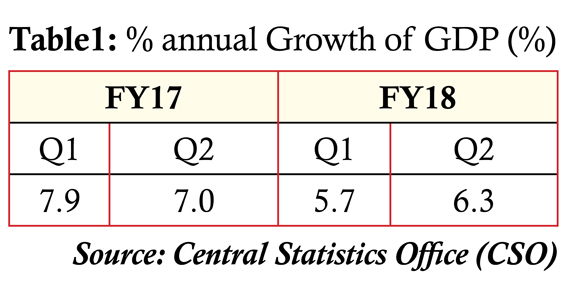
Reasons for Cheer are GST disruption behind, manufactures pick-up, signs of pick-up in investment and consumption growth steady. Worries are moderate farm sector and jobs-generating construction sector lacks strength.
Sector that registered growth of over 6% for the July-September quarter were manufacturing, electricity, gas, water supply and other utility services, trade, hotels, transport, communication and services related to broadcasting, the data showed. In contrast, the agriculture sector grew by 1.7%. The mining sector grew by 5.5 percent as compared to decline of 1.3 per cent in Q2 of 2016-17 as the production of coal went up by 8.6 per cent from a fall of (-)0.7 per cent in the previous year. The higher coal production also led to an increase in electricity generation resulting in the power sector posting a 7.6 per cent growth up from 5.1 per cent in Q2 of 2016-17.
However, the growth of the construction sector growth slowed to 2.6 percent as compared to growth of 4.3 percent in Q2 of 2016-17. Key indicators of construction sector, namely, production of cement and consumption of finished steel registered growth rates of (-) 0.4 percent and 4.1 percent respectively during Q2 of 2017-18 as compared to 3.4 percent and 6.5 percent respectively during Q2 of 2016-17.

The key question the GDP growth numbers for the September quarter were supposed to answer was: Has the Indian economy recovered from the ravages of the introduction of the goods and services tax (GST)?
Well, the overall number looks good, since gross value added (GVA) growth at constant prices has come in at 6.1%, against 5.6% for the June quarter. But some of the shine gets rubbed off because the growth rate got a boost from a lower base. While the 5.6% real GVA growth in Q1 of 2017-18 was on top of a 7.6% growth in Q1 last fiscal year, the Q2 real GVA growth of 6.1% was on top of a lower growth of 6.8% in Q2 last year. So, a jump in growth was expected and that was not only because of the base effect, but also due to the effect of restocking by businesses after the introduction of GST.
The second quarter GDP data recorded the impact of the GST on the economy for the first time since its implementation. In the previous quarter, massive destocking happened, which led the economic growth to a three-year low. But after the implementation of the GST, restocking began to take place, with a positive impact on the GDP.
The festive season seems to have cushioned country’s growth against the slowdown. Since mid-year, sales of two-wheel and commercial vehicles, oil consumption, cargo traffic and rail freight have all increased. Sales of cars, refrigerators and televisions also surged more than 15% ahead of Dussehra and Navratri. Auto sales also reported an increase of 10% due to the festive season. The sales also surged ahead of the imposition of additional GST cess on luxury cars. Shrugging off the impact of demonetisation and the Goods and Services Tax (GST), the economy seems to be on the rebound.


