India, US to focus on increasing mkt access, reducing tariff
India, US to focus on increasing mkt access, reducing tariff and non-tariffbarriers: Prasada
India and the US are planning to negotiate a mutually beneficial, multi-sector Bilateral Trade Agreement, Minister of State for Commerce and Industry Jitin Prasada in Lok Sabha
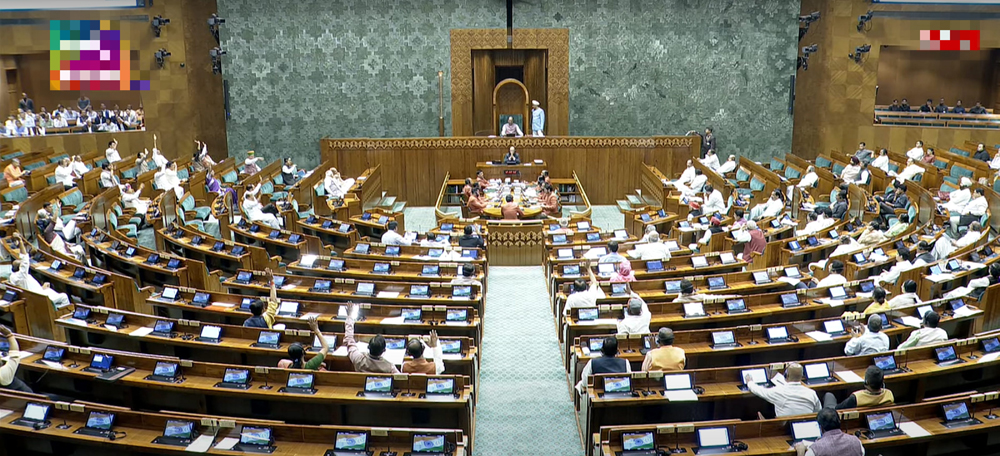
Members in the Lok Sabha during the Budget session of
Parliament, in New Delhi, Tuesday, March 11, 2025. (Sansad TV via PTI Photo)
NEW DELHI — India and the US are planning to negotiate a trade agreement and
both countries will focus on increasing market access, reducing import duty and
non-tariff barriers, and enhancing supply chain integration, Parliament was
informed on Tuesday.
In a written reply to the Lok Sabha, Minister of State
for Commerce and Industry Jitin Prasada said that as on date, reciprocal
tariffs have not been imposed by the US on India.
"Both countries plan to negotiate a mutually
beneficial, multi-sector Bilateral Trade Agreement. Both countries would focus
on increasing market access, reducing tariff and non-tariff barriers, and
enhancing supply chain integration," he said.
The US issued Memorandum on Reciprocal Trade and Tariffs
on February 13, wherein the Secretary of Commerce and United States Trade
Representative are to take necessary actions to investigate harm to America
from any non-reciprocal trade arrangements adopted by trading partners and
provide a report with detailed proposed remedies for each trading partner.
Tariffs are import duties imposed and collected by the
government and paid by companies to bring foreign goods into the country.
During the visit of Prime Minister Narendra Modi to
Washington last month, India and the US announced their commitment to more than
double the two-way commerce to USD 500 billion by 2030 and negotiate the first
tranche of a mutually beneficial, multi-sector Bilateral Trade Agreement (BTA)
by fall of 2025.
In 2023, the US-India bilateral trade in goods and
services stood at USD 190.08 billion (USD 123.89 billion in goods and USD 66.19
billion in services trade). That year, India's merchandise exports to the US
stood at USD 83.77 billion, while imports were USD 40.12 billion, leaving a
trade gap of USD 43.65 billion in favour of India.
During 2021-24, America was India's largest trading
partner. The US is one of the few countries with which India has a trade
surplus.
Prasada also said that India continues to engage with the
US to achieve enhancement and broadening of bilateral trade ties in a mutually
beneficial and fair manner.
"This is an ongoing exercise and Indian exporters
are working towards diversifying trade baskets and export destinations,"
he said.
In 2023-24, India has exported engineering goods worth
USD 17.62 billion. The other major goods included electronics (USD 10 billion),
gems and jewellery (USD 9.9 billion), petroleum products (USD 5.83 billion),
textiles (USD 4.7 billion), marine products (USD 2.5 billion).
In a separate reply, the minister said India's tariff
policy aims to regulate trade, protect domestic industries, and generate
revenue through taxes on imported and exported goods.
"Recent reforms have focused on streamlining the
tariff structure and facilitating trade," Prasada said.
India is a member of the WTO (World Trade Organization)
and bound to its maximum tariff that can be applied on a product category. The
applied tariffs are generally below the bound tariff for a given commodity
line.
"With the changing trade scenario, India is moving
towards having Preferential/Free Trade Agreements wherein customs tariffs and
non-tariff barriers are reduced or eliminated on substantial trade between the
PTA/FTA members," he added.
At present, India is a member of 13 FTAs and 9 PTAs apart
from the negotiations with the EU, the UK, and Oman.